
Last Tuesday in Nottingham, a client messaged me at 11pm. She’d just used three different calculators. One showed BMR: 1,410 calories. Another displayed AMR: 1,950 calories. A third suggested something in between. “Which one do I actually eat to?” she asked, clearly frustrated. This confusion around bmr vs amr happens constantly. I see it every single week. People find two different numbers and assume one must be wrong. Neither is wrong. They just measure different things.
The main difference between these two metrics changed how I help people plan their nutrition entirely. BMR tells you what keeps you alive. AMR shows how you live. Both matter, but in completely different ways that calculators rarely explain properly.
Why BMR vs AMR Confuses So Many People
This question usually appears late at night. Phone in hand. Calculator open. Suddenly there are two numbers where you expected one.
A Familiar UK Scenario
Sunday evening planning is when it happens most. Tea going cold on the table in Liverpool. You’re trying to sort out Monday’s meals. The calculator gives you numbers that don’t make sense together.
“Which number do I actually eat to?” becomes the urgent question. BMR says 1,400. AMR says 2,000. That’s a 600-calorie difference. How can both be right?
The confusion kills motivation before Monday even starts. You close the calculator. Put off the plan. Another week passes without clarity.
Why Tools Rarely Explain the Difference
Assumed knowledge is the main problem. Calculators think you already know what BMR and AMR mean. They present abbreviations without context. Results appear with no guidance on how to use them.
Abbreviations without explanation create chaos. BMR, AMR, TDEE, RMR, letters pile up. Each calculator uses different terms. Some explain. Most don’t.
Results shown without guidance leave people guessing. You’ve got a number. Great. Now what? Do you eat that amount? Subtract from it? Add exercise? Nobody tells you.
What BMR Actually Measures
BMR is often misunderstood as a daily calorie target. It’s really a baseline measurement that shouldn’t guide eating directly.
Basal Metabolic Rate Explained Simply
Energy used at complete rest is what BMR measures. Imagine lying in bed all day. Not moving. Not digesting food. Just breathing and existing.
Breathing, circulation, and organ function all require energy. Your heart pumps blood constantly. Your brain uses glucose even when you’re sleeping. Also, Your kidneys filter waste. Your liver does hundreds of metabolic jobs.
No movement gets included in BMR. Walking to the bathroom? Not counted. Cooking dinner? Not counted. Typing at work? Not counted. BMR is purely resting energy needs.
What BMR Is Not
Not a daily calorie goal despite what many people think. Eating at your BMR level long-term causes problems. Energy crashes. Muscle loss. Metabolic adaptation.
Not a fat-loss number either. BMR doesn’t account for activity. You can’t create a deficit from it safely without considering total daily burn.
Not personalised to your lifestyle at all. BMR is the same whether you work construction or sit at a desk. Whether you exercise daily or never. It’s just resting metabolism.
What AMR Actually Measures
AMR is where real life finally enters the picture. It’s the number that actually reflects how you live.
Active Metabolic Rate Defined
BMR plus activity energy creates your AMR. Take your resting burn. Add the energy you spend moving, working, exercising, and living.
Includes movement and exercise throughout your entire day. Walking to the Tube station. Climbing stairs at the office. Gym sessions. Cleaning the house. All of it gets added to your baseline.
Closer to daily needs than BMR alone. For most people, AMR runs 300-1,000 calories higher than BMR depending on activity level. This is what you actually burn in a day.
Why AMR Feels More Realistic
Reflects workdays properly. If you’re on your feet as a nurse in Cardiff, your AMR accounts for that. If you sit all day, your AMR stays lower.
Accounts for steps, chores, and workouts that BMR ignores. Those 8,000 daily steps matter. Hoovering the flat matters. The evening workout matters. AMR includes all of it.
Still an estimate, but broader than BMR. It’s not perfect. Calculators use general activity multipliers. But it’s far closer to reality than BMR alone.
How BMR and AMR Are Calculated
Both numbers come from maths. Just with different layers added on top.
Common BMR Formulas
Mifflin-St Jeor is considered most accurate for BMR. It uses your weight, height, age, and sex to estimate resting metabolism. For women: (10 × weight in kg) + (6.25 × height in cm) – (5 × age) – 161. For men, add 5 instead of subtracting 161.
Harris-Benedict is older but still widely used. Created in 1918, revised in 1984. Slightly different calculation but similar results in most cases.
Population averages form the basis of both formulas. They’re built from studies of thousands of people. They work well for average bodies. Less well for outliers.
How AMR Builds on BMR
Activity multipliers get applied to your BMR. Sedentary (little exercise) uses 1.2. Lightly active (1-3 days weekly) uses 1.375. Moderately active (3-5 days) uses 1.55. Very active (6-7 days hard exercise) uses 1.725.
Self-reported movement creates the biggest problem. People consistently overestimate activity levels. They remember workouts. They forget sitting for 10 hours daily.
Broad assumptions mean errors compound. The BMR estimate might be off by 100 calories. The activity multiplier might be wrong too. Combined, you could be 300-400 calories off actual needs.
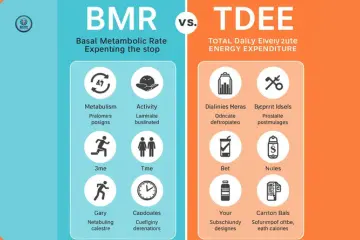
BMR vs AMR Side-by-Side Comparison
After reviewing multiple UK calculator tools and comparing outputs against real behaviour, this table highlights where BMR and AMR genuinely differ.
| Aspect | BMR | AMR |
|---|---|---|
| Includes movement | No (complete rest only) | Yes (all daily activity) |
| Reflects lifestyle | No (same for everyone at same stats) | Partially (depends on activity selection) |
| Used for | Baseline energy reference | Daily needs estimation |
| Risk if misused | Dangerous under-eating | Over-estimating burn |
| Best used as | Safety floor for intake | Planning range |
| Changes with | Weight, muscle mass, age | Activity level changes |
| Typical daily value | 1,200-1,800 calories (UK adults) | 1,600-2,800 calories (varies widely) |
Why AMR Often Looks “Too High”
Many people panic when they see their AMR number. Especially during weight loss attempts.
Activity Level Overestimation
“Moderately active” confusion causes most errors. Someone does three 45-minute workouts weekly. They select “moderately active.” But they sit at a desk 40 hours. Commute 10 hours. Sleep 56 hours. That’s 106 sedentary hours versus 2.25 active hours.
Desk jobs with short walks don’t equal “active.” Walking 15 minutes to the station twice daily is good. It’s not moderate activity in the calculator’s terms.
Inflated calorie outputs follow automatically. Select the wrong activity level, and your AMR might be 400 calories too high. You eat that amount. Weight doesn’t budge. Frustration builds.
Emotional Reaction
Disbelief is the first response. “There’s no way I burn 2,100 calories. I barely move.” The number feels impossibly high compared to what diet culture has taught you.
Guilt about eating more creeps in. You’ve been restricting to 1,400 calories. AMR says 1,950. Eating that much feels reckless. Scary. Like permission to gain weight.
Ignoring hunger cues becomes easier than trusting the calculator. You stay at 1,400 because it feels safer. Even though your AMR suggests more. Your body knows it needs more. But trust in the number has been destroyed.
Why BMR Often Feels “Too Low”
BMR numbers can feel almost insulting at first glance. Like your body is working against you.
The Shock Factor
“That’s all I burn?” is the common reaction. A woman in Brighton calculates her BMR at 1,340 calories. She’s stunned. It feels impossibly low.
Comparison with peers makes it worse. Your mate’s BMR is 1,550. Yours is 1,340. You weigh the same. Why is hers higher? (Probably more muscle mass, but calculators don’t show that.)
Fear of restriction sets in immediately. If BMR is only 1,340, how little do I have to eat to lose weight? Panic about extreme dieting follows.
The Danger of Treating BMR as a Target
Fatigue arrives quickly when eating at BMR. Your body needs more than baseline to function in actual life. Eating only BMR means chronic under-fueling.
Irritability and mood changes happen within days. Brain fog. Difficulty concentrating. Snapping at colleagues. Your body is desperate for energy.
Poor adherence becomes inevitable. You can maintain BMR-level eating for maybe two weeks. Then hunger overwhelms you. Overeating follows. The cycle repeats.
British Expert Insight on BMR vs AMR
UK nutrition professionals regularly see confusion between these two metrics causing unnecessary struggle.
Registered Dietitian Perspective
Dr Sarah Schenker, a respected UK Registered Dietitian, explains it clearly: basal metabolic rate shows what your body needs for essential functions at rest. Active metabolic rate includes the energy cost of movement and daily living. Neither should be followed blindly without understanding what they represent.
NHS-aligned advice emphasises realistic activity assessment. Their guidance warns against overestimating movement. Most British adults are more sedentary than they realise.
Emphasis on ranges, not absolutes, characterises professional approaches. A dietitian might say “somewhere between 1,800 and 2,000 calories” rather than “exactly 1,923 calories.” That flexibility prevents obsession.
BMR vs. AMR: Understanding Your “Energy Floor” vs. “Energy Ceiling”
In 2026, nutrition science has moved away from “one size fits all” calorie targets. To master your weight, you must understand the relationship between your BMR (Basal Metabolic Rate) and your AMR (Active Metabolic Rate).
1. The Definitions
- BMR (Basal Metabolic Rate): This is your biological floor. It is the number of calories your body requires just to stay alive, breathing, circulating blood, and organ function. If you lay in bed for 24 hours without moving, this is what you’d burn.
- AMR (Active Metabolic Rate): This is your real-world burn. It includes your BMR plus the energy used for every movement you make, from brushing your teeth to a heavy deadlift session. In 2026, fitness pros often refer to this as your TDEE (Total Daily Energy Expenditure).
2. The Math of 2026 Fitness
To find your AMR, you first calculate your BMR using the Mifflin-St Jeor formula and then apply an activity multiplier.
AMR = BMR Activity Factor
| Activity Level | Description | Multiplier |
| Sedentary | Little or no exercise, desk job | 1.2 |
| Lightly Active | Light exercise/sports 1-3 days/week | 1.375 |
| Moderately Active | Moderate exercise/sports 3-5 days/week | 1.55 |
| Very Active | Hard exercise/sports 6-7 days/week | 1.725 |
| Extra Active | Very hard exercise/physical job | 1.9 |
3. Why Most People Get AMR Wrong
The biggest mistake in 2026 is Over-estimation.
- The “Gym Trap”: Many people select “Moderately Active” because they go to the gym 3 days a week. However, if they spend the remaining 23 hours a day sitting at a desk and sleeping, their true AMR is likely closer to the “Lightly Active” (1.375) multiplier.
- The “NEAT” Factor: Your AMR is heavily influenced by Non-Exercise Activity Thermogenesis (NEAT). A waiter who doesn’t go to the gym may have a higher AMR than a software engineer who lifts weights for an hour and sits for ten.
Performance Tip: If you want to lose fat, calculate your AMR and eat 500 calories below that number, not below your BMR. Eating below your BMR can cause metabolic adaptation and muscle loss.
A Real-Life UK Example of Getting It Wrong
This happens more often than people admit. The pattern is predictable and painful.
The Midweek Energy Crash
Eating near BMR starts Monday with good intentions. Sarah from Glasgow set her intake to 1,400 calories. Her BMR was 1,380. She thought she was being sensible.
Long workdays make everything harder. Tuesday’s fine. Wednesday gets tough. By Thursday, she’s struggling to concentrate. Constantly cold. Thinking about food constantly.
Low mood by Thursday evening becomes overwhelming. She’s irritable. Exhausted. Her workout that evening is terrible. She barely has energy to cook dinner.
What Changed When AMR Was Used Properly
Better energy came within three days of increasing intake. Sarah recalculated. Her AMR with light activity was 1,900 calories. She increased to 1,700. The difference was immediate.
Fewer binges followed naturally. When you’re adequately fueled, desperate hunger disappears. Weekend overeating stopped because she wasn’t starving anymore.
More consistency became possible. Eating 1,700 was sustainable. She could maintain it for months. At 1,400, she’d crashed every two weeks.
When You Should Pay Attention to BMR
BMR still matters. Just not in the way most people think it does.
Useful Situations
Avoiding severe under-eating is BMR’s main value. It creates a floor. A minimum. Never eat significantly below your BMR for extended periods.
Medical supervision sometimes requires BMR knowledge. If a doctor is monitoring your intake, BMR provides baseline context for safe lower limits.
Long-term health planning benefits from understanding BMR. Knowing your baseline helps you understand how weight changes affect energy needs. Lose 10 kilograms, your BMR drops. That’s normal, not damage.
When AMR Is the More Useful Number
Most people should spend more time thinking about AMR than BMR.
Practical Use Cases
Weight maintenance becomes simpler with AMR. Match your intake to your AMR, and weight stays stable. It’s not perfect, but it’s a reasonable starting point.
Sustainable fat loss works better from AMR. Create a modest deficit from AMR, maybe 300-400 calories, rather than eating at or below BMR.
Fueling active days requires AMR awareness. Training for a half-marathon in Leeds? Your AMR on running days is much higher than rest days. Fuel accordingly.
Why AMR Still Needs Adjustments
Daily variability means AMR changes constantly. Busy Saturday walking around town? Higher AMR. Sunday on the sofa? Lower AMR. The calculator gives you an average.
Seasonal changes affect movement patterns dramatically. Winter in Newcastle means less walking, more driving, more indoor time. Your AMR in January might be 200 calories lower than July.
Stress and sleep alter metabolic rate in ways calculators can’t capture. Poor sleep disrupts hormones. Chronic stress elevates cortisol. Both affect actual burn beyond activity level.
How to Use BMR and AMR Together Safely
The smartest approach isn’t choosing one. It’s understanding both and how they work together.
Practical Guardrails
Never eat below your BMR for extended periods. Use it as your absolute floor. If BMR is 1,400, don’t eat 1,200. Ever. Not even for “quick” weight loss.
Use AMR as a range, not an exact target. If your AMR calculates to 2,050, think of it as 1,900-2,100. Allow flexibility. Some days you’ll be higher. Some lower.
Adjust based on feedback over weeks. AMR says 1,950? Try it for three weeks. Track weight, energy, hunger, mood. If weight is stable but you want to lose, drop 200 calories. If energy is terrible, add 100.
What to Monitor Instead of Numbers Alone
Hunger patterns tell you more than calculations. Constantly ravenous? Probably under-eating. Never hungry? Might be over-eating or stress is suppressing appetite.
Energy throughout the day reveals whether intake matches needs. Crashing mid-afternoon? Struggling through workouts? These signals matter more than calculator precision.
Training performance shows fueling adequacy. Getting stronger? Recovering well? Hitting good times in runs? You’re probably eating appropriately. Performance declining? Likely under-fueled.
Common Calculator Mistakes with BMR vs AMR
Most issues come from interpretation, not maths errors.
Frequent Errors
Overstating activity is the biggest mistake. People remember the gym. They forget the commute, the desk time, the evening on the sofa. “Moderately active” gets chosen when “lightly active” fits better.
Daily recalculations create unnecessary anxiety. Your BMR doesn’t change overnight. Recalculate after significant weight changes (5+ kilograms). Not daily.
Ignoring trends in favor of single numbers causes problems. One day of eating above AMR doesn’t matter. Weekly averages matter. Monthly trends matter. Daily fluctuations are noise.
Alternatives Beyond BMR and AMR
Sometimes better insight comes from behaviour, not equations.
TDEE Tracking
Real-world feedback beats calculator estimates. TDEE (Total Daily Energy Expenditure) can be calculated by tracking intake and weight changes over several weeks. Eat 2,000 calories daily for three weeks. Weight stable? That’s roughly your TDEE.
Week-to-week averages smooth out daily variation. Don’t panic about one high day or one low day. Look at the weekly total divided by seven.
This approach requires patience but provides accuracy. After 4-6 weeks of careful tracking, you know your actual needs. Not estimated. Actual.
Professional Support
Dietitians provide personalised assessment. They consider your history, health, lifestyle, and goals. Then create plans based on you, not population averages.
GP referrals help when confusion persists or health concerns arise. Unexplained fatigue? Persistent weight plateau? Get blood work done. Rule out thyroid issues or other medical factors.
NHS resources offer free support in many areas. Weight management programmes. Dietitian consultations. Exercise on prescription. Ask your GP what’s available locally.
The Bigger Picture on BMR vs AMR
These numbers are tools. Not rules. Not judgments. Just information.
What Actually Drives Results
Consistency beats perfection every time. Eating reasonably well most days trumps hitting exact targets occasionally then bingeing.
Awareness of patterns matters more than precision. Noticing you overeat when stressed is more valuable than knowing your AMR to the exact calorie.
Flexibility allows long-term adherence. Rigid rules around numbers cause burnout. Understanding ranges and responding to your body creates sustainability.
Final Recommendation
The confusion around bmr vs amr usually comes from misunderstanding what each number represents and how to use it practically. BMR is your baseline, the minimum energy your body needs at complete rest. AMR includes your actual daily activity, giving you a more realistic picture of total burn. I’ve watched hundreds of people struggle because they ate at BMR level thinking it was their daily target, then crashed within weeks from chronic under-fueling. Use BMR as your safety floor, never eat significantly below it.
Use AMR as your planning range, understanding it’s an estimate that needs adjusting based on how you actually feel and perform. The calculator can’t know your stress levels, sleep quality, or individual metabolism quirks. Track your energy, hunger, and strength over weeks, then adjust intake accordingly instead of blindly following whatever number a formula produces.
FAQs
BMR is calories your body burns at rest. AMR adds daily movement and tasks. Together, they show your true daily energy needs.
A BMR calculator estimates calories burned while resting. It uses age, height, weight, and sex to give a simple baseline number.
AMR means Active Metabolic Rate. It includes walking, work, and exercise. It shows how many calories you burn during normal daily life.
Yes, almost always. AMR includes activity, so it is higher than BMR. The more you move, the bigger the gap between the two.
Use AMR for calorie targets. It reflects real life better. BMR alone may be too low and could slow progress or energy levels.
Multiply your BMR by an activity factor. Light, moderate, or high movement changes the number. Many online tools do this for you.
Yes. Age, muscle, and habits affect both. Track changes monthly and adjust your intake to stay on track with your goals.

Ehatasamul Alom is a dedicated health-tech enthusiast and the co-founder of BMRCalculator. With a passion for metabolic science, he focuses on providing accurate health data for the UK community. Ehatasamul ensures that every tool and guide aligns with NHS standards and public health research. His mission is to simplify complex biological data, helping British residents make informed decisions about their fitness, calorie needs, and long-term wellness. When not analyzing health trends, he explores the latest innovations in wearable fitness technology.