
Finding a plan that fits your life in London can be quite a task. I used to think I had to eat like a bird to see the scale budge. Once I learned how to use bmr for weight loss, the whole process felt much easier. It gave me a clear map to follow without the constant hunger or stress. Now, I want to share that same peace of mind with you so you can reach your goals.
Why BMR Matters for Weight Loss in the First Place
Your BMR is the base of your health house. It tells you the energy your body needs just to stay alive.
The Weight Loss Problem Most People Hit
Many folks eat less but see no change at all. They feel tired and their progress just stops. This happens because they do not know their starting point. They guess their calorie needs and often guess wrong.
A Typical UK Context
Most of us have desk jobs where we sit for hours. Our walks in the winter are short because it is cold and dark. We spend long evenings sitting down to rest. Without a clear plan, these habits make it hard to lose weight.
What BMR Actually Tells You (And What It Doesn’t)
Knowing what the numbers mean is half the battle.
BMR Explained in Plain Terms
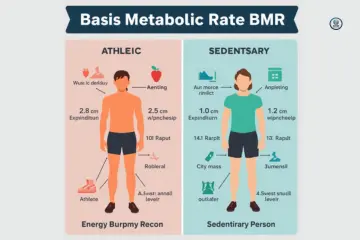
BMR stands for Basal Metabolic Rate. It is the fuel your body needs at complete rest. Think of it as the energy for “keeping the lights on.” It runs your heart, lungs, and brain while you sleep.
Common Misunderstandings
Your BMR is not your total daily calorie goal. It is also not your whole metabolism. It is just the bare minimum. You must add your daily movement on top of this number.
Step One – Find Your BMR Using a Calculator
Getting your number is the first real step to success.
What You’ll Need to Enter
To get an answer, you will need a few facts. You will enter your age, sex, height, and weight. Most tools use a simple math formula to give you a result.
Why Your Number Is an Estimate
No website can see inside your body. The result is a very good guess based on large groups of people. Every person is a bit different. Perfection is not the goal here; a good start is what matters.
Step Two – Turn BMR Into Daily Calorie Needs
Now you need to account for your real life.
From BMR to TDEE (Simply Explained)
TDEE is your total daily energy use. You find it by multiplying your BMR by an activity factor. If you sit all day, your number is lower. If you move a lot, it goes up.
UK Lifestyle Reality Check
Think about your daily commute or your hours at the office. Do you walk to the shops or take the car? Our weekend moves often differ from our weekdays. Being honest about this helps you set a better goal.
BMR vs TDEE for Weight Loss
| Term | What It Means | Why It Matters |
| BMR | Calories used at complete rest | Your vital baseline |
| TDEE | Total calories burned in a day | Your maintenance line |
| Deficit | Calories eaten below your TDEE | The key to losing fat |
Step Three – Create a Sensible Calorie Deficit
The best plan is one you can actually keep doing.
Why Bigger Deficits Backfire
If you cut too much, your energy will drop. You might lose muscle instead of fat. This makes your progress slower over time. It also makes you feel cross and tired.
A Beginner-Friendly Deficit Range
A gentle reduction of 300 to 500 calories is often best. This pace is easy to sustain for a long time. You will have fewer mood swings and fewer cravings for sweets.
How BMR Helps You Avoid Common Weight Loss Mistakes
Knowing your base helps you stay safe and healthy.
Under-Eating Without Realising It
Some people skip meals to save time. This leads to low protein and constant fatigue. Your body needs fuel to keep your muscles strong.
Over-Restricting on Busy Days
When you are stressed, you might eat too little during the day. This often leads to overeating in the evening. It starts a cycle of guilt that is hard to break.
Using BMR Alongside Exercise (Without Obsession)
Movement should help you, not drain you.
Strength Training and Metabolism
Lifting weights helps keep the muscle you have. This supports your BMR in the long run. Even simple bodyweight moves at home can make a big difference.
Cardio’s Role (Kept Realistic)
Cardio burns extra calories, but it is not a magic fix. It should not replace good food. Even a brisk walk in the park counts toward your daily goal.
How Habits Affect Weight Loss Using BMR
| Habit | Effect on Body | Result |
| Strength Training | Supports metabolism | Better long-term burn |
| Crash Dieting | Slows progress | Harder to keep weight off |
| Poor Sleep | Increases hunger | More cravings |
| Regular Meals | Improves consistency | Stable energy all day |
2026 Expert Secrets: Why Your BMR is the Key to Fat Loss
In the world of 2026 nutrition, we’ve moved past the “eat less, move more” mantra. The secret to faster results isn’t found in a deeper calorie deficit, it’s found in Metabolic Calibration. By understanding your Basal Metabolic Rate (BMR), you stop guessing and start engineering your results.
1. The “BMR Floor” Paradox
The biggest secret of 2026? Eating more to lose more. * The Logic: When you eat below your BMR, your body enters a “conservation state” (adaptive thermogenesis). This shuts down non-essential calorie burning, like hair growth and heat production.
- The Expert Hack: Set your daily calories at or slightly above your BMR. Let your exercise (TDEE) create the deficit. This keeps your metabolism “hot” while the fat melts away.
2. Muscle: The BMR Force Multiplier
Muscle mass is the most expensive tissue you own. In 2026, experts treat every gram of muscle as a passive income stream for calorie burning.
- The Secret: Resistance training doesn’t just burn calories during the session. It raises your BMR for up to 48 hours via Excess Post-exercise Oxygen Consumption (EPOC).
- The Result: You burn more calories while you sleep because your body is working to repair that dense muscle tissue.
3. Protein’s “Free” Calories
Not all calories are created equal. Protein has a Thermic Effect of Food (TEF) of roughly 25-30%.
- The Math: If you eat 100 calories of protein, your body uses 30 of those calories just to process them.
- The Secret: By shifting your BMR budget toward a higher protein percentage (approx. 1.6g to 2.2g per kg of body weight), you effectively increase your BMR without changing your total volume of food.
4. The 2026 “NEAT” Audit
Weight loss isn’t just about the 60 minutes in the gym; it’s about the other 23 hours. Non-Exercise Activity Thermogenesis (NEAT) is the lever that moves the scale.
- The Secret: London professionals often have “active” weekends but sedentary weekdays. To keep your BMR-based plan on track, aim for a consistent floor of 8,500 steps. This prevents your metabolism from “down-regulating” during long office hours.
Expert Performance Tip: Weigh yourself once a week, but measure your waist circumference every 14 days. If your BMR-driven plan is working, you will see the inches drop even when the scale is slow to move due to muscle retention.
British Expert Advice on Using BMR for Weight Loss
It is wise to listen to those who know the science best.
UK Dietitian Perspective
Dr Helen Bond, a top UK-registered dietitian, has a clear view. She says that your calorie needs should rarely dip below your BMR for long. Eating enough helps ensure long-term weight loss success. This keeps your body happy while you reach your goals.
12-Week BMR Calibration Schedule
In 2026, metabolic science emphasizes that BMR is not a fixed number, but a moving target. As you lose weight or gain muscle over 12 weeks, your “resting engine” will recalibrate. If you don’t adjust your intake to match these shifts, you will likely hit the dreaded “12-Week Plateau.”
Use this schedule to perform a Metabolic Audit every 30 days.
Phase 1: The Baseline (Weeks 1–4)
Goal: Establish your true starting point and identify your “Metabolic Type.”
- Week 1: Calculate your BMR using the Mifflin-St Jeor formula. Track every calorie for 7 days to see if your “Maintenance” actually matches the math.
- Week 2: Measure your Resting Heart Rate (RHR) upon waking. A lowering RHR over time often indicates improved cardiovascular efficiency (which can slightly lower BMR).
- Week 4 Calibration: * The Check: Have you lost >2kg?
- The Adjustment: If yes, re-calculate your BMR. Your “new” smaller body requires less energy to maintain. Lower your daily target by ~50–100 kcal to keep the same deficit.
Phase 2: The Adaptation (Weeks 5–8)
Goal: Detect “Metabolic Adaptation” (where your body tries to slow down to save energy).
- Week 6: Track your NEAT (Step count). Are you subconsciously moving less because you’re tired? If steps have dropped by 20%, your metabolism is effectively “slowing” via behavior.
- Week 8 Calibration:
- The Check: Is weight loss stalling despite perfect tracking?
- The Adjustment: Implement a 2-day “Maintenance Reset.” Eat at your full TDEE (maintenance calories) for 48 hours to signal to your hormones (leptin/thyroid) that you are not starving.
Phase 3: The Engine Shift (Weeks 9–12)
Goal: Account for the “Muscle Bonus.”
- Week 10: Take a waist-to-hip ratio measurement. If your weight is stable but your waist is smaller, you are gaining muscle.
- Week 12 Calibration:
- The Check: Compare your Week 12 BMR to Week 1.
- The Adjustment: Switch from the Mifflin-St Jeor formula to the Katch-McArdle formula (which uses Lean Body Mass). If you’ve gained muscle, your BMR might actually be higher than it was at Week 1, even if you weigh less.
Monthly Recalibration Log
| Milestone | Weight (kg) | BMR (Calculated) | RHR (BPM) | NEAT (Avg Steps) |
| Day 1 | ||||
| Day 30 | ||||
| Day 60 | ||||
| Day 90 |
The “Adaptive Thermogenesis” Warning
By Week 12, your body may become up to 15% more efficient, meaning you burn fewer calories doing the exact same workout you did in Week 1. This is why the Week 12 Recalibration is the most important; most people fail because they continue to eat “Week 1” calories for a “Week 12” body.
A Real-Life Day Using BMR for Weight Loss
Imagine a normal Tuesday. You start with a good breakfast. You pick a healthy lunch for work.
By the evening, you listen to your hunger cues. Because you have a plan, you feel a sense of relief. There is less guilt about what you eat. You feel more confident each day.
Signs You’re Using BMR the Right Way
How do you know it is working?
Positive Signals
Your energy stays stable all day long. Your hunger feels manageable, not like a crisis. You see slow and steady progress on the scale.
When to Recalculate or Adjust
As your weight changes, your BMR will too. You should check your numbers again after you lose a few pounds. If your activity goes up or the seasons shift, make a small tweak.
When to Get Extra Help Beyond BMR Calculators
Sometimes a website is not enough.
Professional Support Options
A registered dietitian can give you a plan made just for you. If you feel very tired, a GP check is a good idea. They can look at your thyroid or other health markers.
Final Recommendation
I have found that the best way to use bmr for weight loss is to be kind to yourself. Do not aim for a perfect day every time. Use the numbers as a guide to help you eat well and feel great. When you support your body, it will support you back.
FAQs
To use BMR for weight loss means starting with your resting calorie needs. You then eat slightly less than this level to support steady and planned weight loss.
Use BMR for weight loss by finding your daily number first. Then adjust calories with light activity in mind. This keeps food choices clearer and more balanced.
Yes, it is safe to use BMR for weight loss as a guide. It helps avoid extreme cuts. Pair it with healthy food and steady movement for best results.
You can use BMR for weight loss without exercise, but results may be slower. Adding light activity helps burn more energy and supports long term progress.
When you use BMR for weight loss, a small calorie cut works best. Large cuts can cause low energy. Slow changes are easier to maintain over time.
Using BMR for weight loss works for most people, but results vary. Age, muscle, and health matter. It is a guide, not a fixed rule for all.
Review your plan every few weeks when you use BMR for weight loss. Changes in weight or energy may mean your calorie needs have shifted slightly.

Ehatasamul Alom is a dedicated health-tech enthusiast and the co-founder of BMRCalculator. With a passion for metabolic science, he focuses on providing accurate health data for the UK community. Ehatasamul ensures that every tool and guide aligns with NHS standards and public health research. His mission is to simplify complex biological data, helping British residents make informed decisions about their fitness, calorie needs, and long-term wellness. When not analyzing health trends, he explores the latest innovations in wearable fitness technology.