Living in Manchester, I spent months glued to a health app, trying to master my weight loss. I would wake up, step on the scales, and wait for the screen to tell me exactly what to eat. However, I soon realised that a bmr calculator app limitations can often lead us down a confusing path if we treat them as law. These tools are helpful, but they don’t know the real you or how your body feels after a long week. Learning to look beyond the screen was the best thing I ever did for my own health and peace of mind.
Why People Rely So Heavily on BMR Calculator Apps
In our busy world, we all love a quick answer that fits in our pocket.
The Appeal of a Quick Number
Apps give us instant results without needing a trip to a lab. You just type in a few details and get a clear number back. This gives us a sense of control over our bodies, especially when we feel a bit lost with our fitness goals.
A Typical UK Scenario
Imagine an early morning in mid-winter. You open your app before breakfast, hoping for a low number to boost your mood. Those digits on the screen set the tone for your whole day. We trust the app because it feels like science, even if it is just a simple math formula.
What BMR Calculator Apps Are Designed to Do
These apps have a specific job, and it is vital to know where that job ends.
The Intended Purpose
The main goal is to estimate how much energy you use while resting. It provides a helpful starting point for anyone looking to lose or gain weight. It supports your broader plan by giving you a baseline to work from.
What They Were Never Meant For
An app cannot diagnose a slow metabolism or medical issues. It was never meant to give an exact, “perfect” calorie prescription. Most importantly, it can never replace the expert advice of a doctor or a registered dietitian.
Limitation 1 – They Rely on Population Averages
Apps use formulas that look at thousands of people at once, not just you.
How Formula-Based Calculations Work
Most tools use the Mifflin-St Jeor or Harris-Benedict equations. These are based on large sets of data from past studies. They assume you are an “average” person of your age and weight.
Why This Matters in Real Life
In the real world, two people with the exact same inputs can have very different needs. One might have a much higher natural burn than the other. Because the app uses averages, it might be off by 10% or more, which adds up quickly over a week.
Limitation 2 – Apps Can’t See Your Body Composition
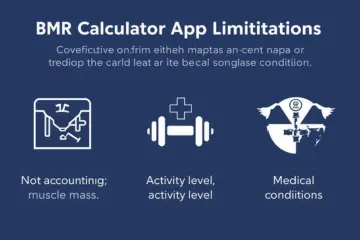
The biggest flaw in most apps is that they don’t know if your weight is muscle or fat.
Muscle Changes Everything
Muscle is much more active than fat tissue. If you have been lifting weights at the gym, your BMR will be higher than the app thinks. The app just sees “70kg” and gives you a standard number.
Common User Frustration
I have heard many people say, “I do everything right, but I’m not losing weight.” Often, the app tells them to eat too little because it doesn’t account for their muscle. This leads to a stall in progress and a lot of frustration.
Limitation 3 – Lifestyle Factors Are Mostly Invisible
Your body is affected by many things that happen outside of your meals.
What Apps Don’t Track Well
Most apps have no idea if you slept for four hours or eight. They don’t see your stress levels or if you are recovering from a nasty cold. All of these factors change how much energy your body uses.
UK Lifestyle Reality
Our British lives involve long commutes on trains or sitting in traffic. We deal with poor sleep during the dark winter months. A desk-heavy week can lower your real needs, but the app might still suggest the same high target.
Limitation 4 – Activity Levels Are Often Misjudged
Picking the right “activity level” is where most people get the wrong result.
Why Activity Multipliers Are Tricky
Most of us overestimate how much we move. We might pick “moderately active” because we go to the gym twice a week. In reality, if we sit for the other 23 hours, we are actually “sedentary.”
How This Skews Results
This confusion leads to inflated calorie targets. You might eat more than you burn without knowing it. This is a top reason why people stop seeing results even when they “follow the app.”
App Activity Levels vs Real-World UK Movement
| App Label | Reality for Many Users | Risk |
| Sedentary | Office job + short walks | Often the most accurate |
| Lightly active | Daily walking + 1-2 workouts | Easy to over-select |
| Very active | Physical job or 5+ hard sessions | Rarely fits a desk worker |
Limitation 5 – BMR Apps Don’t Adjust Well Over Time
Your body is not a static object; it changes as you reach your goals.
Weight Loss Changes Energy Needs
As you lose weight, you have a smaller body to support. This means your BMR naturally drops. If you don’t update your details, the app will give you numbers that are too high for your new size.
Why Static Numbers Cause Problems
Using the same number for months leads to plateaus. You might feel you have to restrict your food even more just to see a change. This causes mental fatigue and makes it hard to stay on track.
Limitation 6 – Emotional Impact of Over-Trusting Apps
Letting an app rule your life can take a toll on your mental health.
When Numbers Create Anxiety
It is easy to feel guilt if you go over your “app limit” by a few calories. You might start to fear eating out or enjoying a treat. This obsessive tracking can take the joy out of food.
Behavioural Consequences
Some people start to ignore their own hunger cues because “the app says I’ve had enough.” Chasing precision on a screen is never as important as listening to what your body needs.
British Expert Advice on BMR Calculator Limitations
Listening to a pro can help you put these tools in their proper place.
UK Dietitian Perspective
Dr Helen Bond, a highly respected UK-registered dietitian, often reminds us that apps should guide, not govern. She notes that apps are just a starting point. The most important thing is to use real-world feedback, like your energy and mood, to decide if your plan is working.
Why Your BMR App Might Be Lying to You in 2026
We live in an age where our watches tell us how we slept and our phones tell us how many calories we burned. But when it comes to Basal Metabolic Rate (BMR), most apps are using math developed in the 1990s. While convenient, relying on an uncalibrated app can lead to “Metabolic Frustration”, where you follow the plan perfectly but see zero results.
1. The “Average Human” Bias
Most apps utilize the Mifflin-St Jeor equation by default. While this is the “gold standard” for sedentary office workers, it is notoriously inaccurate for:
- Athletes: Those with high Lean Body Mass (LBM) burn more at rest than the app predicts.
- The Over 65s: Standard formulas often fail to account for the natural decline in mitochondrial density that occurs with age.
2. The “Skinny-Fat” Paradox
If your body fat percentage is high despite a “normal” BMI, an app will likely overestimate your BMR. Because fat is less metabolically active than muscle, the app thinks you are burning 1,600 calories at rest, when your actual biological burn might be closer to 1,400.
3. Ignoring “Metabolic Adaptation”
This is the app’s biggest failure in 2026. If you have been dieting for 6 months, your body has become more efficient.
- The Reality: Your BMR today is lower than what the math says it should be.
- The Fix: Apps don’t know you’re in a “starvation survival” mode; you have to manually down-adjust your targets to break a plateau.
4. Wearable “BMR Drift”
Many popular smart rings and watches “estimate” your BMR based on your sleeping heart rate. However, factors like caffeine, stress, or a late-night meal can artificially raise your heart rate, leading the app to believe your metabolism is faster than it truly is.
5. The Multiplier Mess
Apps often ask for your activity level (Sedentary, Active, etc.) and then “bake” that into your BMR. This creates a messy number that makes it impossible to know your true baseline.
Expert Tip: Always use an app that lets you see your BMR separately from your activity calories. If your app combines them into one “Budget,” it’s time to switch to a more transparent professional tool.
When BMR Calculator Apps Are Still Useful
Even with their flaws, apps can still be a part of a healthy journey.
Appropriate Use Cases
They are great for beginners who have no idea where to start. They offer educational insight into how food and movement work together. They also help you stay aware of general trends over time.
Combining Apps With Human Feedback
The best way to use an app is to check in with yourself. Ask: “How is my energy? Am I actually hungry? Do I feel strong?” If the app says one thing but your body says another, trust your body.
How to Use BMR Apps Without Falling Into Their Limitations
You can be “app-smart” by following a few simple rules.
Practical, Tool-Smart Tips
Recalculate your numbers every time you lose about 5kg. Use a calorie range instead of an exact number to give yourself some breathing room. Focus on the trend of your weight over weeks, not days.
When to Seek Professional Help
If you feel tired all the time or are totally confused, see an expert. A registered dietitian can look at your whole life. Your GP can also check for things like thyroid issues that no app can detect.
Final Recommendation
I’ve learned that knowing the bmr calculator app limitations makes you more powerful, not less. I stopped letting a screen tell me if I was “good” or “bad” for the day. Use the apps as a helpful map, but remember that you are the one driving the car. Trust your instincts and be kind to yourself as you go.
FAQs
Common BMR calculator app limitations include rough estimates. Apps use formulas, not real tests. This means results may not match your true daily energy needs.
BMR calculator app limitations affect accuracy because apps cannot see muscle, stress, or health. They rely on basic data, which can miss key body differences.
Some BMR calculator app limitations include weak activity tracking. Many apps guess activity levels, which can skew calorie advice and affect planning.
No. BMR calculator app limitations vary by app quality. Some tools update data often, while others use old formulas that may not suit modern lifestyles.
Yes. BMR calculator app limitations can mislead goals if taken as exact. Treat results as a guide, not a rule, and adjust based on real progress.
Yes. These limitations affect people with high muscle or unique body types more. Apps struggle to reflect bodies that fall outside average ranges.
Handle BMR calculator app limitations by tracking energy, weight, and mood. Use the app as a starting point, then fine tune choices with real results.

Ehatasamul Alom is a dedicated health-tech enthusiast and the co-founder of BMRCalculator. With a passion for metabolic science, he focuses on providing accurate health data for the UK community. Ehatasamul ensures that every tool and guide aligns with NHS standards and public health research. His mission is to simplify complex biological data, helping British residents make informed decisions about their fitness, calorie needs, and long-term wellness. When not analyzing health trends, he explores the latest innovations in wearable fitness technology.