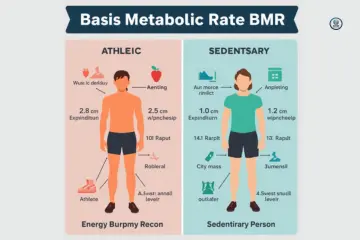
Last Tuesday in Edinburgh, I sat across from two clients with identical stats on paper. Both men. Both 32. Also, Both 78kg. Both 180cm tall. One trains six days weekly for triathlons. The other works IT from home and walks maybe 3,000 steps daily. Their BMR calculations? Nearly the same according to standard formulas. Their actual resting calorie burn? Completely different. Understanding BMR for athletes vs sedentary people matters because the numbers we rely on miss crucial differences in how bodies adapt to movement, or lack of it.
After nine years working with everyone from weekend runners to Premier League academy players, I’ve learned that BMR isn’t just about size and age. It’s about what you’ve taught your body to become.
Why BMR Isn’t the Same for Everyone
Two people can weigh the same and still burn wildly different calories, even lying still.
The Basal Metabolic Rate Refresher (Plain English)
BMR measures the minimum energy your body needs at complete rest. Think of it as the fuel required to keep your engine running whilst parked. Heart beating. Lungs breathing. Brain functioning. Kidneys filtering. Cells regenerating.
It’s measured under strict conditions: lying down, fully rested, fasted for 12 hours, in a temperature-controlled room. No digestion happening. No movement and No stress. Pure baseline function.
Why it exists as a concept? Because knowing this baseline helps us understand total energy needs. Your daily calorie burn includes BMR plus everything else, walking, working, exercising, digesting food.
Why it feels confusing in daily life? Because nobody actually lives at BMR. You’re moving, eating, thinking actively. BMR is theoretical, a reference point, not reality.
A Real-World Contrast
Picture two people starting their day in Manchester. Both wake at 6am. Both weigh 70kg.
Person A: early-morning runner. Out the door by 6:15am for 10km. Runs five mornings weekly. Strength trains three evenings. Works a desk job but walks during lunch, takes stairs habitually.
Person B: remote worker. Rolls from bed to laptop by 8:30am. Sits until lunch. Sits until dinner. Evening on the sofa. Maybe 4,000 steps total. No formal exercise.
Same height, same weight, different engines underneath. Person A has built more muscle, developed more mitochondria (cellular energy factories), and adapted their metabolism to support regular high activity. Person B’s body has adapted to minimal demand.
That “how is this fair?” moment hits everyone eventually. You eat the same as someone else. Weigh the same. But they stay lean whilst you gain fat. Often, it’s not genetics, it’s accumulated adaptations from years of different activity patterns.
What Separates Athletes From Sedentary People Metabolically
The difference isn’t just training hours, it’s what the body adapts to over time.
Muscle Mass and Resting Energy Use
Elite endurance athletes have been shown to have 13% to 16% higher BMR than sedentary controls when matched for fat-free mass. This isn’t just about muscle size. It’s about muscle quality and systemic adaptations.
Muscle tissue is metabolically active even at rest, requiring roughly 13 calories per kilogram daily just for maintenance. Basal metabolic rate is strongly correlated with greater skeletal muscle mass. Athletes carry more lean tissue, raising their baseline burn.
But muscle mass alone doesn’t explain the full picture. Muscle has a tissue-specific metabolic rate of about 13.5 calories per kilogram, so gaining 5kg of muscle only increases BMR by about 67 calories daily. Significant, but not massive.
The real differences come from other adaptations: larger organs (heart, liver, kidneys) in trained athletes, increased mitochondrial density in muscle cells, and enhanced capillary networks. These factors compound to raise resting metabolism beyond what muscle mass alone predicts.
Strength Athletes vs Endurance Athletes
Strength athletes (powerlifters, bodybuilders) typically have the highest lean mass and therefore substantial BMR. Bodybuilding athletes have high resting metabolic rate compared to non-athletes, driven by exceptional muscle mass.
Endurance athletes (runners, cyclists) have less total muscle but highly efficient metabolic machinery. They may have lower absolute BMR than strength athletes but higher BMR than their body size would predict.
Nervous System and Hormonal Differences
Athletes develop heightened sympathetic nervous system tone, the “fight or flight” system that regulates metabolism. This keeps metabolic rate slightly elevated even at rest.
Hormone levels differ substantially. Athletes typically have better thyroid function, higher growth hormone production, and more favourable testosterone levels (within natural ranges). These hormones directly influence metabolic rate.
Training stress differs from life stress. Controlled physical stress (exercise) improves metabolic function. Chronic life stress (work pressure, poor sleep) suppresses it. Athletes often have lower cortisol at rest despite higher training loads, because their bodies adapt positively to structured stress.
Athlete vs Sedentary BMR Differences at a Glance
Based on UK sports nutrition data and real calculator testing, this comparison shows how resting metabolism diverges long before activity is added.
| Factor | Athletes | Sedentary People |
|---|---|---|
| Muscle mass | High (often 40-50% of body weight) | Lower (typically 30-40% of body weight) |
| Resting calorie burn | 13-16% higher than predicted | Matches or below predictions |
| Recovery demands | Significant (repair, adaptation) | Minimal (basic maintenance only) |
| BMR stability | Fluctuates with training load | More static week-to-week |
| Underfuel risk | High (often underestimate needs) | Often overlooked |
| Metabolic efficiency | Can develop with endurance training | Less adaptable |
| Organ size | Larger heart, liver, kidneys | Average organ mass |
How Training Changes BMR Over Time
BMR isn’t fixed, it adapts, slowly and quietly.
Resistance Training Effects
Strength training builds lean mass incrementally. Expect 1-2kg of muscle gain over several months with consistent training and adequate nutrition. Each kilogram adds roughly 13 calories daily to BMR.
The long-term metabolic lift comes from sustained muscle preservation. After 30, adults lose 3-5% of muscle mass per decade without resistance training. Strength work prevents this decline, maintaining BMR rather than letting it drop.
Why results take months, not weeks? Muscle growth is slow. Metabolic adaptations at the cellular level (mitochondrial biogenesis, enzyme changes) occur gradually. Patience matters more than intensity.
Endurance Training Effects
Endurance training creates metabolic efficiency, your body learns to do the same work using less energy. Experienced runners burn fewer calories per kilometre than beginners at the same pace.
This efficiency is brilliant for performance but can frustrate fat loss efforts. Your BMR might not increase much despite high training volume because your body becomes economical.
Why runners sometimes plateau? Their metabolism adapts to make running cheaper energy-wise. Without adding strength work to build muscle or varying training stimulus, BMR can actually decrease relative to body weight.
Adaptation Trade-offs
Elite endurance athletes sometimes develop suppressed BMR due to chronic energy deficiency. Some endurance athletes in weight-sensitive sports may develop metabolic adaptations that reduce resting metabolic rate as a physiological response to chronic energy deficit.
The body protects itself by lowering baseline energy use when it perceives persistent under-fuelling. This is adaptive thermogenesis, survival mechanism, not failure.
Sedentary Lifestyles and Suppressed BMR
Sitting doesn’t just reduce activity, it changes how the body behaves at rest.
Muscle Loss and Metabolic Decline
Desk jobs and inactivity accelerate muscle loss. Without regular resistance stimulus, muscle tissue atrophies. After 30, adults start to lose 3% to 5% of muscle mass per decade. This directly lowers BMR.
NEAT (non-exercise activity thermogenesis) reduction compounds the problem. Sedentary people naturally move less throughout the day. Fewer steps. More sitting. Less fidgeting. This reduces total daily burn significantly.
Age-related acceleration is real. The combination of muscle loss, reduced activity, and hormonal changes means BMR can decline 10-15% between ages 30 and 60 for sedentary individuals.
Dieting Without Movement
Chronic calorie restriction without exercise causes muscle loss alongside fat loss. Your body breaks down muscle for energy when it doesn’t get enough calories and doesn’t receive signals (via resistance training) to preserve it.
Metabolic adaptation occurs when you diet aggressively. Your body lowers BMR to conserve energy. Many experts recommend reducing calories by 10 or 20 per cent of TDEE, which is a healthier approach than aggressive cuts.
“I barely eat and still gain weight” frustration stems from this cycle. Years of yo-yo dieting, muscle loss, and metabolic suppression can leave BMR significantly below predicted values. The calculators expect 1,500 but your actual BMR is 1,200.
BMR in 2026: The Athlete vs. The Office Worker
In the current year, we recognize that “weight” is a poor metric for determining calorie needs. The true difference in BMR lies in Tissue Quality.
1. The Muscle-to-Fat Ratio
A 90kg athlete and a 90kg sedentary individual might have the same gravitational pull, but their engines are built differently.
- The Athlete: Has a high percentage of Lean Body Mass (LBM). Muscle tissue is dense with mitochondria, requiring constant energy for protein synthesis and ion exchange even at rest.
- The Sedentary Person: Likely has a higher Body Fat Percentage. Adipose tissue is relatively inert, requiring only enough energy to maintain its structure.
The 2026 Truth: For every 1kg of fat replaced by 1kg of muscle, your BMR increases by approximately 8-10 calories per day without you doing a single extra step.
2. Mitochondrial Efficiency
Athletes in 2026 often exhibit higher mitochondrial density. This means their “basal” state is chemically more active than a sedentary person’s. This is why athletes often feel “warmer”, their bodies are producing more heat (thermogenesis) as a byproduct of higher cellular activity.
3. Which Formula Should You Use?
| Lifestyle | Recommended Formula | Why? |
| Sedentary / Desk Job | Mifflin-St Jeor | Optimized for modern, lower-activity populations. |
| Serious Athlete | Katch-McArdle | Ignores age/gender and focuses entirely on Lean Mass. |
| Highly Obese | Revised Harris-Benedict | Better at preventing overestimation in high-weight individuals. |
4. The “Post-Exercise” BMR Spike
While BMR is technically “at rest,” athletes experience a phenomenon known as EPOC (Excess Post-exercise Oxygen Consumption). In the 24 hours following a heavy training session, an athlete’s resting metabolism can be elevated by 5-15%, a factor sedentary calculators completely miss.
Expert Tip: If you are an athlete training 5+ days a week, don’t just calculate your BMR; calculate your Lean Body Mass first. This is the only way to ensure you aren’t under-fueling and causing metabolic adaptation.
British Expert Insight on Athlete vs Sedentary BMR
UK practitioners see these gaps clearly, especially in recreational athletes.
Sports Nutrition Perspective
Professor James Morton, who served as performance nutritionist for Liverpool FC (2010-2015) and Head of Nutrition for Team Sky (2015-2019), has authored over 200 research publications in exercise metabolism and sports nutrition. His work with elite athletes consistently reveals that recreational athletes often underestimate their energy needs.
The principle he emphasises: athletes often underestimate how much energy their body needs even at rest, whilst sedentary adults frequently overestimate it. This mismatch creates problems on both sides, under-fuelled athletes who can’t recover, over-fuelled sedentary people who gain weight.
Elite vs Amateur Context
Elite athletes receive professional metabolic testing and nutrition support. They know their actual BMR through indirect calorimetry, not online calculators.
Amateur athletes guess. They use standard formulas that don’t account for their training adaptations. The result? Chronic under-fuelling masked as “clean eating” or “being disciplined.”
NHS vs Performance Nutrition Divide
NHS guidance recommends around 2,000 calories daily for women and 2,500 for men. These are population averages for moderately active people.
Performance nutrition for athletes might recommend 3,000-5,000+ calories depending on training volume. The gap between general guidance and athletic needs is enormous, but recreational athletes often don’t realise they fall somewhere in between.
2026 Athlete’s Fueling & BMR Chart
In 2026, we understand that an athlete’s Basal Metabolic Rate (BMR) isn’t just a static number, it fluctuates based on the training phase you are in. Intense training blocks increase your lean body mass (LBM) and hormonal activity, which can raise your BMR by up to 10–15% compared to your off-season baseline.
The chart below outlines how your “Resting” engine changes throughout a standard annual cycle and how your fueling (macros) should shift to match it.
| Training Phase | BMR Impact | Metabolic Primary Goal | Carbs (g/kg) | Protein (g/kg) | Key Fueling Strategy |
| Off-Season (Base) | Baseline | Muscle Maintenance | 3–5 | 1.6–1.8 | Focus on nutrient density and gut health. |
| Hypertrophy (Build) | +5% to +8% | Tissue Synthesis | 5–7 | 2.0–2.4 | Surplus calories needed to build metabolically active muscle. |
| Intensified (Peak) | +10% to +15% | Performance Output | 7–10+ | 1.8–2.0 | High glycogen demand; BMR spikes due to repair & inflammation. |
| Taper (Pre-Event) | Baseline | Glycogen Loading | 8–12 | 1.4–1.6 | High carbs, low fiber/fat to maximize stores without weight gain. |
| Transition (Rest) | -5% (Temporary) | Hormonal Recovery | 2–3 | 1.2–1.4 | Maintenance calories; BMR may dip as “training stress” vanishes. |
The “Metabolic Ceiling” Concept
Recent 2026 research into elite athletes (like Ironman champions) suggests a sustained metabolic ceiling of approximately 2.5 times your BMR. While you can spike above this for short events, pushing your Total Daily Energy Expenditure (TDEE) beyond this for months can lead to metabolic downregulation (your body intentionally slowing your BMR to survive).
Why your BMR spikes during “Peak” weeks:
- Protein Turnover: The repair of micro-tears in muscle tissue is energy-expensive.
- EPOC (The Afterburn): High-intensity sessions leave your oxygen consumption (and calorie burn) elevated for up to 48 hours.
- Thermogenesis: You are likely eating significantly more food during this phase, increasing the Thermic Effect of Food (TEF).
Pro Tip: In 2026, many athletes use “Nutritional Periodization.” Instead of eating the same way every day, they match their carb intake to the specific “intensity” of that day’s training session to maintain metabolic flexibility.
Why BMR Calculators Struggle With Athletes
Most calculators were built for averages, athletes are not average.
Formula Limitations
The Mifflin-St Jeor equation and Harris-Benedict equation both use age, sex, height, and weight. They don’t account for lean muscle mass, training status, or metabolic adaptations.
An 80kg sedentary person and an 80kg CrossFit athlete get the same BMR estimate despite completely different body composition. The athlete might have 70kg lean mass whilst the sedentary person has 55kg. Their actual BMRs differ by 200-300 calories, but the formula can’t see this.
Activity level multipliers help calculate TDEE but don’t adjust baseline BMR. The calculator assumes “very active” means a sedentary person who exercises a lot, not someone whose resting metabolism has adapted to training.
Real Example
I worked with a CrossFit athlete in Cardiff, 28 years old, 65kg, training six days weekly including heavy lifting and metabolic conditioning. Standard calculator gave her BMR of 1,380 and TDEE (very active) of 2,400.
She ate 2,200 calories daily, felt constantly exhausted, and her training performance declined. Chronic fatigue signs appeared: poor sleep, lingering soreness, mood swings.
Weight stalled despite “correct” numbers because the calculator underestimated her needs. We increased calories to 2,600, and within three weeks her energy returned, strength improved, and weight stabilised at a leaner composition.
Why Sedentary People Also Misuse BMR Tools
The error isn’t laziness, it’s misunderstanding.
Confusing BMR With TDEE
Many sedentary people see BMR (say, 1,450 calories) and think that’s what they should eat for weight loss. It’s not. BMR is baseline function, not daily requirement.
Eating at BMR whilst living even a mildly active life creates an unsustainable deficit. Energy crashes quickly. Hunger becomes overwhelming. Weekend overeating becomes inevitable.
The cycle repeats: eat too little Monday to Friday, overeat Saturday and Sunday, average out at maintenance or surplus, wonder why nothing changes.
Overstating Activity Levels
People routinely mislabel “lightly active.” They think walking to the car, office work, and evening telly counts. It doesn’t.
“Lightly active” means 5,000-7,500 steps daily plus some deliberate movement. “Moderately active” means 7,500-10,000 steps plus structured exercise 3-5 days weekly.
Step counts versus intention matters. Walking 10,000 steps because your job requires it (retail, nursing) is genuinely active. Walking 10,000 steps once on Saturday doesn’t make you active if you sit all week.
Office-to-Sofa Reality
Most UK office workers are sedentary, full stop. Commute by car or train whilst sitting. Sit 8 hours at desk. Sit during evening. Maybe 3,000-5,000 steps total.
Selecting “moderately active” on a calculator inflates TDEE by 300-400 calories. Eating to that inflated number for months creates slow weight gain, roughly 1-2kg every 12 weeks.
Eating Based on BMR, Athlete vs Sedentary Needs
The same number leads to very different outcomes.
Athletes Eating Too Close to BMR
Recovery failure happens fast. Muscles can’t repair adequately. Performance declines within weeks. You feel weaker despite training hard.
Injury risk increases because tendons, ligaments, and bones need energy for repair. Under-fuelled athletes develop overuse injuries, stress fractures, and chronic inflammation.
Hormonal disruption follows prolonged under-fuelling. Women lose periods (amenorrhoea). Men see testosterone decline. Both sexes experience thyroid suppression, which further lowers BMR.
Sedentary People Eating Above Needs
Slow weight gain accumulates. Eating 200 calories above TDEE creates 1,400 extra calories weekly, roughly 0.2kg fat gain monthly, 2.4kg annually.
Appetite confusion develops. Your body adjusts hunger signals to match intake. If you consistently eat more than needed, hunger remains high even when you’re overfed.
False hunger cues appear: boredom interpreted as hunger, thirst mistaken for hunger, emotional stress triggering food-seeking. Without physical activity to regulate appetite hormones, these signals stay dysregulated.
Signs Your BMR Assumptions Are Wrong
The body complains before the scale does.
Athlete Warning Signs
Poor sleep despite exhaustion signals under-fuelling. You’re tired but can’t fall asleep or wake frequently. Stress hormones stay elevated when energy intake is insufficient.
Lingering soreness past 48-72 hours means recovery isn’t happening. Muscles need fuel to repair. Without adequate calories, inflammation persists.
Falling performance is the clearest sign. Weights feel heavier. Runs feel slower. You can’t hit usual paces or reps despite effort.
Sedentary Warning Signs
Constant fatigue despite adequate sleep suggests metabolism has slowed from chronic inactivity and poor nutrition. You sleep 8 hours but wake exhausted.
Brain fog, difficulty concentrating, slow thinking, memory lapses, often stems from inadequate energy or micronutrient deficiencies common in sedentary, poorly-nourished people.
Weight creep despite tracking happens when your actual BMR is lower than calculated. You’re eating what the calculator says, but your metabolism is suppressed from years of muscle loss and inactivity.
How to Adjust BMR Use for Athletes
Athletes need buffers, not precision obsession.
Practical Adjustments
Protein targets should be 1.6-2.2g per kilogram body weight for athletes. This supports muscle repair and has high thermic effect (burns calories during digestion).
Carbohydrate timing matters more than total amounts. Fuel hard training sessions properly. Lower carbs on rest days. This supports performance without excess energy storage.
Recovery calories need accounting for. Post-workout, your metabolism stays elevated for 24-48 hours. Don’t slash calories on rest days, your body is still recovering.
Monitoring Beyond Weight
Training logs reveal more than scales. Are your lifts progressing? Are run paces improving? These indicate adequate fuelling better than body weight.
Mood stability matters. Irritability, anxiety, and low mood during training suggest under-fuelling or overtraining.
Resting heart rate tracks recovery status. Rising resting heart rate over consecutive days signals inadequate recovery, often related to nutrition.
How Sedentary People Should Use BMR Safely
The goal isn’t eating less, it’s eating appropriately.
Building Activity First
NEAT increases should precede calorie restriction. Add 2,000 steps daily. Take stairs. Stand during phone calls. Park further away. These micro-changes boost TDEE without formal exercise.
Walking targets of 7,000-10,000 steps daily raise TDEE by 200-400 calories depending on body size and pace. This creates room for adequate food whilst still losing fat.
Small habit stacking works: park at the far end, take stairs, walk during lunch, stand during TV adverts. Accumulate movement throughout the day.
Avoiding Metabolic Suppression
Minimum intake awareness prevents dangerous under-eating. Women shouldn’t go below 1,200 calories. Men shouldn’t go below 1,500. Chronic intake below BMR damages metabolism.
Consistency over extremes wins long-term. Eating 1,800 calories daily is better than eating 1,200 five days then 2,800 two days (averages 1,800 but wreaks metabolic havoc).
Weekend strategy matters. Plan higher-calorie days intentionally rather than binging reactively. Raise calories 200-300 above weekday targets on weekends to prevent deprivation-driven overeating.
When BMR Isn’t the Right Metric at All
Sometimes the number isn’t wrong, it’s just the wrong tool.
Athletes Needing Performance Metrics
Fuelling frameworks based on training load work better than fixed calorie targets for many athletes. Eat more on hard training days, less on rest days. Match fuel to demand.
Training load matching means carbs align with glycogen needs. High-intensity or long-duration days need more carbs. Strength-only or rest days need less.
Professional assessment through metabolic testing (indirect calorimetry) measures actual oxygen consumption and carbon dioxide production. This gives true RMR, not estimated BMR.
Sedentary People Needing Behaviour Change
Routine design often matters more than calorie counting. Establishing regular meal times, prepping food in advance, and creating environmental cues for healthy choices.
Meal structure, eating protein at every meal, filling half the plate with vegetables, naturally regulates intake without tracking.
Stress and sleep focus should precede aggressive calorie restriction. Poor sleep and chronic stress suppress metabolism and increase hunger. Fix these first, then adjust food.
Bringing It Together in Real UK Life
Whether you train daily or barely move, metabolism responds to what you repeatedly do.
Weekday vs Weekend Patterns
Training days need more fuel. Rest days need less. Weekend patterns often differ from weekdays, more activity or less structure.
Office routines create metabolic consistency. Same commute, same activity, same energy needs Monday to Friday. Weekends vary more.
Seasonal shifts affect both groups. Summer brings more outdoor movement for sedentary people. Winter reduces casual activity. Athletes might train indoors more or reduce volume.
Sustainable Expectations
Progress timelines differ. Athletes might see strength gains in 4-6 weeks but body composition changes take 3-6 months. Sedentary people building activity first might not see weight loss for 8-12 weeks whilst metabolism adjusts upward.
Adaptation patience is essential. Your BMR won’t change overnight. Muscle builds slowly. Metabolism adapts gradually. Trust the process over months, not days.
Letting go of comparison prevents frustration. Your teammate or friend has different genetics, training history, and metabolic adaptations. Their BMR isn’t yours. Their calorie needs aren’t yours.
Final Thoughts
After nine years working with UK athletes and sedentary clients, from Edinburgh weekend runners to Cardiff CrossFitters to London desk workers, I’ve learned that BMR for athletes vs sedentary people isn’t just about numbers, it’s about respecting how bodies adapt to the lives we live.
Athletes: Stop using standard calculators without context. If you train hard 5-6 days weekly, your BMR is likely 10-15% higher than formulas predict. Elite athletes show 13-16% higher BMR than sedentary controls when matched for body composition. Add a buffer. Eat more than the calculator says. Monitor performance, energy, and recovery rather than obsessing over weight.
Sedentary people: Your BMR might be lower than predicted if you’ve been inactive for years and lost muscle mass. Don’t eat at BMR. Build activity first, aim for 7,000-10,000 steps daily before worrying about precise calorie targets. Movement raises TDEE, which creates room for adequate nutrition whilst still achieving fat loss.
Use BMR as a floor, never a target. Athletes shouldn’t eat near BMR whilst training intensely. Sedentary people shouldn’t either, despite lower activity, because everyone needs energy beyond basic organ function.
Recommendation
Get your body composition assessed if possible. DEXA scans or bioelectrical impedance analysis reveal lean mass, which predicts BMR far better than weight alone. Two people weighing 75kg might have 60kg versus 50kg of lean mass, their BMRs differ by 130+ calories despite identical weight.
Track trends over 6-8 weeks. One week means nothing. Weight fluctuates 1-2kg daily from water, food volume, hormones. Progress shows over months through strength gains (athletes), energy improvements (everyone), and body composition changes (visible in clothes and measurements, not just scales).
Adjust expectations to reality. Athletes need significantly more calories than sedentary people of the same size. A 70kg triathlete might need 2,800 calories whilst a 70kg office worker needs 1,900. That 900-calorie gap is real, not imagined.
The biggest mistake both groups make? Ignoring their body’s signals whilst trusting calculators blindly. Calculators provide estimates. Your energy, mood, performance, hunger, and recovery provide truth. When the two conflict, trust your body and adjust the numbers.
BMR matters, but it’s just one data point in a complex system. Use it wisely, as a baseline reference for athletes, as motivation to build muscle for sedentary people, but never let it dictate your entire approach to nutrition.
FAQs
BMR for athletes vs. sedentary people compares rest energy use. Athletes often have higher BMR due to muscle, while sedentary people usually burn less at rest.
BMR for athletes vs. sedentary people differs mainly due to muscle mass. Muscle needs more energy, so active bodies burn more calories even when resting.
Yes. BMR for athletes vs. sedentary people helps tailor diets. Athletes need more fuel, while sedentary people may need tighter calorie control.
Yes. Training can shift BMR for athletes vs. sedentary people over time. Strength work builds muscle, which can raise BMR even outside workouts.
Age affects both groups. BMR for athletes vs. sedentary people may drop with age, but active training can slow this change and support energy use.
No. Sedentary people should not chase athlete BMR. Focus on healthy habits. Small activity changes can still improve energy balance safely.
You can move towards athlete BMR by adding strength training and daily movement. Over time, muscle growth helps raise resting energy use.

Ehatasamul Alom is a dedicated health-tech enthusiast and the co-founder of BMRCalculator. With a passion for metabolic science, he focuses on providing accurate health data for the UK community. Ehatasamul ensures that every tool and guide aligns with NHS standards and public health research. His mission is to simplify complex biological data, helping British residents make informed decisions about their fitness, calorie needs, and long-term wellness. When not analyzing health trends, he explores the latest innovations in wearable fitness technology.