Last week in Edinburgh, a client showed me her phone. She’d been using three different apps. One said her BMR was 1,380 calories. Another claimed her metabolism was “slow.” A third suggested her daily burn was over 2,200 calories. She looked exhausted and confused. “Which number is actually me?” she asked. I see this pattern constantly. People use BMR and metabolism as if they mean the same thing. They don’t. Understanding the difference between bmr vs metabolism changed how I approach every conversation about weight and energy. It stops the self-blame. It ends the frustration. Most importantly, it helps people actually make progress instead of spinning in circles with confusing calculator results and conflicting advice.
Why BMR and Metabolism Are Constantly Confused
The confusion isn’t your fault. Apps, fitness websites, and social media posts use these words interchangeably all the time. Even when they shouldn’t.
In common conversation, people often say “I have a slow metabolism” when they really mean their BMR is lower than average. In 2026, understanding this distinction is the first step toward effective body composition management.
1. The Definitions
- Metabolism: The entire set of life-sustaining chemical reactions in your cells. It includes Catabolism (breaking down molecules like glucose for energy) and Anabolism (using that energy to build components like muscle fiber).
- BMR (Basal Metabolic Rate): A measure of the minimum energy (calories) your metabolism requires to keep you alive while you are in a state of complete rest.
2. The Relationship
Think of Metabolism as the engine of a car and BMR as the fuel consumption of that engine while it is idling.
| Component | Definition | Percentage of Daily Burn |
| BMR | Energy for vital organ function | 60% – 75% |
| TEF | Energy used to digest food | ~10% |
| Activity | Energy for movement (Gym + NEAT) | 15% – 30% |
3. Can You Change Them?
- BMR: Difficult to change quickly. It is mostly determined by your Lean Body Mass (LBM). To increase BMR in 2026, the primary lever is adding muscle through resistance training.
- Total Metabolism: Very easy to change. By increasing your physical activity or even changing the thermic effect of your diet (eating more protein), you increase your total metabolic rate without necessarily changing your BMR.
Key Takeaway: You don’t “fix” a BMR; you manage your total metabolism.
Difference between BMR and RMR explained
This video provides a clear visual breakdown of how BMR functions as the core of your metabolism and how it differs from resting metabolic rates.
Where the Confusion Starts
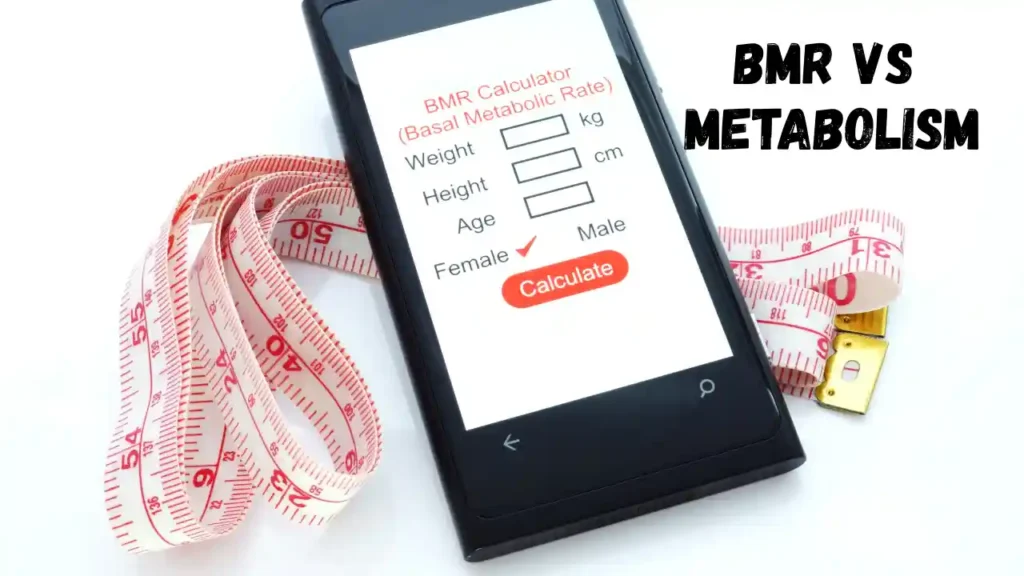
Open any calorie calculator online. It asks for your age, height, and weight. Then it spits out a number. Sometimes it calls that number BMR. Sometimes it calls it “your metabolism.” Neither label is quite right.
Fitness apps make things worse. They show you one number for “resting burn.” Another for “total metabolism.” A third for daily needs. The language changes depending on which app you’ve downloaded. The science behind them all is the same, but the labels create chaos.
Social media soundbites don’t help either. You’ll see posts claiming “your metabolism is broken” or “boost your BMR by 500 calories.” These phrases mix up concepts that actually mean different things. No wonder people feel lost.
A Familiar UK Moment
Picture this scene from a rainy Tuesday evening in Cardiff. You’re sat at the kitchen table. Kettle’s on. You’ve opened yet another calculator because the first three gave different results. The numbers make no sense together.
You’re asking yourself: “Is this my metabolism or my BMR? Are they the same? Why does one seem too low and another impossibly high?” The frustration builds. You close the laptop. Nothing feels clearer than before you started.
This happens because the words get used incorrectly so often that the actual definitions have blurred. Understanding what each term really means cuts through all that noise.
What BMR Actually Means (Plain English)
BMR is narrow and specific. It’s one number. One measurement. Not a system or a process.
Basal Metabolic Rate Explained Simply
Your BMR represents energy needed at total rest. Imagine lying completely still in bed. Not moving. Not digesting food. Just existing. Your heart beats. Your lungs breathe. Also, Your brain thinks. Your body maintains temperature at 37°C. Your cells repair damage.
All of that requires energy. That energy requirement, measured in calories, is your BMR. It’s the absolute minimum your body needs to stay alive. Nothing more, nothing less.
Most adults in the UK have a BMR somewhere between 1,200 and 1,800 calories daily. Women typically sit lower in that range. Men typically sit higher. But massive individual variation exists based on body size and muscle mass.
What BMR Does Not Include
This is where confusion creeps in. BMR excludes everything beyond basic survival. Walking to the bus stop? Not included. Cooking dinner? Not included. Typing emails at work? Not included.
Exercise obviously isn’t in there either. Nor is fidgeting, cleaning, or any other movement. Even digesting food burns extra calories beyond BMR. That’s separate too.
BMR is measured under strict laboratory conditions. Fasted state. Temperature controlled room. Complete rest. Those conditions never exist in real life. That’s why BMR alone doesn’t tell you much about actual daily needs.
Metabolism Booster Comparison (2026)
In 2026, exercise science has shifted away from simply counting “calories burned in a session” toward looking at Total Daily Energy Expenditure (TDEE). The winner isn’t always the activity that feels the hardest, but the one that keeps your metabolism elevated for the longest duration.
To help you choose, here is a comparison of how HIIT, Weightlifting, and Walking impact your “daily burn” based on the three metabolic pillars: Active Burn, Afterburn (EPOC), and Basal Shift.
| Activity Type | Active Burn (Per 30 Mins) | Afterburn (EPOC) Duration | Metabolic “Bonus” | Best For… |
| HIIT | High (~300-450 kcal) | 8–24 Hours | High spike in VO2 max and insulin sensitivity. | Busy schedules and rapid cardiovascular fitness. |
| Weightlifting | Moderate (~110-180 kcal) | Up to 48 Hours | Increases BMR; 1kg of muscle burns ~15-20 extra kcal/day at rest. | Long-term metabolic “insurance” and body reshaping. |
| Walking (LISS) | Low (~100-150 kcal) | Negligible (0-5%) | Supports recovery and lowers cortisol (stress hormone). | Daily consistency, fat oxidation, and mental health. |
The “Secret” Winner: NEAT
While the table above focuses on planned exercise, the largest portion of your daily burn actually comes from NEAT (Non-Exercise Activity Thermogenesis).
- The Impact: Differences in NEAT can account for up to 2,000 extra calories burned per day between two people of the same weight.
- The Comparison: A high-NEAT day (standing, walking to the shops, cleaning) often results in a higher total daily burn than a 30-minute HIIT class followed by 8 hours of sitting.
Which should you choose?
- For the “Afterburn” Effect: Choose HIIT or Weightlifting. The intensity forces your body to spend energy for hours after you finish to repair tissues and replenish oxygen levels.
- For a Faster Engine: Choose Weightlifting. Adding muscle mass is the only way to permanently “boost” your metabolism so you burn more calories even while you sleep.
- For Sustainability: Choose Walking. It is the easiest to do every single day without the risk of injury or burnout that comes with high-intensity training.
Our Expert Tip: The most effective metabolic strategy in 2026 is the “Hybrid Method”: 2–3 strength sessions per week to build the “engine,” 1–2 HIIT sessions for the “afterburn,” and 8,000+ daily steps to keep your NEAT levels high.
What People Mean When They Say “Metabolism”
Here’s where it gets interesting. Metabolism means something specific in science. It means something completely different in everyday conversation.
Scientific Meaning of Metabolism
Scientifically, metabolism refers to all chemical processes happening in your body. Every single one. That includes breaking down food into energy. Building new proteins. Repairing damaged cells. Making hormones. Regulating temperature.
Metabolism comprises the processes that the body needs to function. It’s not one number. It’s an entire system. A living, breathing, constantly adapting system.
Your metabolism includes thousands of chemical reactions happening simultaneously. Some produce energy. Some use energy. Together they keep you alive and functioning. BMR represents just one small part of this massive system.
Everyday Meaning of Metabolism
When your mate says “I have a slow metabolism,” they don’t mean their chemical processes are sluggish. They mean they gain weight easily. They mean dieting feels harder for them than for others.
People use “metabolism” to explain why they can’t eat like their friend does. Why the weight won’t budge. Why they feel tired all the time. It becomes shorthand for “something about my body isn’t working right.”
This creates misunderstandings because the everyday meaning and scientific meaning don’t match. Someone blaming their “slow metabolism” for weight gain is usually talking about energy balance. Not about the chemical reactions happening inside their cells.
BMR vs Metabolism Side by Side
Based on UK nutrition research and clinical definitions, here’s how these concepts actually differ without the fitness marketing confusion.
| Aspect | BMR | Metabolism |
|---|---|---|
| What it is | A single number (calories at rest) | An entire system (all body processes) |
| Scope | Very narrow (minimum survival needs) | Very broad (all chemical reactions) |
| Measured directly | Rarely (requires lab equipment) | No single test exists |
| Changes quickly | No (shifts slowly over months) | Yes (responds to stress, food, activity) |
| Used in calculators | Yes (as starting point) | Indirectly (calculators estimate parts of it) |
| Can be “broken” | No (always functioning) | No (always active, just adapts) |
| Accurate to measure | Difficult (needs strict conditions) | Impossible (too many variables) |
Where TDEE Fits Between BMR and Metabolism
This is the piece most people never learn about. It’s also the most useful for actual daily life.
Total Daily Energy Expenditure Explained
TDEE stands for Total Daily Energy Expenditure. It bridges the gap between BMR and the vague concept of “metabolism.” It’s calculated by first figuring out your Basal Metabolic Rate, and then multiplying that value by an activity multiplier.
TDEE includes everything. BMR plus movement throughout the day plus digesting food plus exercise. It’s your actual total burn. For most people, TDEE runs 300-1,000 calories higher than BMR depending on activity level.
A typical office worker in Bristol might have a BMR of 1,450 calories but a TDEE of 1,900 calories. The extra 450 comes from walking, working, cooking, and digesting meals. Not from formal exercise necessarily. Just from living.
Why People Blame Metabolism Instead of TDEE
Here’s what happens. Someone calculates their BMR. They see 1,400 calories. They think, “That’s my metabolism.” Then they eat 1,600 calories and don’t lose weight. They conclude their “metabolism is broken.”
But their TDEE might be 2,000 calories. They’re actually in a deficit, just a small one. Or they’re overestimating burn from exercise. Or underestimating food intake. The problem isn’t metabolism. It’s maths and expectations.
Activity gets overestimated constantly. You think you walked 15,000 steps. Your tracker says 8,000. You remember the gym session. You forget the three hours sat in meetings. Weekend activity feels high. Weekday reality is mostly sedentary.
TDEE accounts for this reality. BMR doesn’t. But people fixate on BMR and ignore everything else. Then they blame metabolism when results don’t match predictions.
Why BMR Feels “Too Low” to Most People
Seeing your BMR for the first time can feel confronting. I’ve watched it happen hundreds of times.
Psychological Reaction to the Number
A woman in Leeds calculated hers recently. It came back as 1,320 calories. Her face fell. “That can’t be right,” she said immediately. “I eat way more than that.” Yes. She should eat more than that. BMR isn’t meant to be your intake target.
Fear sets in quickly. People worry they’ll have to restrict drastically. They compare their number to friends’ numbers. They feel like they drew the short straw somehow. The number feels like a judgment.
Others react with disbelief. They’re sure the calculator must be wrong. They try different equations. They get slightly different numbers, which creates even more confusion. The emotional reaction blocks rational understanding.
Why BMR Isn’t Meant to Be Eaten At
BMR is a baseline. A floor. Not a target for eating. Eating at or below BMR long-term causes problems. Energy crashes. Metabolism adapts downward. Muscle loss accelerates. Performance tanks.
What happens when people try anyway? They feel awful. Constantly hungry. Tired. Irritable. They can’t concentrate. Training suffers. Eventually they burn out and overeat. Then they blame themselves for lacking willpower.
The entire premise was wrong from the start. You need to eat more than BMR because you do more than just lie in bed all day. TDEE is the relevant number. BMR is just the foundation it’s built on.
Why People Say They Have a “Slow Metabolism”
This phrase is everywhere. It’s also rarely accurate in the way people think.
What’s Usually Actually Happening
True metabolic disorders exist. Thyroid problems, for instance. But they’re far less common than people believe. When someone says they have a slow metabolism, the real issue is usually something else entirely.
Reduced movement is the biggest culprit. Even basic physical activity, such as standing up, cleaning, and taking the stairs, can help you burn calories. This type of activity is referred to as non-exercise activity thermogenesis (NEAT). When NEAT drops, total daily burn drops. But it feels like metabolism slowing.
Muscle loss plays a role too. Muscle tissue burns more energy at rest than fat tissue does. Lose muscle through crash dieting or inactivity, and your BMR genuinely does decrease. But it’s not mysterious. It’s predictable based on body composition changes.
Long-term dieting also causes metabolic adaptation. Your body becomes more efficient. It uses less energy for the same tasks. This is real. It’s not “damage” though. It’s adaptation. And it’s at least partially reversible.
UK Lifestyle Factors
Desk jobs dominate British working life. Eight, nine, ten hours sat at a computer. Minimal movement. Low energy expenditure all day. Then an evening on the sofa. Total daily movement might be shockingly low despite feeling busy.
Car dependence compounds the problem. Drive to work. Drive to shops and Drive to see friends. Steps barely hit 3,000 on some days. Compare that to someone walking everywhere or cycling, and the TDEE difference is massive.
Seasonal inactivity hits hard too. Winter in Newcastle means dark mornings and dark evenings. Cold weather. Rain. People move less for months. Then spring arrives and they wonder why weight crept up. It wasn’t metabolism. It was behaviour responding to environment.
How BMR and Metabolism Change Over Time
Neither stays exactly the same forever. But they change differently and for different reasons.
What Changes BMR
Weight change is the biggest factor. Gain weight, your BMR rises because there’s more tissue to maintain. Lose weight, your BMR drops. This is normal. Not damage. Just physics.
Muscle mass changes matter significantly. Gain 5kg of muscle through strength training, and your BMR might increase by 50-100 calories daily. Not massive, but real. Lose muscle through crash dieting, and the opposite happens.
Age. Your BMR decreases with age mainly due to a loss of muscle mass. The decline isn’t dramatic though. Maybe 1-2% per decade after age 20. Lifestyle factors like reduced activity cause more change than aging itself.
What Changes Metabolism More Broadly
Stress affects metabolism substantially. Chronic stress elevates cortisol. Sleep quality determines recovery and hormone balance. Poor sleep disrupts everything from appetite regulation to insulin sensitivity.
Hormonal changes create shifts too. Menopause alters metabolic rate in women through muscle mass changes and hormonal shifts. Thyroid disorders genuinely do slow metabolism, but they show up with other clear symptoms beyond just weight gain.
Illness or injury forces metabolic adaptation. Your body prioritises healing. Energy allocation changes. Inflammation requires resources. All of this is metabolism adapting, not breaking.
British Expert Insight on BMR vs Metabolism
UK health professionals spend considerable time correcting the language confusion before they can address actual health concerns.
Registered Dietitian Perspective
Dr Sarah Schenker, a respected UK Registered Dietitian, has noted that basal metabolic rate accounts for about 70% of the daily calorie expenditure by individuals. BMR is one component. A major component. But still just one part of the bigger metabolic picture.
The NHS approach focuses on controllable factors rather than blaming “slow metabolism.” They emphasise sustainable eating patterns. Regular activity. Good sleep. Stress management. These affect how your metabolism functions day to day.
Most registered dietitians redirect conversations away from BMR numbers and towards behaviour patterns. What are you actually eating? How much are you genuinely moving? How’s your sleep? These questions matter more than calculator results.
A Real-Life UK Example
This is how the confusion typically unfolds in everyday situations.
Same Person, Different Interpretations
Sarah from Glasgow used three different calculators in one evening. First showed BMR: 1,340 calories. Second showed TDEE: 1,750 calories. Third showed one day’s burn from her fitness tracker: 2,100 calories.
All three numbers are technically about the same person. But they measure different things. BMR is minimum at rest. TDEE is average daily total. The tracker number includes a workout that day. They’re not contradictory. They’re just different measurements.
Sarah concluded: “My metabolism must be broken.” Why else would the numbers disagree so much? In reality, her metabolism was working perfectly. The numbers were measuring different aspects of energy use. The language just made it impossible to understand.
Emotional Reality
Self-blame follows quickly. Sarah felt like her body was faulty somehow. She’d been doing everything “right” but the numbers didn’t make sense. Confidence crumbled. Motivation disappeared.
Loss of confidence leads to giving up. If your metabolism is “broken,” what’s the point of trying? Might as well accept defeat. This mindset destroys progress before it even starts.
Relief comes when someone finally explains the difference properly. BMR is one narrow measurement. Metabolism is the entire system. TDEE is what actually matters for daily eating. Suddenly the confusion clears. The numbers make sense. Progress becomes possible again.
Which One Should You Pay Attention To?
It depends on what you’re trying to accomplish and where you are in your journey.
When BMR Is Useful
Understanding BMR helps establish minimum energy needs. It creates a floor you shouldn’t go below. This prevents dangerous under-eating disguised as aggressive dieting.
Avoiding extreme restriction matters for long-term success. Knowing your BMR is roughly 1,400 calories stops you from attempting 1,000-calorie diets that wreck your metabolism and muscle mass.
Educational context makes BMR valuable too. Learning that your body burns 1,500 calories just existing helps you understand why eating 1,600 doesn’t automatically mean weight loss. You need a deficit from total expenditure, not from BMR.
When Metabolism Matters More
Long-term health depends on overall metabolic health, not BMR numbers. Can you regulate blood sugar? Do you sleep well? Can you recover from workouts? These questions reflect metabolic function.
Energy levels throughout the day indicate metabolic health. Mood stability. Recovery from training. Hunger and satiety signals working properly. These matter infinitely more than any calculator result.
Sustainable habits trump numbers every time. Building patterns that support healthy metabolic function beats obsessing over BMR. Focus on the system, not the single measurement.
How to Use BMR and Metabolism Together
You don’t have to pick sides. They’re part of the same picture.
Practical Framework
Think of BMR as the floor of a building. Essential foundation. Everything else builds on top. TDEE is the actual usable space where life happens. Metabolism is the entire building’s operation system keeping everything running.
Use BMR to understand minimums. Never eat significantly below it long-term. Use TDEE for planning your actual intake. That’s the number to create modest deficits from. Let metabolism be the background system you support through good habits.
This framework ends the confusion. BMR informs the bottom boundary. TDEE guides daily decisions. Metabolism just does its thing when you provide proper sleep, nutrition, movement, and stress management.
Signals to Watch Beyond Numbers
Hunger tells you more than calculations. Are you genuinely hungry or just bored? Is hunger steady or chaotic? These patterns reveal whether your intake matches needs.
Energy levels matter enormously. Do you crash mid-afternoon? Feel strong during workouts? Wake up refreshed? Your body broadcasts metabolic health constantly if you pay attention.
Sleep quality reflects everything. Poor sleep disrupts metabolism profoundly. Training performance shows whether you’re fueling properly. These signals trump any calculator.
Common Myths About BMR and Metabolism
These ideas persist because they sound logical. They fall apart under scrutiny.
“Boosting Metabolism Fixes Everything”
Some things genuinely increase metabolic rate short-term. Caffeine. Spicy food. High-intensity exercise. The effects are tiny and temporary though. Maybe an extra 50-100 calories daily at most.
Long-term metabolic health comes from sustainable habits. Building muscle through strength training. Moving consistently. Sleeping well. Managing stress. These create lasting change. Not supplements or special foods.
Behaviour still determines results regardless of metabolic rate. You can’t out-supplement a sedentary lifestyle and poor diet. The fundamentals matter far more than trying to “boost” metabolism.
“Low BMR Means Failure”
A lower BMR just means you’re smaller or have less muscle mass. It’s not a judgment or a curse. Plenty of people with lower BMRs maintain healthy weights successfully.
What actually predicts progress? Consistency. Patience. Realistic expectations. Sustainable habits. None of those depend on having a high BMR. They’re completely separate factors.
Comparing your BMR to others’ is pointless. You’re different sizes. Different body compositions. Different activity patterns. Your BMR is yours. Work with it, not against it.
When to Seek Professional Help
Sometimes the issue isn’t numbers or confusion. It’s actual health problems needing medical attention.
Potential Red Flags
Persistent fatigue despite adequate sleep and reasonable activity suggests something beyond simple calorie balance. Cold intolerance beyond normal preference points toward potential thyroid issues.
Sudden unexplained changes deserve investigation. Rapid weight gain or loss without obvious cause. Energy crashes that appeared from nowhere. Hair loss, skin changes, or mood shifts accompanying weight changes.
These symptoms might indicate thyroid disorders, hormonal imbalances, or other conditions affecting metabolism. They need proper diagnosis, not just calculator adjustments.
UK Support Pathways
Start with your GP. Explain symptoms clearly. Request blood tests if appropriate. Thyroid function tests and iron levels commonly get checked when metabolic concerns arise.
Blood tests show whether actual metabolic disorders exist or if lifestyle factors explain symptoms. Either way, you get clarity instead of guessing.
Dietitian referral through NHS can provide personalised guidance. They assess your actual intake, activity, and health markers. Then they create realistic plans based on your specific situation, not generic calculator results.
The Bigger Picture
Numbers are tools. Not destinations. Understanding what they measure matters more than obsessing over the values.
Long-Term Perspective
Habits compound over months and years. Small consistent actions matter far more than perfect calculator accuracy. Your body adapts to what you do regularly, not what you plan occasionally.
Bodies adapt constantly. Metabolism responds to stress, food, movement, sleep. These responses are normal. Expected. Not signs of damage. Understanding adaptation removes fear and blame.
Numbers guide decisions. They don’t judge worth. BMR is just information about energy needs at rest. Metabolism is just your body’s chemical processes. Neither defines success or failure.
Letting Go of Comparison
Different bodies have different baselines. Always. Your friend’s BMR has zero relevance to your health. Their weight loss speed doesn’t predict yours.
Personal trends matter most. Is your energy improving? Is sleep better? Are you stronger than last month? These questions reveal progress that no calculator captures.
Understanding replaces frustration when you stop comparing. Your BMR is what it is. Your metabolism works exactly as it should. Focus on supporting both through sustainable habits instead of wishing they were different.
Final Recommendation
The confusion around bmr vs metabolism creates unnecessary stress and self-blame. BMR is simply one measurement, the minimum calories your body needs at rest. Metabolism is the entire living system of chemical reactions keeping you alive. Neither is broken, slow, or damaged in the way most people fear. I’ve watched hundreds of people find relief once they understand this difference and stop obsessing over calculator results.
Use BMR to understand your baseline needs, use TDEE for planning actual intake, and support your broader metabolism through sleep, movement, nutrition, and stress management. The numbers are just information, not judgments. Your body already knows how to manage energy brilliantly, you just need to provide it with consistent, sustainable support instead of fighting against imaginary metabolic problems.
FAQs
BMR is the calories you burn at rest. Metabolism covers all body processes, including movement and digestion. BMR is just one part.
Not quite. BMR vs metabolism shows BMR is the base rate only. Metabolism also includes exercise, steps, and daily tasks.
BMR makes up most of your metabolism. It runs all day, even while sleeping. Knowing it helps you plan food and fitness goals.
Often yes. A lower BMR can mean fewer calories burned at rest. But habits, sleep, and muscle also affect your overall metabolism.
Use a trusted BMR calculator with age, height, weight, and sex. It gives a close estimate. Pair it with activity data for better results.
Exercise boosts metabolism straight away. Over time, muscle gain can lift BMR too. Small gains add up across the week.
Track both for balance. Use BMR as your base, then add activity. Watching the full metabolism helps you manage weight better.

Ehatasamul Alom is a dedicated health-tech enthusiast and the co-founder of BMRCalculator. With a passion for metabolic science, he focuses on providing accurate health data for the UK community. Ehatasamul ensures that every tool and guide aligns with NHS standards and public health research. His mission is to simplify complex biological data, helping British residents make informed decisions about their fitness, calorie needs, and long-term wellness. When not analyzing health trends, he explores the latest innovations in wearable fitness technology.