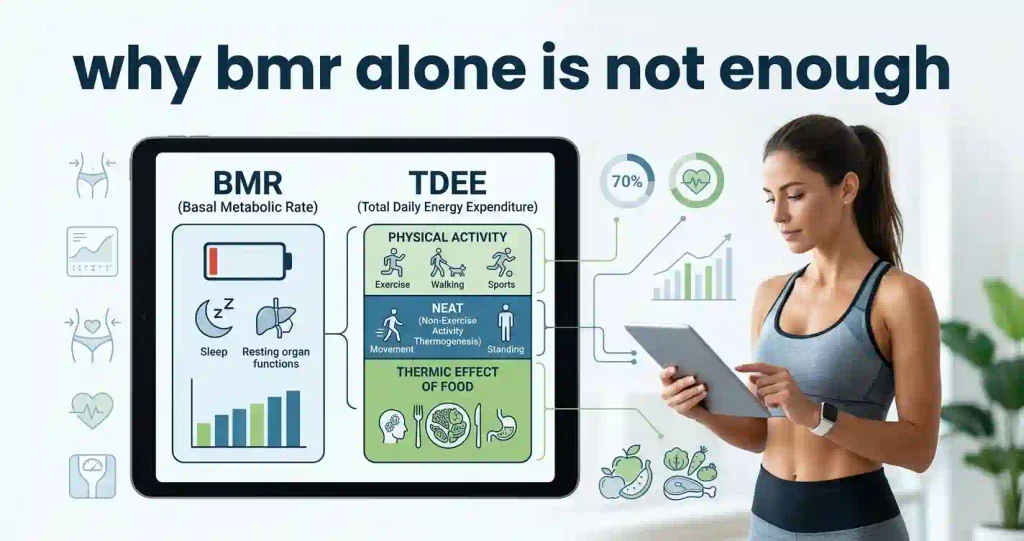
When I first tracked my daily calories while living in Leeds, I made a huge mistake. I took my basal metabolic rate from an online calculator and used it as my daily target. Within a week, I felt tired, hungry, and weak during my morning walks. I soon learned that bmr alone is not enough to figure out how many calories you need each day. BMR estimates the energy your body uses for basic functions while resting in bed. It does not cover the energy you burn when walking, working, or eating meals. Your total daily energy burn also depends on your daily physical activity and the thermic effect of food.
Why Is BMR Alone Not Enough?
Using BMR as your daily calorie target ignores everything you do after waking up. A person does more than breathe and keep their heart beating during the day. This is why a resting-energy figure cannot show your total daily energy use.
BMR Only Represents Resting Energy Use
Your basal metabolic rate covers the basic processes that keep you alive. It measures energy use under strict resting conditions.
- Breathing
- Circulation
- Brain activity
- Maintaining body temperature
- Organ function
- Other essential processes
Daily Life Uses More Energy
Every bit of movement burns extra calories above your resting state. Walking to the bus stop, standing at a desk, studying, and exercising all add to your total daily energy burn.
Digestion Also Uses Energy
Eating food actually requires energy. Your body burns calories to break down, digest, and store nutrients from every meal you eat. This is known as the thermic effect of food.
TDEE Gives the Bigger Picture
Total daily energy expenditure (TDEE) gives a complete view of your daily energy needs. It combines your resting energy use, your physical activity, and the energy used for digestion into one clear total.
BMR vs Total Daily Energy Expenditure
Comparing these two measures shows why a BMR result is much lower than your total daily calorie need. This table breaks down what each figure includes so you can plan your daily energy intake with confidence.
| Measure | What It Represents | Includes Activity? | Includes Food Digestion? |
| BMR | Basal resting energy use | No | No |
| RMR/REE | Resting energy expenditure | No | No |
| TDEE | Total daily energy expenditure | Yes | Yes |
| Calorie needs | Estimated daily energy requirement | Usually | Usually |
The National Academies lists resting energy, physical activity, and the thermic effect of food as the three main parts of total energy expenditure.
BMR Is One Part of the Equation
BMR provides a solid starting point for energy calculations. However, it is only the foundation of your total energy needs, not the end result.
TDEE Includes More Than BMR
TDEE builds directly on top of your resting metabolism. It adds the calories you burn from all daily movement and meal digestion to your resting base.
Why TDEE Is Usually Higher Than BMR
Your total energy burn is higher than your BMR because you move around and eat food every day. Unless you lie completely still without eating, your daily energy use will exceed your BMR.
The Three Main Parts of Daily Energy Expenditure
Understanding daily energy expenditure becomes much easier when you break it into three clear categories. This simple model explains where your calories go each day.
Resting Energy Expenditure
Resting energy expenditure is the calories your body burns just to stay alive. It powers your heart, lungs, kidneys, and brain while you rest.
Physical Activity Energy Expenditure
Physical activity covers every single movement you make throughout the day. It includes both planned exercise and regular daily motion.
- Walking
- Cycling
- Climbing stairs
- Household chores
- Sport
- Work-related movement
- General movement throughout the day
Thermic Effect of Food
Eating takes energy. Your digestive system burns calories to break down food, absorb nutrients, and turn meals into usable fuel.
A Simple Energy-Use Model
You can estimate your daily energy needs with this basic relationship:
Total daily energy expenditure ≈ resting energy expenditure + physical activity + thermic effect of food
Real human metabolism is complex, so treat this formula as a useful practical guide rather than an exact law.
Why Your BMR Is Not Your Daily Calorie Need
A BMR score shows resting metabolism, whereas daily calorie needs reflect your entire day. Confusing these two figures can lead to underfueling.
A BMR Number Describes a Resting State
A BMR score tells you what your body needs to survive in a temperature-controlled room without moving or eating. It does not reflect an active day.
Daily Needs Depend on Activity
An active person burns far more energy than someone sitting at a desk all day. Daily movement changes your total calorie requirement significantly.
Daily Needs Also Depend on Other Factors
Your overall energy requirements vary based on age, height, weight, muscle mass, and general health. No two bodies burn energy at the same rate.
Do Not Treat a Calculator Output as a Perfect Number
Online calculators use general mathematical formulas to estimate energy needs. They offer useful estimates, but they cannot measure your exact calorie burn.
BMR vs TDEE Comparison Table
This comparison table highlights the core differences between BMR and TDEE. Use it as a quick reference when reviewing calculator results.
| Question | BMR | TDEE |
| Measures resting energy? | Yes | Yes, as one component |
| Includes walking? | No | Yes |
| Includes exercise? | No | Yes |
| Includes digestion? | No | Yes |
| Represents a whole day? | No | Yes |
| Used to estimate daily needs? | As a starting point | Yes |
How Activity Changes the Energy Picture
Daily movement is often the missing piece when people wonder why their BMR seems so low. Physical activity includes far more than deliberate workouts.
Planned Exercise
Structured workouts like running, swimming, gym sessions, and cycling burn significant calories and raise your total physical activity expenditure.
Non-Exercise Activity
Non-exercise activity thermogenesis (NEAT) covers all movement that is not formal exercise. NEAT plays a huge role in your total daily calorie burn.
Everyday NEAT Examples
- Walking around the house
- Standing at work
- Carrying shopping bags
- Gardening in the yard
- Cleaning the kitchen
- Taking the stairs
- Walking to work or school
Research shows that physical activity is a flexible part of daily energy expenditure, with non-exercise movement contributing greatly to daily burn.
Why Two People With Similar BMRs Can Have Different Daily Needs
Two people with the same height, weight, and BMR can have very different calorie needs. If one works a desk job and the other works on a construction site, their daily energy needs will differ by hundreds of calories.
The Thermic Effect of Food Explained
The thermic effect of food (TEF) is often overlooked in basic calorie guides. Knowing how TEF works helps explain why total daily energy expenditure exceeds resting metabolism.
What Is the Thermic Effect of Food?
TEF is the energy your body uses to digest, absorb, transport, and store the nutrients in your food.
Does Every Meal Use the Same Amount of Energy?
Different nutrients require different amounts of energy to digest. Protein takes the most energy to break down, while fats and simple carbohydrates require much less.
Why TEF Matters in a TDEE Estimate
TEF accounts for roughly 10% of your total daily energy expenditure. Leaving it out leads to an incomplete picture of your daily calorie needs.
Factors That Can Change Your Daily Energy Needs
Your daily energy requirements change over time. Human metabolism adapts to lifestyle changes, environment, and physical health.
Age
Metabolic rate tends to decline gradually as people age. This change is often linked to a loss of muscle mass and lower daily activity levels.
Body Size
Larger bodies require more energy to function at rest and during movement. Height and weight directly impact your baseline energy needs.
Body Composition
Muscle tissue burns more calories than fat tissue, even at rest. A person with higher muscle mass will have a higher resting metabolic rate.
Physical Activity
How much you move throughout the day is the most variable component of your total energy burn. Increasing movement raises daily calorie needs immediately.
Physiological State
Recovery from illness, injury, or physical growth increases energy demands. The body requires extra fuel to repair tissue and support growth.
Environment
Extreme heat or cold forces your body to work harder to maintain its core temperature, which can slightly increase daily calorie expenditure.
Why One Number Cannot Capture Everything
Your body’s energy needs fluctuate based on your daily routine. A single BMR score cannot account for all the factors that influence daily energy burn.
BMR vs Calorie Needs
People often confuse BMR with target daily calorie intake. Understanding these terms helps you choose the right figure for your goals.
| Term | Simple Meaning | Main Use |
| BMR | Energy used at basal rest | Resting metabolism estimate |
| RMR | Energy used while resting | Practical resting estimate |
| TDEE | Energy used across the day | Daily expenditure estimate |
| Calorie needs | Estimated energy required | Daily nutrition planning |
What Are Calorie Needs?
Your calorie needs represent the total energy required to maintain your current weight, support daily movement, and maintain health.
Why Calorie Needs Differ Between People
Calorie requirements vary based on age, sex, body composition, and daily movement. There is no single calorie target that fits everyone.
Why UK General Calorie Figures Are Not Personal BMR Results
The NHS notes that average adults need around 2,000 kcal for women and 2,500 kcal for men daily. These general guidelines reflect average TDEE across the population, not an individual’s personal BMR.
How a BMR Calculator Fits Into a TDEE Calculator
Online tools follow a simple step-by-step process to estimate your daily energy needs. Understanding this path helps you enter better data and interpret results correctly.
Step 1 — Enter Personal Information
You start by providing key personal measurements:
- Age
- Height
- Weight
- Sex
Step 2 — Estimate BMR
The calculator uses a predictive equation to estimate your resting metabolic rate from your personal inputs.
Step 3 — Add Activity
Next, the tool multiplies your resting score by an activity factor that matches your typical daily movement level.
Step 4 — Estimate TDEE
The final figure provides an estimate of your total daily energy expenditure based on resting metabolism and activity.
Why Different Calculators Can Give Different Results
Calculators use different mathematical formulas, such as Mifflin-St Jeor or Harris-Benedict. Variations in activity definitions can also lead to different results.
BMR Alone vs BMR Plus Activity
Comparing a quiet day to a busy one makes the difference between resting energy and daily energy expenditure clear.
Imagine a Quiet Desk Day
Picture a typical office workday in London. You ride the train to work, sit at a desk for eight hours, take a brief lunch walk, and relax on the sofa in the evening. Your energy burn stays relatively close to your resting baseline.
Now Imagine a Busy Saturday
Consider a active Saturday. You clean the house, walk around the city, run errands, and meet friends for an evening walk. You burn significantly more calories on Saturday than on a quiet desk day.
The BMR Does Not Suddenly Become Your Activity
Your basal metabolic rate remains relatively stable from day to day. The increase in weekend calorie burn comes entirely from physical movement and food digestion, not a sudden jump in BMR.
A Real-Life UK Example of Why BMR Alone Is Not Enough
To see how daily energy expenditure builds over 24 hours, consider a typical weekday routine.
Morning: Resting Energy
While you sleep in bed, your body burns calories at its basal rate to power vital organs, circulation, and breathing.
Daytime: Movement Adds Up
When you wake up, walk to the station, climb stairs, and go about your workday, your calorie burn rises well above resting levels.
Evening: Food Processing Continues
As you eat breakfast, lunch, and dinner, your digestive system burns additional calories to process those meals.
The Lesson for Calculator Users
Your BMR represents the starting point of your daily energy expenditure. It is the base layer, not the total picture.
Why BMR Calculators Are Useful Despite Their Limits
BMR calculators are valuable planning tools when used correctly. Understanding what they measure allows you to use them effectively.
They Give a Starting Point
A BMR score provides a clear baseline estimate for calculating overall daily energy needs.
They Make Complex Maths Easier
Online tools run complex predictive equations instantly, saving you from calculating formulas manually.
They Help Explain TDEE
Calculating your BMR makes it easier to understand how physical activity and digestion build your total daily energy burn.
What a Good Calculator Should Show
- Formula or method used
- Input fields
- Units
- BMR result
- Activity assumptions
- TDEE or daily-energy result
- Clear limitations
How Accurate Is a BMR Calculator?
Understanding the accuracy limits of online calculators helps you set realistic expectations for your health goals.
BMR Equations Are Predictive Models
Calculators estimate energy needs based on population averages. They do not measure your individual metabolic rate directly.
Individual Results Can Differ
Two people with identical height, weight, and age can have slightly different resting metabolic rates due to differences in genetics and muscle mass.
Indirect Calorimetry Can Measure Resting Energy Expenditure
In medical labs, indirect calorimetry measures oxygen consumption and carbon dioxide production to determine exact resting energy expenditure.
Why “Exact” Calculator Results Can Be Misleading
A calculator output showing an exact number like 1,643.52 calories implies a level of precision that predictive formulas cannot provide. Treat the output as a reasonable estimate.
Worldwide Expert Advice on Using BMR Correctly
Health organizations emphasize looking beyond resting metabolism when estimating daily energy requirements.
National Academies: Look Beyond Resting Energy
The 2023 Dietary Reference Intakes for Energy from the National Academies notes that total energy expenditure includes resting metabolic rate, physical activity, and the thermic effect of food.
NHS: Daily Energy Needs Vary
NHS guidance emphasizes that individual energy needs depend on age, weight, height, and daily activity levels.
Expert Name Reference: Jean-Pierre Flatt
Metabolic researcher Jean-Pierre Flatt published extensive research on energy balance, demonstrating how physical activity and dietary intake combine with resting expenditure to maintain body weight.
How to Present Expert Advice
Focus on clear, evidence-based guidelines from established research institutions rather than unverified quotes.
Common Mistakes When Using a BMR Calculator
Avoiding common mistakes ensures you use BMR figures effectively for nutrition and fitness planning.
Treating BMR as a Daily Calorie Target
Eating only your BMR calories creates an unintended energy deficit, as it ignores the calories burned through daily movement and digestion.
Ignoring Activity Level
Failing to account for daily movement leads to underestimating total daily energy needs.
Choosing an Unrealistic Activity Category
Selecting an activity multiplier that is too high or too low distorts your TDEE estimate.
Comparing Different Calculators Without Checking Their Methods
Different calculators use different mathematical formulas, which explains why results vary across websites.
Believing the Number Is Exact
Remember that all online calculator outputs are estimates, not exact measurements.
Forgetting Normal Daily Movement
Everyday tasks like washing dishes, walking the dog, or standing at work burn calories that build your total expenditure.
BMR Alone Is Not Enough for Different Goals
Selecting the right energy measure depends on your health and fitness objectives.
If You Want Resting Energy Information
BMR or RMR provides the relevant baseline figure for resting metabolism.
If You Want Daily Energy Expenditure
TDEE offers the correct estimate for total daily calorie burn.
If You Want to Understand Activity
Track physical activity levels and non-exercise movement alongside resting metabolism estimates.
If You Want General Calorie Guidance
Use a TDEE estimate alongside balanced nutrition guidelines rather than relying solely on BMR.
BMR, RMR, TDEE and Calorie Needs Compared
Understanding the subtle differences between energy terms helps you choose the right metric for your fitness plan.
| Measure | What It Tells You | Activity Included? |
| BMR | Basal energy requirement | No |
| RMR | Resting energy expenditure | No |
| TDEE | Total daily energy expenditure | Yes |
| Daily calorie needs | Estimated energy required across the day | Yes |
BMR vs RMR
BMR requires strict measurement conditions after overnight fasting and rest. RMR uses less rigid testing conditions, making it a more practical resting measure.
BMR vs TDEE
BMR measures resting energy use only, while TDEE accounts for resting metabolism, physical movement, and meal digestion over 24 hours.
RMR vs TDEE
RMR estimates resting energy needs, whereas TDEE reflects total energy burn across an entire active day.
TDEE vs Calorie Needs
TDEE estimates total energy expenditure. Your target calorie needs may equal, exceed, or fall below TDEE depending on whether your goal is weight maintenance, gain, or loss.
Frequently Asked Questions About Why BMR Alone Is Not Enough
Why is BMR alone not enough?
BMR estimates resting energy use only. It leaves out the energy spent on physical movement, daily chores, and digesting meals throughout the day.
Is BMR the same as daily calorie needs?
No. BMR measures baseline resting metabolism, whereas daily calorie needs cover all physical movement, daily tasks, and digestion over 24 hours.
What should I use instead of BMR?
Use total daily energy expenditure (TDEE) to account for resting metabolism, physical movement, and meal digestion when planning daily nutrition.
Does BMR include walking?
No. Walking counts as physical activity, which adds to your energy burn above your baseline basal metabolic rate.
Does BMR include exercise?
No. Planned workouts fall under physical activity expenditure rather than basal resting metabolism.
Does BMR include digestion?
No. The energy required to digest and absorb nutrients is called the thermic effect of food and is separate from BMR.
Why is my TDEE higher than my BMR?
TDEE includes calories burned through daily movement, formal exercise, and meal digestion in addition to resting metabolism.
Can BMR change from day to day?
Basal metabolic rate stays relatively steady day to day, though changes in muscle mass, weight, and health status influence it over time.
Is a BMR calculator accurate?
BMR calculators offer useful estimates based on population averages, but they do not measure individual metabolic rates directly.
How to Use a BMR Calculator the Right Way
Follow this straightforward approach to get accurate results from online energy calculators.
Enter Accurate Information
Double-check your age, height, and weight measurements before running the calculation.
Check the Calculator’s Formula
Look for tools that specify their prediction equation, such as the Mifflin-St Jeor formula.
Select the Correct Activity Level
Choose an activity multiplier that matches your typical routine rather than an unusually active day.
Read Both BMR and TDEE Results
Review both your resting energy estimate and your total daily expenditure to understand your overall energy picture.
Treat the Output as an Estimate
Use calculator outputs as a practical starting point, adjusting your intake based on real-world progress and energy levels.
Related BMR and Energy Calculator Topics
- BMR calculator UK
- BMR calculator
- TDEE calculator
- Calorie needs calculator
- Daily calorie calculator
- BMR vs TDEE
- BMR vs RMR
- Resting metabolic rate calculator
- Resting energy expenditure
- Total daily energy expenditure
- Daily energy expenditure calculator
- Basal metabolic rate formula
- Mifflin-St Jeor calculator
- Harris-Benedict calculator
- Activity level calculator
- Calorie maintenance calculator
- NEAT calculator
- Thermic effect of food
- Physical activity energy expenditure
- Energy balance calculator
Final BMR vs Daily Energy Reference Table
Use this quick reference table to match your specific health and fitness questions with the appropriate energy metric.
| If You Want to Know… | Relevant Measure |
| Basic energy use at rest | BMR |
| Resting energy expenditure | BMR/RMR |
| Energy used during the whole day | TDEE |
| Effect of physical activity | Activity expenditure |
| Energy used to process food | Thermic effect of food |
| Broader daily energy requirement | Calorie needs/TDEE |
The Simple Idea to Remember
BMR measures the baseline energy your body burns at rest. It does not account for the energy required for daily movement, work, and digestion. Combining resting metabolism, physical activity, and meal digestion gives you an accurate view of your total daily energy needs.
Final Recommendation
When I first planned my diet in Leeds, relying on my BMR alone left me underfueled because it ignored my daily walks and activities. Through personal experience, I found that bmr alone is not enough to set an accurate daily calorie target. I recommend using your BMR score purely as a starting base, then calculating your TDEE to account for daily movement and digestion. Adjusting your intake based on real-world energy levels and steady progress yields far better results than relying on a resting metric alone.

Ehatasamul Alom is a dedicated health-tech enthusiast and the co-founder of BMRCalculator. With a passion for metabolic science, he focuses on providing accurate health data for the UK community. Ehatasamul ensures that every tool and guide aligns with NHS standards and public health research. His mission is to simplify complex biological data, helping British residents make informed decisions about their fitness, calorie needs, and long-term wellness. When not analyzing health trends, he explores the latest innovations in wearable fitness technology.