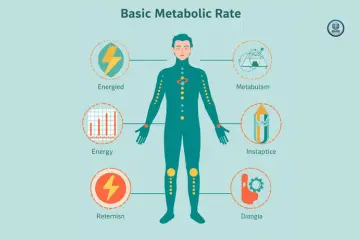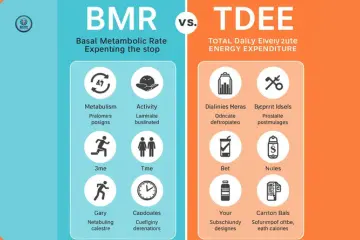

Sofa, telly on, absolutely nothing happening, and your body is still busy working away underneath it all. Your heart is beating, you are breathing, and your body is quietly keeping itself warm. That everyday moment is the easiest way to start understanding BMR explained without medical terms, and it is exactly how I like to introduce the topic to readers here on the site. BMR simply estimates how much energy your body needs to keep its basic functions running while you rest. It is not a diet target, not your total daily calorie burn, and definitely not a score that tells you whether your metabolism is “good” or “bad”.
What Does BMR Mean in Simple Words?
Forget the long name for a moment. Basal metabolic rate sounds like something from a university lecture, but the basic idea is actually quite simple.
Think of BMR as the energy your body needs just to keep the lights on.
BMR in one simple sentence
BMR is the estimated amount of energy your body uses to keep you alive and functioning while you are resting. That covers breathing, your heart beating, keeping your body warm, supporting your organs and keeping your cells working. Cleveland Clinic describes BMR as the minimum energy needed for basic body functions.
Imagine your body as a house
Even when nobody is moving around the house, the fridge still uses electricity. The heating system may still run. The boiler still works. The lights may be off, but the house is not completely switched off. Your body is similar. It never truly powers down, a point our BMR explained guide expands on further.
What BMR does not mean
BMR is not the number of calories you burn in a full day, not the number of calories you should automatically eat, not the number of calories you burn during exercise, not a measure of how fit you are, and not a medical diagnosis.
Why Does Your Body Need Energy When You Are Doing Nothing?
This is often the first “aha” moment for beginners. You may be lying in bed, but your body has not clocked off for the night. There is a lot happening quietly in the background.
Your heart keeps beating
Your heart keeps pumping blood around your body, delivering oxygen and nutrients everywhere they need to go, whether you notice it or not.
Body keeps its temperature steady
Your body spends energy maintaining a stable internal temperature, regardless of how cold the room around you happens to be.
You keep breathing
Your lungs continue working whether you are jogging in Leeds or lying under a duvet in Glasgow. Breathing never stops, even during your deepest sleep.
Your brain and organs keep working
Your brain and organs need a steady supply of energy to support the essential functions covered in our guide on what your body uses BMR energy for.
The simple “body running in the background” analogy
BMR is like the basic electricity your home needs even when you are sitting quietly with the telly off. Keep this analogy simple, and remember your body is not literally an electrical appliance, just a helpful way to picture the idea.
Guide to Basal Metabolic Rate (BMR) vs Metabolism: Are They the Same Thing?
This is one of the biggest areas of confusion. People often say, “I have a fast metabolism,” when they really mean something broader than BMR alone.
BMR is one part of metabolism and energy use, not the whole story, as our dedicated BMR versus metabolism guide explains fully.
What does metabolism mean?
Metabolism is the collection of processes your body uses to turn nutrients into energy and keep itself working. NIDDK describes metabolism as the process of generating energy from nutrients.
What does BMR mean?
BMR focuses specifically on the energy needed for basic functions at rest, a narrower slice of the wider metabolic picture.
The easiest way to remember the difference
Metabolism is the bigger picture. BMR is one part of that picture, sitting alongside activity, exercise and the energy used to process food.
BMR vs metabolism table
I built this table to strip away the jargon before it becomes confusing for anyone new to the topic.
| Term | Simple meaning |
|---|---|
| Metabolism | All the processes your body uses to manage energy |
| BMR | Energy your body needs for basic functions at rest |
| Activity | Energy used when you move |
| TDEE | Your estimated total energy use across the day |
What Is the Difference Between BMR and the Calories You Burn Each Day?
Your BMR is only the starting point. You do not spend twenty four hours lying perfectly still in a lab, and thankfully, life is rather more interesting than that.
Walking to the shops, climbing stairs and even doing household jobs all add to your daily energy use, a distinction covered in our BMR versus active calories guide.
BMR is your baseline
BMR represents the basic energy cost of keeping your body functioning, nothing more and nothing less.
Movement adds more energy use
Walking, cycling, running, cleaning, gardening, shopping and going upstairs all add extra energy demand on top of your resting baseline. NIDDK notes that activities such as walking, climbing stairs, household tasks and exercise increase energy use beyond basic resting needs.
Food also takes energy to process
Digesting and processing your food genuinely requires energy too, a small but real slice of your total daily expenditure.
Simple daily energy table
| Part of daily energy use | Simple example |
|---|---|
| BMR | Breathing and keeping your body working |
| Movement | Walking to work |
| Exercise | A gym session |
| Food processing | Digesting your lunch |
| Total daily use | All of the above combined |
What Factors Change Your BMR?
Two people can be the same age and still have different BMR estimates. That is completely normal. Your body is not a copy and paste job.
Several personal factors affect how much energy your body needs at rest, some covered further in our factors affecting BMR guide.
Your body size
Larger bodies generally require more energy to maintain, simply because there is more tissue for your body to support.
Your muscle mass
Lean muscle tissue uses more energy to maintain than body fat, a relationship our piece on the role of muscle mass in BMR explains properly.
Your age
BMR tends to change with age, with changes in body composition being one contributing factor, as covered in how age affects BMR and why BMR slows with age.
Your sex
BMR equations commonly use sex as an input because average body size and body composition differ between groups, which is why our BMR calculator for men and BMR calculator for women apply slightly different constants.
Your genetics
Genetics can play a role, though the science is more complex than simply saying someone has a “fast” or “slow” metabolism.
Other factors
Body composition, hormonal factors, illness, pregnancy and environmental temperature can all play a smaller part too, without needing a deep medical detour here.
What can and cannot change your BMR
| Factor | Can it affect BMR? | Simple explanation |
|---|---|---|
| Age | Yes | Energy needs can change over time |
| Height | Yes | Body size affects energy needs |
| Weight | Yes | Larger bodies often need more energy |
| Muscle mass | Yes | Lean tissue needs energy to maintain |
| Genetics | Yes | People naturally differ |
| Daily steps | Not directly | They affect total daily energy use |
| Exercise | Indirectly | Activity adds to total energy use |
How Does a Guide to Basal Metabolic Rate (BMR) Calculator Work?
A BMR calculator takes a few details about you and uses a mathematical formula to estimate your resting energy needs. It is much quicker than measuring metabolism in a specialist lab.
The trick is understanding that the answer is an estimate, not a measurement taken directly from your body, a nuance our BMR calculator works guide explains in full.
What information does a BMR calculator need?
Usually your age, sex, height and weight, entered into a BMR calculator built around a recognised formula.
What happens when you click Calculate?
Your information passes through a mathematical formula, and out comes your estimated BMR, calculated in seconds rather than hours.
Why calculators use formulas
Direct laboratory testing requires controlled conditions, so equations provide a practical way for everyday users to estimate BMR. Cleveland Clinic notes that laboratory measurement is more precise, but that equations are used to estimate BMR for most people.
A beginner’s BMR calculator journey
Tom, 35, enters his height, weight, age and sex. He presses Calculate. The result says 1,650 kcal per day. That does not mean Tom should eat exactly 1,650 calories. It is simply an estimate of his basic resting energy needs, a distinction our most reliable BMR calculator guide reinforces.
What Does Your BMR Number Actually Tell You?
Seeing a number on the screen is easy. Knowing what to do with it is the useful part, and this section slows things down to explain the result properly.
What does “kcal per day” mean?
Kcal means kilocalorie, and it is commonly called a “calorie” in everyday nutrition talk without anyone batting an eyelid.
Does a higher BMR mean a healthier person?
No. BMR is not a health score, and a higher number simply reflects things like body size rather than overall wellbeing.
Does a lower BMR mean your metabolism is broken?
Not necessarily. BMR varies naturally between people, a point our guide on signs of a low or high BMR explains with proper nuance.
Your BMR is not a grade
There is no gold star for having a BMR of 1,800 instead of 1,500. The number is useful for estimating energy needs, not for judging the person behind it.
What Is a “Normal” Guide to Basal Metabolic Rate (BMR)?
This question sounds simple, but it has a slightly awkward answer. There is no single BMR that everyone should have.
A calculator result should be viewed in the context of the individual using it, not against some imaginary universal standard.
Why BMR differs from person to person
Height, weight, age, sex and body composition all shape your personal BMR, which is exactly why comparing yourself to a friend rarely makes sense.
Why averages can be misleading
Population averages do not tell you what your personal BMR “should” be. Cleveland Clinic notes that there is no single normal BMR and that averages are only broad estimates.
Average BMR vs personal BMR
| Question | Simple answer |
|---|---|
| Is there one normal BMR? | No |
| Can averages be useful? | Yes, for broad context |
| Should you compare yourself with a friend? | Not really |
| Is your calculator result exact? | No |
| Can BMR change? | Yes |
Guide to Basal Metabolic Rate (BMR) Explained Without Medical Terms: A Real Life Example
This is where the explanation becomes properly practical. Imagine a normal weekday in the UK. Rain outside. Alarm going off. Tea brewing. You are already using energy before you have even left the house.
A day in the life of Sarah’s energy use
Sarah gets out of bed, makes breakfast, walks to the bus, works at a desk, walks around town, cooks dinner and takes the dog out. BMR is only the quiet background energy her body uses throughout all of this, while her movement and daily activities add to her overall energy expenditure on top.
What her BMR does not include
Her bus journey walking, dog walking, cleaning, exercise and shopping all sit outside her resting BMR figure entirely, a gap our BMR versus TDEE guide covers properly.
The “body never switches off” example
Even when Sarah sits down at 9pm with a cuppa, her body is still using energy quietly in the background, exactly as it has been all day long.
Guide to Basal Metabolic Rate (BMR) vs RMR: Do Beginners Need to Know the Difference?
You may see another term online, RMR, or resting metabolic rate. It is similar to BMR, which is exactly why the two get mixed up so often.
For a beginner, the important thing is knowing that both describe energy use while resting, but the measurement conditions differ slightly.
What is RMR?
RMR describes the energy your body uses while resting, though the testing conditions are usually a little less strict than a true clinical BMR measurement.
Why BMR and RMR are often confused
Everyday websites sometimes use the terms loosely, which is understandable but can genuinely confuse beginners trying to learn the basics.
Do you need to worry about the difference?
Usually not, for basic calculator use. Focus on the practical meaning rather than the technical detail behind it.
Simple BMR and RMR comparison
| BMR | RMR |
|---|---|
| Stricter measurement idea | More practical resting estimate |
| Basic body functions | Resting energy needs |
| Often estimated by formula | Also commonly estimated |
| Used as a baseline | Used as a practical baseline |
Cleveland Clinic explains that RMR and BMR are similar but not identical, with RMR allowing for some low effort activity.
Can You Use Guide to Basal Metabolic Rate (BMR) to Work Out How Many Calories You Need?
This is where many people accidentally make the biggest mistake. They see their BMR number and think, right, that’s my calorie allowance. Not quite.
BMR is not your full daily calorie need
BMR only covers your resting energy needs, leaving out every bit of movement, exercise and digestion that happens across your day.
What is TDEE?
Total Daily Energy Expenditure is your estimated total energy use across a normal day, calculated easily with our TDEE calculator.
How BMR fits into TDEE
BMR feeds into activity, exercise and food processing, and all of that combines into your total daily energy use.
BMR vs TDEE table
| Measure | What it tells you |
|---|---|
| BMR | Basic energy needs at rest |
| TDEE | Estimated total energy use in a day |
| Calorie intake | Energy you get from food and drink |
| Calorie deficit | Eating less energy than you use |
NIDDK’s energy balance resources highlight the roles of resting energy expenditure, food processing and physical activity in total energy expenditure.
Can Guide to Basal Metabolic Rate (BMR) Help With Weight Loss?
A BMR calculator can be useful for weight management, but it is one piece of the puzzle. It should help you understand your energy needs rather than encourage extreme dieting.
Start by estimating your BMR
Use our BMR calculator as your starting point before anything else.
Move from BMR to TDEE
Daily activity matters enormously here, which is why our calorie needs calculator is the natural next step.
Focus on sustainable habits
Balanced meals, regular movement, strength training where appropriate, adequate sleep and consistency all matter far more than chasing a single number, a point our using BMR for weight loss guide reinforces. NIDDK recommends a sustainable eating pattern and regular physical activity as part of weight management.
What not to do with your BMR
Do not treat BMR as a strict calorie limit, do not crash diet, do not chase the lowest possible number, and do not assume faster weight loss is always better.
Worldwide Expert Advice on Understanding Guide to Basal Metabolic Rate (BMR)
This section adds trust without turning the article into a medical lecture. The aim is to show that simple explanations can still be grounded in expert guidance.
Dr Marcio Griebeler’s simple view of calorie use
Dr Marcio Griebeler, an endocrinologist and weight management specialist at Cleveland Clinic, offers an accessible explanation that your body burns calories simply to stay alive and keep basic systems working.
What Cleveland Clinic recommends users understand
BMR is a baseline, everyone’s BMR differs, calculators provide estimates, and BMR is not the whole picture on its own.
What metabolic researchers study
NIDDK’s work covers energy balance, resting energy expenditure, physical activity, food processing and body weight regulation. NIDDK research shows that metabolism and energy balance involve several interacting factors rather than one simple fast or slow switch.
Expert friendly message for beginners
Think of BMR as your starting point, not your entire daily calorie story, a phrase I repeat to readers more often than almost anything else on this site.
Common Guide to Basal Metabolic Rate (BMR) Myths Explained in Plain English
BMR has collected quite a few myths over the years. Some sound convincing. Others belong firmly in the “internet said it, so it must be true” basket, as our full common BMR myths guide explains further.
Myth: BMR is the same as metabolism
Reality: BMR is one part of the bigger picture of metabolism and energy use, not the whole story.
Myth: A low BMR means you have a broken metabolism
Reality: BMR naturally differs between people, and a lower estimate rarely signals anything is genuinely wrong.
Myth: You can dramatically increase BMR overnight
Reality: There is no magic food or drink that suddenly transforms your resting energy needs, a point our increase BMR naturally guide covers honestly.
Myth: Exercise directly tells you your BMR
Reality: Exercise affects your overall energy use, not the basic definition of BMR itself.
Myth: Your BMR never changes
Reality: BMR can change with factors such as age, body size and body composition, as explained in our guide on when to recalculate your BMR.
Quick myth vs fact table
| Myth | Fact |
|---|---|
| BMR equals metabolism | BMR is one part of the bigger picture |
| Everyone should have the same BMR | BMR varies between people |
| BMR is your daily calorie allowance | Your total daily needs are higher |
| A calculator gives an exact answer | It provides an estimate |
| A low BMR means something is wrong | Not necessarily |
How to Explain Guide to Basal Metabolic Rate (BMR) to Someone in 10 Seconds
This section is a fun, highly shareable way to simplify the concept, and it reinforces the article’s core promise nicely.
The 10 second BMR explanation
BMR is roughly how much energy your body needs just to keep working while you rest. Your actual daily calorie needs are higher because you move, eat and live your normal life.
The one line version
BMR is your body’s basic energy bill, paid every single day whether you notice it or not.
The tea and telly test
If I spent the whole day resting, would my body still use energy? Yes. That’s the basic idea behind BMR, in one simple question and answer.
How to Use a Guide to Basal Metabolic Rate (BMR) Calculator Without Getting Confused
Once BMR makes sense, using a calculator becomes much easier. The process is simple, but small input mistakes can genuinely change the result, as our common BMR calculation mistakes guide covers in detail.
Enter your age
Use your current age, checked carefully rather than guessed.
Enter your height
Check whether the calculator asks for centimetres, or feet and inches, and convert carefully if needed.
Enter your weight
Check whether it wants kilograms or pounds, ideally measured on a reliable set of digital scales like this one.
Select the correct option for sex
This input is used in many predictive equations because average body composition differs between groups.
Check the result
Look for your BMR figure, the kcal per day unit, the formula used, and any explanation offered alongside it, as our BMR calculator alternatives guide explains further.
Beginner BMR calculator checklist
- Check your units
- Enter accurate details
- Read the explanation
- Remember the result is an estimate
- Do not confuse BMR with TDEE
- Use the number as a starting point
What Should You Do After Finding Your Guide to Basal Metabolic Rate (BMR)?
The calculator should not be the end of the journey. The useful question is what you actually do with the information afterwards.
If you are simply curious
Use the number to understand your body’s energy needs, nothing more complicated than that.
If you want to manage your weight
Consider calculating your TDEE as the sensible next step, using our calorie calculator to bring it all together.
If you want to improve fitness
Focus on regular activity, using resistance bands like these for strength training, good nutrition and proper recovery.
If your results concern you
Do not self diagnose based on a calculator. Speak to a qualified healthcare professional if you have concerns about unexplained weight changes, symptoms or possible health issues, a point our when not to rely on BMR guide reinforces clearly.
The best next step for most beginners
Calculate BMR, understand the result, estimate daily needs, then set realistic goals from there.
Frequently Asked Questions About Guide to Basal Metabolic Rate (BMR)
Our full FAQs page has more answers if yours is not covered below.
What is BMR in simple terms?
BMR is the estimated amount of energy your body needs to keep basic functions running while you are at rest.
Is BMR the same as metabolism?
No. BMR is one part of the larger process of metabolism and daily energy use.
Is BMR the number of calories I should eat?
No. BMR only estimates basic resting energy needs. Your total daily calorie needs are usually higher.
Why is my BMR different from someone else’s?
BMR varies based on factors such as age, height, weight, sex and body composition.
Can I increase my BMR?
Some factors cannot easily be changed. Building and maintaining lean muscle, supported by a set of adjustable dumbbells like these, may affect resting energy needs, but there is no instant way to dramatically change BMR.
Is a BMR calculator accurate?
It can provide a useful estimate, but it is not a direct measurement of your personal BMR, as our limitations of BMR calculators guide explains.
What is a good BMR?
There is no single “good” or “normal” BMR. Your result depends entirely on your individual characteristics.
Should I eat below my BMR to lose weight?
Do not assume that eating below your estimated BMR is automatically safe or appropriate. Your calorie needs should be considered in the context of your total energy use and personal circumstances.
What should I calculate after BMR?
For most people interested in daily calorie needs, TDEE is the logical next estimate because it considers activity as well as resting energy use.
Sources and Further Reading
Keep the sources section clean and trustworthy. Because this article simplifies health and nutrition concepts, the references show that the simple explanation is grounded in credible information.
Recommended authoritative sources
Cleveland Clinic for BMR and RMR explanations, NIDDK for metabolism and energy balance, peer reviewed research for BMR equations, NHS resources for UK nutrition and weight management, and registered dietitians or qualified healthcare professionals for expert commentary all sit behind this guide.
Notes for the finished article
This article avoids claiming BMR calculators are perfectly accurate, avoids any “fat burning” miracle claims, keeps a clear distinction between BMR, metabolism and TDEE, includes an appropriate health disclaimer, and uses UK spelling and terminology throughout.
Final Recommendation
Having explained BMR to more readers than I could possibly count, my honest recommendation for anyone wanting BMR explained without medical terms is simple. Treat the number as your body’s basic energy bill, nothing more mysterious than that. Use our BMR calculator to get your starting figure, then move on to a TDEE calculator once you want the fuller daily picture. Keep your approach simple, stay consistent with movement and food, and never let one number on a screen become a verdict on your health. If anything about your weight or energy genuinely worries you, please speak to your GP rather than relying on a calculator alone.

Ehatasamul Alom is a dedicated health-tech enthusiast and the co-founder of BMRCalculator. With a passion for metabolic science, he focuses on providing accurate health data for the UK community. Ehatasamul ensures that every tool and guide aligns with NHS standards and public health research. His mission is to simplify complex biological data, helping British residents make informed decisions about their fitness, calorie needs, and long-term wellness. When not analyzing health trends, he explores the latest innovations in wearable fitness technology.