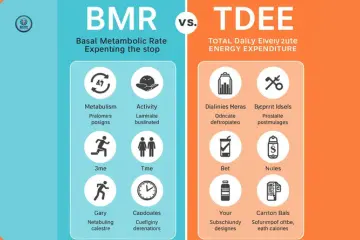

When I first began tracking my nutrition while living in Manchester, I found myself thoroughly confused by online health tools. I plug my age, height, and weight into a website, and it hands back two completely different numbers. Understanding bmr vs adjusted baseline activity is the exact turning point where your daily calorie planning stops feeling like a wild guessing game.
The confusion usually starts when a simple digital tool presents its final figure with absolute certainty, making a basic predictive equation look like a precise laboratory result. These online tools rely on mathematical estimates rather than direct physiological testing. When using an online BMR, TDEE, or general calorie calculator in the UK, mistaking your basic resting energy needs for your total active daily requirement can derail your health targets entirely.
What Is BMR?
At its most basic level, Basal Metabolic Rate (BMR) represents the absolute minimum amount of energy your body requires to stay alive while at complete, motionless rest. Imagine lying in bed all day in a warm room without moving a single muscle, speaking a word, or digesting food; your BMR is the exact calorie burn needed to keep your internal organs running.
Crucially, your BMR is not the number of calories you normally need across a typical 24-hour day. It reflects basic internal survival, not living a real human life with movement, work, and daily activities.
What Does BMR Measure?
BMR measures your foundational, baseline energy expenditure. It reflects the continuous biological work your cells perform every single second, including:
- Continuous lung expansion and breathing.
- Blood circulation pumped by your heart.
- Core body temperature regulation.
- Basic cellular repair and ion transport processes.
- Kidney, liver, and brain organ function.
- Basic tissue maintenance while completely at rest.
BMR vs RMR: Are They the Same?
While people online swap these terms freely, strict clinical definitions set them apart:
- Basal Metabolic Rate (BMR): Measured under strict laboratory conditions immediately upon waking after 8 hours of sleep and 12 hours of fasting, in a temperature-controlled room.
- Resting Metabolic Rate (RMR): Measured under slightly relaxed conditions, requiring rest but not strict overnight clinical stays.
- Resting Energy Expenditure (REE): The actual caloric figure extrapolated from an RMR or BMR measurement over a 24-hour period.
Online fitness calculators use BMR, RMR, and REE almost interchangeably because their formulas estimate a baseline resting figure rather than measuring strict clinical conditions.
What BMR Does Not Include
Your BMR is strictly limited to baseline survival physiology. It leaves out every single external physical action and digestive process, such as:
- Walking to work or popping to the local shops.
- Climbing stairs in your home or workplace.
- Cycling, running, or structured gym sessions.
- Housework, cleaning, and gardening.
- General fidgeting, standing, and desk movement.
- Digestion and processing of daily food.
Accounting for these real-world actions requires an activity adjustment.
What Is Adjusted Baseline Activity?
Adjusted baseline activity is a practical concept used by calculators to bridge the gap between resting survival needs and real life. It is not a single, universally standardized scientific metric tested in a lab, but rather an practical modeling tool built into software.
Different digital tools apply different physical activity levels (PAL) or multipliers, meaning your results depend on the specific calculator you select.
How Activity Changes Energy Expenditure
Total energy expenditure builds upon resting metabolism through several clear layers:
- Resting metabolism: Your baseline BMR or RMR.
- Thermic Effect of Food (TEF): The energy used to digest and absorb nutrients (roughly 10% of daily intake).
- Non-Exercise Activity Thermogenesis (NEAT): Unplanned daily movements like walking, standing, and chores.
- Exercise Activity Thermogenesis (EAT): Planned physical workouts, sports, and structured exercise.
- Total Daily Energy Expenditure (TDEE): The combined sum of all four components above.
What Is a Physical Activity Level (PAL)?
Physical Activity Level (PAL) is a numerical ratio expressing total daily energy expenditure relative to resting energy expenditure (TDEE / BMR). Recent exercise science research reveals that PAL values vary significantly depending on how resting metabolic rates are estimated versus directly measured.
What Is an Activity Factor?
An activity factor is a specific decimal multiplier (typically ranging from 1.2 to 1.9) applied to your estimated BMR to project your total daily needs.
A Warning on Multipliers: Activity multipliers are purely mathematical estimates, not direct calorie measurements. Two different online apps can take your identical personal data and yield drastically different totals simply because they apply different multiplier definitions.
BMR vs Adjusted Baseline Activity: Key Differences
Understanding bmr vs adjusted baseline activity comes down to recognizing what each figure actually represents in practical terms.
BMR Is Your Resting Baseline
Your calculated BMR answers one single, isolated question: How much energy would my body require to stay alive under absolute resting conditions?
Adjusted Activity Accounts for Movement
An adjusted activity calculation answers a far broader practical question: How much energy do I burn when accounting for my job, errands, hobbies, and workouts alongside my resting needs?
BMR Is Lower Than Total Daily Energy Needs
Using your raw BMR as a daily eating target drastically understates how many calories your body needs to fuel normal daily life. Eating strictly at your BMR ignores the substantial energy required just to stand, work, and move around.
Adjusted Activity Is Still an Estimate
Mathematical formulas carry inherent margins of error. Standard predictive equations can show noticeable discrepancies when checked against direct laboratory measurements, with accuracy shifting based on body composition, age, and individual traits.
BMR vs Adjusted Baseline Activity Comparison Table
Evaluating the core characteristics of both metrics side by side provides a clear, scannable reference:
| Feature | BMR | Adjusted Baseline Activity |
| Measures | Resting energy needs | Estimated needs with activity |
| Exercise included? | No | Usually yes |
| Daily movement included? | No | Usually yes |
| Used for | Baseline estimate | Daily calorie estimate |
| Common calculator use | Starting point | TDEE/maintenance estimate |
| Precision | Predictive Estimate | Predictive Estimate |
How BMR and Activity Fit Into TDEE
Before plugging numbers into any formula, you need to picture the complete energy picture. BMR serves as the foundation of the pyramid, not the final total.
What Is Total Daily Energy Expenditure?
Total Daily Energy Expenditure (TDEE) is the total number of calories you burn across a full 24-hour day. It combines four core pillars:
- Your foundational BMR/RMR baseline.
- Physical exercise (EAT).
- Non-exercise daily movement (NEAT).
- Food digestion costs (TEF).
BMR → Activity Adjustment → TDEE
[ BMR Baseline ] ──> [ Activity Multiplier ] ──> [ Estimated TDEE ]
Calculators first estimate your baseline resting rate, then scale that number up using an activity adjustment to arrive at your final estimated TDEE.
Why BMR Alone Is Not a Maintenance Calorie Number
Consider a typical day for someone working in Leeds or London. They wake up, walk to the train station, stand during their commute, walk to an office, climb stairs between meetings, walk home, cook dinner, and take an evening stroll.
Their total energy demand goes far beyond basic resting survival. In the UK, NHS physical activity guidance actively encourages adults to build movement into their weekly routines and minimize long periods of sitting. Restricting your calorie intake strictly to your BMR ignores all of that extra daily effort.
How BMR Is Calculated
Online health software uses established mathematical formulas to estimate resting metabolism, though no single equation fits every human body perfectly.
Mifflin-St Jeor Equation
Published in 1990 by Mifflin and St Jeor, this formula remains one of the most widely validated equations for estimating resting metabolic rate in modern adults.
- Variables used: Weight (kg), Height (cm), Age (years), and Biological Sex.
- Men:
- Women:
Harris-Benedict Equation
Originally derived in 1919 and revised in 1984, the Harris-Benedict equation is another common formula found in older online calculators. However, it tends to slightly overestimate resting needs in modern, less active populations compared to Mifflin-St Jeor.
Why Different BMR Equations Give Different Results
Two calculators often return conflicting numbers because they rely on different formulas or mathematical assumptions. Variations stem from:
- Differences in the original study populations.
- Whether lean muscle mass is accounted for.
- Age, sex, and weight distributions in the underlying data.
- Standard mathematical error margins inherent in populating general formulas.
A comprehensive systematic review of predictive equations confirmed that while Mifflin-St Jeor is exceptionally reliable for population estimates, individual variations still create discrepancies.
How Adjusted Activity Levels Are Estimated
Calculators scale up your resting BMR by asking you to select an overall activity tier. Picking the wrong tier is the single most common cause of skewed calorie targets.
Sedentary Activity
- Multiplier: Roughly 1.2
- Typical profile: Desk-bound job, commuting by car or train, sitting for most of the day, very little walking, no formal exercise routines.
Lightly Active
- Multiplier: Roughly 1.375
- Typical profile: Desk job mixed with regular light walking, light domestic chores, or 1 to 3 light exercise sessions per week.
Moderately Active
- Multiplier: Roughly 1.55
- Typical profile: Standing job or active daily routine combined with 3 to 5 moderate exercise or sport sessions per week.
Very Active
- Multiplier: Roughly 1.725
- Typical profile: Highly active physical job (e.g., construction, active nursing) or intensive training sessions 6 to 7 days per week.
Extremely Active
- Multiplier: Roughly 1.9
- Typical profile: Heavy manual labor combined with intense athletic training, or professional multi-session daily sports training.
A Reality Check: A single 45-minute gym session does not automatically make you “Very Active” if you sit at a computer desk for the remaining 15 hours of your waking day. Overall daily lifestyle dictates your true category.
BMR vs Adjusted Baseline Activity Example
Working through a practical example makes these theoretical concepts far easier to grasp.
Example of a Sedentary Office Worker
Consider a 35-year-old male office worker in Birmingham:
- Height: 178 cm | Weight: 80 kg
- Calculated BMR (Mifflin-St Jeor): ~1,733 kcal/day
- Selected activity level: Sedentary (1.2)
- Estimated TDEE:
Example of a More Active Worker
Now consider a worker with identical physical metrics (35 years old, 178 cm, 80 kg) who works as an active hospital supervisor:
- Calculated BMR (Mifflin-St Jeor): ~1,733 kcal/day
- Selected activity level: Moderately Active (1.55)
- Estimated TDEE:
Why Exercise Alone Does Not Define Activity Level
Both individuals share the exact same baseline BMR, yet their real-world energy requirements differ by over 600 calories every single day. The total volume of movement across all 24 hours drives that gap, not just structured gym time.
Activity Level vs Exercise Calories
Confusing general activity multipliers with explicit workout burn leads to double-counting calories.
What Counts as Daily Activity?
Your full daily activity includes every single physical movement you make:
- Walking up steps and commuting on foot.
- Standing up from your desk and carrying groceries.
- Ironing, vacuuming, and cleaning.
- General body movements, fidgeting, and exercise sessions.
What Is NEAT?
Non-Exercise Activity Thermogenesis (NEAT) refers to the energy expended for everything that is not sleeping, eating, or sports-like exercise. Relatable examples include:
- Pacing while talking on the phone.
- Carrying shopping bags back from the market.
- Taking the stairs instead of the lift.
- Tidying around the house or working in the garden.
Why Two People With the Same Workout Can Have Different Needs
If two people complete the exact same 30-minute bike ride, but person A sits on a sofa for the rest of the evening while person B spends four hours gardening and playing with their kids, person B will burn significantly more total daily calories due to higher NEAT.
BMR vs Adjusted Baseline Activity for Weight Goals
Calculators offer useful baseline targets, but individual health circumstances always call for personal flexibility.
Using BMR for Weight Maintenance Estimates
Never treat your raw BMR as a maintenance calorie goal. Eating strictly at your BMR creates an unintended, drastic calorie deficit because it completely fails to account for basic daily movement.
Using Activity-Adjusted Estimates
An activity-adjusted figure provides a far more practical starting baseline for setting weight loss, maintenance, or muscle gain targets. It reflects your total energy throughput rather than just resting survival.
Why Calculator Results Should Be Treated as Estimates
Every output generated by an online tool is a mathematical projection. Real human energy requirements fluctuate constantly due to:
- Natural individual variations in metabolic efficiency.
- Shifts in weekly step counts and non-exercise movement.
- Differences in muscle-to-fat ratios.
- Minor formula assumptions built into different online tools.
Which Is More Accurate: BMR or Adjusted Activity?
Neither figure is inherently “more accurate” than the other because they measure completely different physiological states.
BMR Estimates Resting Energy Needs
BMR accurately isolates your baseline resting requirement, but it tells you nothing about what you burn when walking or working.
Adjusted Activity Estimates Daily Energy Needs
An adjusted activity calculation provides a far more realistic picture of total daily energy needs, making it the superior tool for practical meal planning and TDEE estimations.
Measured RMR vs Estimated BMR
In clinical settings, indirect calorimetry measures resting energy expenditure by evaluating oxygen consumption and carbon dioxide output. Research shows that mathematical equations can deviate from measured laboratory values by 10% or more, proving that calculated BMR should be viewed as a starting estimate rather than a rigid fact.
Common Mistakes When Using BMR Calculators
Avoid these frequent pitfalls when putting digital calorie calculators to work:
Mistake 1: Treating BMR as Daily Calorie Needs
Eating only your BMR calories leaves your body underfueled for daily movement, leading to unnecessary fatigue and poor recovery.
Mistake 2: Choosing Too High an Activity Level
Selecting “Very Active” based on three brief workouts a week while working a sedentary desk job inflates your estimated daily target.
Mistake 3: Ignoring Non-Exercise Movement
Focusing solely on workouts while ignoring daily walking, chores, and standing leads to an incomplete picture of total energy expenditure.
Mistake 4: Comparing Different Calculator Formulas
Getting confused when two websites give different results usually stems from comparing one tool using Harris-Benedict against another using Mifflin-St Jeor.
Mistake 5: Assuming the Number Is Exact
Expecting predictive equations to pinpoint your exact calorie burn down to the single digit ignores natural physiological variation.
How to Choose the Right Activity Level in a BMR Calculator
Following a practical decision process keeps your initial calorie estimates grounded:
Look at Your Whole Week
Evaluate your average day across all seven days, taking into account:
- Total hours spent sitting at a desk or driving.
- Commuting style (walking vs. sitting on transport).
- Average daily step counts.
- Structured exercise frequency and intensity.
Use Typical Activity, Not Your Best Day
Base your selection on your standard, average week rather than an unusually busy Saturday or an intense single training day.
Reassess When Your Routine Changes
Update your calculator entries whenever your lifestyle shifts, such as:
- Switching from a field job to a remote desk role.
- Starting regular bicycle commuting.
- Shifting your regular gym training schedule.
UK Activity Guidelines and What They Mean for Calculator Users
It helps to separate UK health recommendations from calculator formulas.
NHS Physical Activity Guidance
The NHS advises adults aged 19 to 64 to aim for at least 150 minutes of moderate-intensity activity or 75 minutes of vigorous-intensity activity every week. They also recommend muscle-strengthening activities on at least two days per week, alongside reducing prolonged periods of sitting.
Moderate vs Vigorous Activity
The NHS uses the simple “talk but not sing” test to identify moderate activity:
- Moderate activity: You can talk comfortably while moving, but you cannot sing (e.g., brisk walking, easy cycling).
- Vigorous activity: You breathe hard and can only say a few words without pausing for breath (e.g., running, hard sports).
Why Meeting Guidelines Does Not Give You a Precise Calorie Number
Meeting the NHS guidance of 150 moderate minutes a week is fantastic for heart health and disease prevention, but it does not translate into a single fixed calorie number on a website. Health guidelines aim for long-term health, whereas calorie tools attempt to estimate daily energy math.
Expert Advice on BMR and Activity Estimates
Understanding the research consensus helps you use online calculators responsibly.
What Researchers Say About Prediction Equations
Metabolic researchers consistently emphasize that while predictive equations are valuable population-level tools, no single mathematical formula is perfectly accurate for every individual. Validation studies show that formulas like Mifflin-St Jeor hit within 10% of true resting metabolic rates for the majority of adults, but individual outliers remain common.
Why Individual Context Matters
Unique physiological factors influence real-world energy expenditure beyond basic math, including:
- Specific body composition (ratio of lean muscle to adipose tissue).
- Age-related shifts in tissue metabolism.
- Biological sex differences in fat distribution.
- Health status, recovery demands, and hormonal variations.
When Professional Advice Makes Sense
If you are managing specific clinical conditions, pregnancy, or medical recovery, online calculators should take a back seat. Consulting a registered dietitian or your local NHS GP ensures your dietary targets are tailored safely to your actual medical requirements.
How to Use a BMR vs Activity Calculator
Follow these actionable steps to get the most accurate results from online tools:
Step 1: Enter Accurate Personal Data
Input accurate metrics for your age, height, weight, and biological sex. Avoid using target weights or estimated height numbers.
Step 2: Select Your Usual Activity
Choose the activity category that reflects your overall weekly routine rather than an ambitious best-case day.
Step 3: Compare BMR and Estimated TDEE
Examine both figures. Recognize that your BMR is your resting baseline, while your active TDEE represents your full daily expenditure.
Step 4: Track Changes in Your Routine
Monitor your real-world energy levels, weight trends, and activity habits over several weeks, adjusting your estimates whenever your lifestyle changes.
BMR vs Adjusted Baseline Activity: Calculator Comparison Table
This tool output comparison clarifies what each calculated metric delivers:
| Calculator Result | What It Means | Includes Activity? | Best Used For |
| BMR | Resting energy estimate | No | Baseline resting indicator |
| RMR | Resting energy estimate | No | Energy research & baseline |
| Activity-Adjusted BMR | BMR modified using activity | Yes | Daily expenditure estimate |
| TDEE | Total daily energy estimate | Yes | Understanding maintenance needs |
Note: Terminology can vary slightly between digital tools, so always check the specific method listed on the calculator you are using.
Why Your Calculator Result May Change Over Time
Your metabolic numbers are dynamic figures that evolve over time.
Changes in Body Weight
As your total weight changes, the baseline energy required to move and maintain your body shifts accordingly.
Changes in Activity
Shifting from an active outdoor role to a sedentary desk job, or taking up daily cycling, directly alters your daily multiplier.
Changes in Age and Body Composition
Predictive equations incorporate age adjustments. Furthermore, shifts in lean muscle tissue over time alter your actual resting metabolism in ways standard equations may not fully capture.
BMR vs Adjusted Baseline Activity FAQs
Is BMR the same as adjusted baseline activity?
No. BMR estimates resting energy needs at complete rest, while adjusted baseline activity includes the energy expended through daily movement and exercise.
Is BMR higher or lower than TDEE?
BMR is normally lower because TDEE builds upon BMR by adding energy expended through physical activity, chores, and food digestion.
What does adjusted activity mean on a calorie calculator?
It means the calculator has multiplied your resting metabolic estimate by an activity factor to reflect your typical lifestyle movement.
Should I use BMR or TDEE?
Use BMR to understand your body’s resting baseline, but rely on TDEE when estimating total daily calorie targets for meal planning.
Can BMR change?
Yes. Changes in body weight, muscle mass, age, and overall body composition will alter your resting metabolic rate.
Why do two BMR calculators give different answers?
They likely rely on different mathematical formulas (such as Mifflin-St Jeor vs. Harris-Benedict) or apply different activity multiplier categories.
Is Mifflin-St Jeor accurate?
It provides one of the most reliable population-level estimates available, but individual variance means it remains an estimate rather than a direct measurement.
Does exercise increase BMR?
While building muscle tissue can slightly elevate resting metabolism over time, a single exercise session mainly increases active energy expenditure (TDEE) rather than directly resetting your baseline BMR.
Final Tool-Focused Checklist: BMR vs Adjusted Baseline Activity
- BMR: Your baseline resting energy requirement.
- Activity Adjustment: The extra energy required for daily movement.
- TDEE: Your estimated total daily energy demand.
- Check which formula your calculator uses.
- Select activity levels based on your standard weekly routine.
- View calculator figures as starting estimates, not absolute facts.
- Recalculate whenever your weight or lifestyle changes significantly.
- Rely on UK health guidelines for activity context, not as calorie formulas.
Final Recommendation
Understanding bmr vs adjusted baseline activity completely transformed how I track my health goals. In my experience working with online tools, treating calculated figures as flexible starting points rather than absolute facts yields the best results. I always recommend starting with an activity-adjusted estimate, monitoring your real-world energy and progress for a few weeks, and adjusting your numbers as your routine shifts. Always listen to your body over an online screen.

Ehatasamul Alom is a dedicated health-tech enthusiast and the co-founder of BMRCalculator. With a passion for metabolic science, he focuses on providing accurate health data for the UK community. Ehatasamul ensures that every tool and guide aligns with NHS standards and public health research. His mission is to simplify complex biological data, helping British residents make informed decisions about their fitness, calorie needs, and long-term wellness. When not analyzing health trends, he explores the latest innovations in wearable fitness technology.