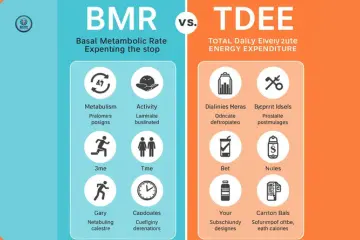
Understanding how calories work starts with your baseline resting energy burn. During my health work in Leeds, many clients asked me about the difference between bmr vs bmr x activity calculations. Your basic BMR is the energy your body burns just staying alive in bed. Adding a multiplier accounts for walking, working, and workouts throughout the day.
One figure shows your body at complete rest. The second figure estimates your full daily burn once you move around. Comparing bmr vs bmr x activity factors helps you plan sensible diet goals without guessing.
BMR vs BMR x at a Glance
Readers searching this keyword usually want a quick answer before diving into equations and calorie calculations. The key difference is simple: BMR is the starting number, while BMR × an activity factor is commonly used to estimate your broader daily energy needs.
From a calculator perspective, these numbers serve different jobs. A reliable tool should explain the transition between baseline energy needs and estimated total daily expenditure rather than presenting a mysterious calorie figure.
BMR vs BMR × Activity Factor
| Feature | BMR | BMR × Activity Factor |
| Main meaning | Basal metabolic rate | Estimated daily energy calculation |
| Represents | Baseline energy use | Broader daily energy needs |
| Includes exercise | No | Estimated through activity factor |
| Includes daily movement | No | Partly estimated |
| Typical calculation | Predictive equation | BMR × activity multiplier |
| Main use | Understanding baseline metabolism | Estimating TDEE |
| Result | Calories or kcal per day | Estimated calories per day |
The Short Answer
- BMR estimates the energy your body needs for basic functions at rest.
- BMR × 1.2, 1.375, 1.55 and other factors are commonly used to estimate daily energy expenditure.
- The activity multiplier is an estimate rather than a direct measurement.
- Your BMR does not automatically equal your daily calorie requirement.
- BMR × activity factor is often used to estimate TDEE.
Why Does the “×” Symbol Cause Confusion?
People often see the symbol and think it is a new metric name. It is not a separate health figure called BMR X.
The symbol is a math sign. It means you multiply your base number by a lifestyle factor to find your estimated daily burn.
What Does BMR Mean?
Before comparing the calculations, readers need to understand the starting point. BMR stands for basal metabolic rate. It refers to the energy required to support essential functions while the body is at rest.
What Does Your Body Use BMR Energy For?
Your internal organs consume calories continuously to keep you alive:
- Breathing
- Circulating blood
- Brain activity
- Organ function
- Cell maintenance
- Temperature regulation
What BMR Does Not Normally Include
Your base rate covers rest only. It does not count calories burned while:
- Walking to work
- Going to the gym
- Cleaning the house
- Playing football
- Shopping
- Most other daily activities
A Monday Morning Example
Imagine waking up on a chilly Monday morning in Leeds. Before you put the kettle on, answer an email or walk to the bus stop, your body has already been using energy all night.
That baseline energy use is what BMR attempts to estimate.
What Does BMR × Mean?
This section directly addresses the second half of the focus keyword and should satisfy the primary search intent. When you see BMR × 1.2 or BMR × 1.55, the multiplication sign refers to an activity factor used to estimate broader daily energy expenditure.
The Basic BMR × Formula
Estimating your total daily burn starts with a simple formula:
Different activity factors attempt to account for key lifestyle differences:
- Daily movement
- Exercise
- Work demands
- General activity
Common BMR Activity Multipliers
Standard calculators use fixed lifestyle numbers:
- Sedentary:
- Lightly active:
- Moderately active:
- Very active:
- Extra active:
Why the Result Is Usually Higher Than BMR
Moving around requires extra energy beyond rest. Any physical task adds to your daily calorie output.
Your total daily burn is naturally higher than your baseline figure once you get out of bed.
BMR × 1.2 Does Not Mean You Are Burning Exactly 20% More Every Minute
Activity multipliers are practical estimation tools. They simplify a complex day into a single factor, so they should not be mistaken for minute-by-minute metabolic measurements.
How BMR Is Calculated
A BMR calculator does not directly look inside your body and count calories being burned. Most online tools use predictive equations based on personal characteristics.
The Mifflin-St Jeor Equation
Modern dietitians trust this formula for healthy adults:
The Harris-Benedict Equation
Created in 1919 and updated in 1984, this formula is a classic model in health studies. It remains popular in many web calculators today.
The Katch-McArdle Formula
This calculation works best if you know your exact body composition:
Why Two BMR Calculators Can Give Different Results
- Calculators use different underlying equations.
- Software tools apply different rounding rules.
- User input accuracy varies.
- Body fat estimates alter lean mass formulas.
- Natural biological differences affect real output.
How the BMR × Activity Calculation Works
This section shows what happens after you find your baseline figure. The activity multiplier converts a resting number into a daily total.
Step 1: Calculate Your BMR
First, find your resting energy requirement using an equation:
Step 2: Choose an Activity Factor
Select a multiplier that matches your regular weekly movement pattern honestly.
Step 3: Multiply BMR by the Factor
Apply the chosen multiplier to your resting number:
This total is an estimated TDEE rather than an exact laboratory reading.
Step 4: Review the Estimate Over Time
Keep track of real-world feedback to test your estimate:
- Weight trends
- Daily energy levels
- Training performance
- Overall well-being
The Calculator Does Not Know You Took 18,000 Steps Yesterday
Basic online tools rely on static categories. A single fixed number cannot account for an unexpected long walk or a quiet day on the sofa.
BMR vs BMR × Activity Level Comparison
The two calculations are connected, but they should not be used interchangeably. This table helps readers understand the progression from baseline metabolism to estimated daily calorie expenditure.
The following figures should be presented as a calculator example rather than universal calorie advice. An activity factor can significantly change the final estimate, which is why choosing one honestly matters.
How Activity Factors Change a BMR Estimate (Example BMR: 1,600 kcal)
| Activity Level | Common Factor | Example Calculation | Estimated Result |
| Sedentary | 1.2 | $1{,}600 \times 1.2$ | 1,920 kcal |
| Lightly active | 1.375 | $1{,}600 \times 1.375$ | 2,200 kcal |
| Moderately active | 1.55 | $1{,}600 \times 1.55$ | 2,480 kcal |
| Very active | 1.725 | $1{,}600 \times 1.725$ | 2,760 kcal |
| Extra active | 1.9 | $1{,}600 \times 1.9$ | 3,040 kcal |
Why the Activity Factor Makes Such a Big Difference
Changing your multiplier alters your daily target by hundreds of calories. Picking the wrong category distorts your entire meal plan.
The Risk of Choosing Too High an Activity Level
It is easy to focus on gym sessions while ignoring desk time. Sitting for eight hours reduces total burn even if you train hard for forty minutes.
One Tough Workout Does Not Always Make Someone “Very Active”
An intense workout burns calories, but resting for the remaining twenty-three hours keeps your average output lower than you think.
Which BMR × Activity Factor Should You Choose?
Finding the right factor is tricky because daily movement changes constantly. Be realistic about your actual routine.
BMR × 1.2: Sedentary
- Desk jobs with minimal walking
- No planned weekly exercise
- Low overall daily movement
BMR × 1.375: Lightly Active
Look When BMR × 1.375: Lightly Active
- Light walking every day
- Gentle exercise 1 to 3 times a week
- Standing for part of your workday
BMR × 1.55: Moderately Active
- Moderate exercise 3 to 5 days a week
- Active jobs like retail or teaching
- Regular daily step counts
BMR × 1.725: Very Active
Look When Very Active
- Hard training 6 to 7 days a week
- Physical jobs like construction
- High daily movement throughout the day
BMR × 1.9: Extra Active
- Professional athletic training
- Highly demanding physical labor plus heavy workouts
- Extreme daily energy demands
Be Honest, Even When the Calculator Offers More Calories
Choosing a higher multiplier gives you a higher calorie target, but online tools do not reward wishful thinking. Match your true movement level.
BMR vs TDEE: Where Does BMR × Fit In?
BMR is often used as the starting point for estimating TDEE, while the activity multiplier provides the bridge between the two.
What Is TDEE?
Total Daily Energy Expenditure represents your complete calorie output across 24 hours:
- Basal metabolic needs (BMR)
- Non-exercise movement (NEAT)
- Exercise activity (EAT)
- Thermic effect of food (TEF)
Is BMR × Activity Factor Always TDEE?
Multiplying your base rate gives you an estimated TDEE. It remains a practical calculation rather than a direct metabolic scan.
Why TDEE Changes Over Time
Your daily output shifts as your lifestyle evolves:
- Changing workout habits
- Shifting daily step counts
- Variations in body weight
- Work schedule changes
BMR vs BMR × Activity Factor vs TDEE
| Term | What It Represents | Main Purpose |
| BMR | Baseline energy estimate | Understanding resting energy needs |
| BMR × factor | Mathematical estimate | Adjusting for activity |
| Estimated TDEE | Broader daily energy estimate | Calorie planning |
| Actual energy expenditure | Real individual energy use | Requires direct laboratory assessment |
Think of BMR as the Engine Idling
BMR is like a car engine idling while parked. Moving the car requires extra fuel. The multiplier estimates how much extra fuel you burn on the road.
Real-Life Example: BMR vs BMR × on a Typical UK Day
Seeing how the math works in real life makes planning simpler. Let us look at a practical user profile.
Meet Alex From Bristol
- Age: 30 years old
- Height: 175 cm
- Weight: 70 kg
- Job: Office worker sitting at a desk
- Activity: Walks to work and visits the gym 3 times a week
Alex’s Estimated BMR
Using the Mifflin-St Jeor equation, Alex has an estimated resting rate of roughly 1,610 kcal per day.
Alex’s BMR × Activity Factor
Alex picks the lightly active multiplier (1.375) for regular weekdays:
A Quiet Sunday vs a Busy Saturday
- Quiet Sunday: Sitting at home reading means Alex burns closer to
- Busy Saturday: Hiking and shopping pushes output up to
Why One Number Cannot Perfectly Describe Every Day
Your energy burn changes from day to day. Multipliers estimate your average weekly requirement rather than an exact daily target.
How Accurate Is BMR × Activity Factor?
Predictive formulas offer practical estimates, but they simplify complex human biology. Use them as helpful starting guides.
The Accuracy of the Starting BMR Estimate
Equations work off population averages. Individual organ sizes and genetics mean two people with identical metrics can burn slightly different calories at rest.
The Accuracy of Activity Multipliers
Standard multipliers group complex lives into five rough categories. They do not capture small habits like fidgeting or short walks.
Why Wearable Devices May Also Differ
Fitness trackers monitor heart rate and motion, but their algorithms still estimate calorie burn rather than measuring heat directly.
An Estimate Can Still Be Useful
An imperfect figure gives you a solid starting point. You can adjust your calorie intake based on real-world weight trends over time.
Expert Insight on BMR and Energy Expenditure
Grounding your understanding in published research keeps your health planning realistic.
The Work of Dr M. D. Mifflin and Dr S. T. St Jeor
Dr M. D. Mifflin and Dr S. T. St Jeor created their landmark resting equation in 1990. By measuring energy burn in 498 healthy adults with indirect calorimetry, they proved that age, height, weight, and sex provide a reliable estimate of resting metabolism.
Professor John R. Speakman and Energy Expenditure
Professor John R. Speakman has published extensive research on human metabolism. His work shows that baseline energy output varies between people due to lean organ mass, genetic traits, and tissue composition.
What Experts Can Tell Us About Calculator Results
- Individual metabolic rates vary around population averages.
- Equations offer practical starting estimates rather than precise facts.
- Lifestyle activity is hard to capture with a single multiplier.
- Real-world weight trends are the best way to test your calculations.
Science Gives Us a Map, Not a Crystal Ball
A calculator provides a sensible starting direction. It cannot predict every step, snack, or sudden spike in physical activity.
Common Mistakes When Using BMR × Calculations
Avoiding simple math errors makes your calorie targets far more reliable.
Mistake 1: Treating BMR as Maintenance Calories
Eating only your resting BMR calories puts you in an extreme deficit because it ignores all daily movement.
Mistake 2: Choosing an Unrealistic Activity Factor
Selecting a “very active” multiplier when working a desk job leads to overestimating your daily burn.
Mistake 3: Forgetting That Activity Changes
Your energy requirements drop on rest days and weekends if your physical movement drops.
Mistake 4: Treating the Result as Exact
A figure like 2,347.6 kcal looks precise, but software rounding does not mean your body burns that exact number.
Mistake 5: Using Outdated Body Measurements
Using old weight or height figures distorts your resting BMR calculation from the start.
More Decimal Places Do Not Mean More Accuracy
Displaying decimals makes a calculation look scientific, but your body does not track fractions of a calorie.
How to Use BMR × Activity Factor for Your Goals
Once you calculate your estimated TDEE, apply the result toward your personal health targets.
Using Estimated TDEE for Weight Maintenance
Eating near your estimated TDEE maintains your current body weight over time.
Using Calorie Estimates for Weight Loss
Create a modest daily deficit below your estimated TDEE to encourage steady fat loss:
Using Calorie Estimates for Weight Gain
Add a small surplus above your estimated TDEE to support muscle growth alongside strength training:
Adjusting Your Estimate Over Time
Track your weight over three weeks. If your weight stays flat when trying to lose fat, reduce your daily intake slightly.
Start With the Estimate, Then Observe Reality
Use the initial calculation as a starting baseline, then adjust your food intake based on real scale trends.
BMR Activity Factor Comparison for Different Lifestyles
Select your lifestyle multiplier based on your full day rather than workout sessions alone.
Choosing an Activity Factor by Lifestyle
| Typical Lifestyle | Possible Activity Range | Factors to Consider |
| Mostly seated work | $1.2$ | Low daily steps and no planned workouts |
| Desk job with regular walking | $1.375$ | Moderate daily steps and light exercise |
| Regular gym training | $1.55$ | Moderate job movement with frequent workouts |
| Physical occupation | $1.725$ | Active labor job with high daily physical demand |
| High-level athletic training | $1.9$ | Heavy physical labor plus intense daily workouts |
Why Occupation Matters
Sitting at a desk for eight hours burns far fewer calories than standing in retail or working on a construction site.
Why Daily Steps Matter
Walking 10,000 steps across a workday often burns more energy than a forty-minute weightlifting session.
Why Your Weekly Average May Matter More
Look at your overall week. One active day does not change a sedentary routine into a “very active” lifestyle.
Your Fitbit May Know More About Tuesday Than a Basic Calculator
A standard calculator uses broad categories. Fitness trackers provide extra daily context, though their estimates still have limits.
How to Use a BMR Calculator Correctly
Follow these straightforward steps to get a reliable metabolic calculation.
Step 1: Enter Accurate Details
Gather your current personal figures:
- Age in years
- Height in centimeters or inches
- Weight in kilograms or pounds
- Biological sex
Step 2: Check Which Formula the Tool Uses
Look for transparent formulas like Mifflin-St Jeor or Katch-McArdle in the calculator settings.
Step 3: Calculate Your BMR
Run the calculation to find your baseline resting calorie requirement.
Step 4: Apply an Appropriate Activity Factor
Select a lifestyle multiplier that reflects your average weekly movement level honestly.
Step 5: Review the Estimated TDEE
Use the final number as a practical starting target for your nutrition plan.
Use UK-Friendly Measurements Where Helpful
A practical calculator should support stone, pounds, kilograms, feet, and centimeters without needing manual unit conversions.
When Should You Not Rely Only on BMR × Calculations?
Calculators provide general estimates. Certain circumstances require personal medical guidance.
Significant Changes in Health or Weight
Medical conditions, thyroid shifts, and rapid weight changes alter resting energy output beyond standard formulas.
Special Life Stages
Pregnancy, lactation, and recovery from injury change nutritional demands significantly.
Complex Nutrition Goals
Consult a registered dietitian or healthcare professional if you need custom dietary strategies for health conditions.
A Calculator Is a Tool, Not Your Doctor
Online formulas provide practical general guidance, but they cannot replace individual healthcare advice.
Frequently Asked Questions About BMR vs BMR x
What does BMR × mean?
BMR × refers to multiplying your basal metabolic rate by an activity multiplier to estimate your total daily energy expenditure.
Is BMR × 1.2 the same as TDEE?
BMR × 1.2 estimates TDEE for a sedentary lifestyle, serving as a practical calculation rather than a direct measurement.
Why do I multiply BMR by an activity factor?
Multiplying accounts for the extra calories burned through daily movement, work, and exercise beyond resting survival needs.
What is the difference between BMR and BMR × 1.55?
BMR measures baseline resting needs. BMR × 1.55 estimates your total energy burn on moderately active days.
Which BMR activity factor should I use?
Choose a factor that matches your overall weekly movement, job demands, and workout routine honestly.
Does exercise increase BMR?
Exercise burns calories directly and builds muscle over time, which slightly increases your resting base rate.
Is BMR × activity factor always accurate?
No. It provides a practical population estimate and should be adjusted based on real-world weight trends.
Related Tools and Internal Linking Opportunities
- BMR Calculator: Estimate your baseline resting metabolic rate instantly.
- TDEE Calculator: Apply activity multipliers to find your estimated daily burn.
- Calories Burned Calculator: Track energy expenditure across specific workouts.
- RMR Calculator: Compare resting metabolic rate with strict basal metabolic rate.
- Calorie Deficit Calculator: Plan sensible energy targets for steady fat loss.
Recommended Internal Linking Journey
BMR Calculator → BMR vs BMR × Activity Factor → TDEE Calculator → Calories Burned Calculator → Calorie Deficit Calculator
Final Recommendation
Learning the distinction between bmr vs bmr x activity calculations gives you complete control over your diet plan. From my years testing health tools, I always tell people to start with their resting baseline figure. Adding a multiplier turns that baseline number into a real-world daily calorie target. Keep your lifestyle choice honest so you do not overestimate your burn. Use your estimated TDEE as a starting guide, track your weight over three weeks, and adjust your food intake based on real results.

Ehatasamul Alom is a dedicated health-tech enthusiast and the co-founder of BMRCalculator. With a passion for metabolic science, he focuses on providing accurate health data for the UK community. Ehatasamul ensures that every tool and guide aligns with NHS standards and public health research. His mission is to simplify complex biological data, helping British residents make informed decisions about their fitness, calorie needs, and long-term wellness. When not analyzing health trends, he explores the latest innovations in wearable fitness technology.