Working out your daily energy needs can feel tricky with all the health words used today. Sitting in my kitchen in Leeds on a rainy morning, I remembered how often clients ask me about calorie targets. Getting bmr vs maintenance calories right makes a huge difference when you plan your meals. Your body burns fuel every second just to keep you alive and moving. Understanding these two numbers stops you from eating too little or guessing your daily burn. Let us look at how both numbers work so you can reach your health goals with ease.
BMR and maintenance calories are often confused because both involve calories and metabolism. Yet they describe two very different parts of your daily energy needs. Your BMR is closer to your body’s baseline energy use. Maintenance calories represent a broader estimate of how much energy you use during an ordinary day.
BMR vs Maintenance Calories at a Glance
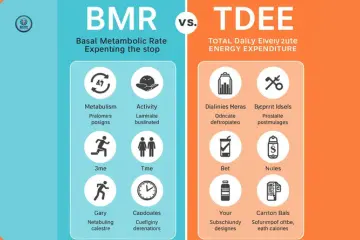
Before exploring equations and activity levels, readers need a clear comparison. This section should answer the primary search query within seconds. The key point is simple: BMR is one component of your total energy needs, whereas maintenance calories attempt to estimate the full amount needed to keep your body weight relatively stable over time.
Quick Comparison Table
A table provides an immediate visual distinction between the two measurements. From a practical calculator perspective, this is useful because people often see both figures on the same website and assume they can be used in exactly the same way.
| Feature | BMR | Maintenance Calories |
| Main meaning | Basal energy requirement | Estimated energy needed to maintain weight |
| Includes basic body functions | Yes | Yes |
| Includes normal movement | No | Yes |
| Includes exercise | No | Yes |
| Includes daily activity | No | Yes |
| Usually higher than BMR | No | Yes, for most people |
| Common use | Estimate baseline energy needs | Estimate daily calorie needs |
| Exact measurement? | No, when calculator-based | No, usually an estimate |
The Simplest Way to Understand the Difference
BMR asks: How much energy does my body need at complete rest? Maintenance calories ask: How much energy do I use across a typical day? BMR is a baseline estimate. Maintenance calories include much more of real life. Neither calculator result should be treated as an exact prescription.
Why People Confuse BMR With Maintenance Calories
Both results use kcal per day. Both appear in calorie calculators. Websites sometimes display them together. Some users assume “calories burned” means the same thing in every context. Seeing “1,650 calories” on a BMR calculator and assuming that is the exact amount you should eat can be tempting. Sadly, metabolism does not come with instructions as neat as a microwave dinner.
What Is BMR?
BMR stands for Basal Metabolic Rate. It estimates the energy required to support essential bodily functions under basal resting conditions. A calculator does not directly measure this in most cases. Instead, it predicts the result using information such as your age, height, weight and sex. Common prediction equations can be useful, but individual error remains possible.
What Does BMR Stand For?
Basal Metabolic Rate represents the energy needed to keep you alive at rest. Essential functions include:
- Breathing
- Blood circulation
- Brain activity
- Organ function
- Temperature regulation
- Cellular processes
What Does a BMR Calculator Measure?
Most online BMR tools estimate rather than directly measure metabolic rate. They use four simple inputs:
- Age
- Height
- Weight
- Sex
Why Age Can Affect BMR Estimates
Prediction equations account for age-related differences in average resting energy expenditure. As we age, muscle mass often decreases, which can lower baseline energy needs over time.
Why Height and Weight Matter
Body size is an important variable in common metabolic prediction equations. A larger body requires more energy to sustain basic cell and organ functions than a smaller frame.
Why Two Similar People Can Have Different Energy Needs
People of the same age and weight may burn energy differently due to several key factors:
- Body composition (muscle vs fat)
- Individual physiology and thyroid status
- Daily activity patterns
- Measurement differences in tracking
Common BMR Calculator Formulas
Predictive equations give us a practical starting point for estimating baseline energy needs without a lab.
Mifflin-St Jeor Equation
This is a widely used predictive equation for estimating resting energy expenditure. A systematic review found it comparatively reliable among several common equations, although noteworthy individual errors remain possible.
Harris-Benedict Equation
This is another commonly used equation developed earlier in the twentieth century. It remains popular, though it can produce slightly higher estimates than Mifflin-St Jeor.
Why Different BMR Calculators Give Different Results
Calculators on different websites do not always match. Variations occur due to:
- Different formulas used
- Different assumptions built into the code
- Rounding methods
- Unit conversions between imperial and metric
- Individual prediction error
What Are Maintenance Calories?
Maintenance calories are the estimated number of calories needed to maintain your current body weight when averaged over time. They are not simply your BMR with a fancy new name. Maintenance needs account for the energy your body uses while living an ordinary life, including movement and physical activity.
Maintenance Calories Explained Simply
The basic energy-balance concept governs weight stability over time. The NHS states that, to remain around the same weight, the calories a person uses should broadly equal the calories they eat and drink.
What Do Maintenance Calories Include?
Maintenance calories build a full picture of your daily expenditure by combining several components:
- Basal metabolic energy needs
- Walking and general movement
- Planned exercise
- Work-related activity
- Household activity
- Digestion and food processing
Why Maintenance Calories Are Usually Higher Than BMR
A person does not spend an entire day under basal metabolic conditions. Even on a quiet Sunday at home, most people still:
- Walk around the house
- Prepare meals
- Stand up and sit down
- Carry out basic tasks
That additional activity requires energy beyond baseline survival needs.
BMR vs Maintenance Calories: The Key Differences
This section serves as the main comparison area of the article. It explains not only the definitions but also the practical consequences of using the wrong figure.
Difference in What Each Number Measures
BMR Measures Baseline Energy Needs
BMR focuses purely on essential energy use under resting conditions. It ignores all external movement and daily effort.
Maintenance Calories Estimate Total Daily Needs
Maintenance calories attempt to represent overall daily energy expenditure. They include every bit of fuel burned from waking up until falling asleep.
Difference in Daily Activity
BMR does not attempt to account for any form of physical exertion. It completely excludes:
- Walking to work
- Working at a desk or on your feet
- Shopping and carrying bags
- Cleaning the house
- Exercise and sports
- General fidgeting and movement
Maintenance estimates attempt to include these activities, usually through a Total Daily Energy Expenditure (TDEE) calculation.
Difference in Practical Use
Choosing between these metrics depends entirely on what you want to calculate.
| Goal | More Relevant Starting Figure |
| Understanding baseline metabolism | BMR |
| Estimating maintenance intake | Maintenance calories |
| Understanding resting energy use | BMR |
| Planning general daily calorie intake | Maintenance calories |
| Building a TDEE estimate | BMR can be a starting input |
How Are Maintenance Calories Calculated?
Many online maintenance calorie calculators begin with a predicted BMR or resting metabolic rate and then account for activity. This creates a practical estimate, but activity categories can introduce additional uncertainty. Real life rarely fits perfectly into a drop-down menu.
The Basic Maintenance Calorie Formula
Calculators use a simplified mathematical shortcut:
This is often used as a practical approach for estimating Total Daily Energy Expenditure (TDEE).
Understanding Activity Factors
Calculators group daily movement into standard categories:
- Sedentary
- Lightly active
- Moderately active
- Very active
- Extremely active
Why Choosing the Right Activity Level Matters
Two people who both exercise three times per week may have very different daily energy expenditure based on their routine:
- Office-based work versus physical labor
- Daily step count differences
- Exercise duration and intensity
- Active commuting versus driving
Activity Level Comparison Table
This table helps readers choose an activity category more realistically for their daily routine.
| Lifestyle Pattern | General Activity Description | Effect on Estimated Maintenance |
| Mostly sitting with little exercise | Sedentary | Lower estimate |
| Some regular movement | Lightly active | Slightly higher |
| Frequent exercise or active lifestyle | Moderately active | Higher |
| Highly physical routine | Very active | Significantly higher |
| Exceptional daily physical demands | Extremely active | Highest estimates |
How BMR Turns Into Maintenance Calories
BMR is often a starting point. Daily movement then adds more layers to the energy picture to build your full maintenance estimate.
Step 1: Calculate Your Estimated BMR
Start by entering your accurate details into a baseline calculator:
- Age
- Height
- Weight
- Biological sex
Accurate and current measurements are vital for a good baseline.
Step 2: Consider Your Normal Activity
Assess your usual overall routine rather than your most active day of the month. Think about:
- Job demands
- Average daily steps
- Commuting style
- Training sessions
- Household tasks
Step 3: Estimate Your TDEE
Multiply your baseline number by your activity factor. Estimated TDEE is commonly used as a practical proxy for maintenance calorie needs.
Step 4: Compare the Estimate With Real-Life Results
Observe how your body responds over time to test the calculation:
- Track body-weight trends over several weeks
- Maintain consistent eating patterns
- Account for temporary changes in activity
- Focus on long-term observations rather than daily shifts
From BMR to Maintenance Calories Table
This overview maps out the journey from baseline calculations to real-world adjustments.
| Stage | What Happens |
| 1 | Estimate BMR using physical inputs |
| 2 | Assess real-world daily activity levels |
| 3 | Estimate total daily energy expenditure (TDEE) |
| 4 | Use the result as an initial maintenance estimate |
| 5 | Monitor longer-term weight trends and reassess |
BMR vs Maintenance Calories: A Real-Life Example
A hypothetical example makes the distinction much easier to understand. Imagine someone living in Manchester who works at a desk, walks to the tram each morning and visits the gym three times a week.
Example Person’s Details
Let us look at our hypothetical profile:
- Age: 30 years old
- Weight: 70 kg
- Height: 175 cm
- Activity: Desk job with light walking and 3 gym sessions weekly
Step 1: Estimate Their BMR
Using the Mifflin-St Jeor formula, their baseline burn calculates to roughly 1,650 kcal/day.
What the BMR Result Means
This result estimates baseline energy expenditure rather than a full day’s energy needs. It reflects what their body uses at complete rest.
Step 2: Estimate Their Maintenance Calories
Applying a “lightly active” factor of 1.375 gives an estimated maintenance target:
Why the Maintenance Figure Is Higher
Everyday movement, commuting, digestion, and gym workouts increase total energy expenditure well above baseline survival levels.
BMR and Maintenance Example Table
Here is how the numbers stack up for our Manchester desk worker.
| Measurement | Example Figure | Meaning |
| Estimated BMR | 1,650 kcal/day | Baseline energy estimate |
| Activity adjustment | 1.375 factor | Accounts for daily lifestyle and exercise |
| Estimated maintenance | 2,268 kcal/day | Approximate daily energy use to hold weight |
What Happens on a Rest Day?
On a quiet day spent on the sofa, actual daily burn drops closer to 1,900 kcal because physical movement is minimal.
What Happens on a Very Active Day?
Actual energy expenditure rises significantly on days involving heavy physical effort:
- A long walk in the countryside
- A physically demanding shift
- An extended cycle ride
- A heavy training session
Should You Eat Your BMR or Maintenance Calories?
For most adults planning their general daily intake, eating exactly at BMR is not the same thing as eating at estimated maintenance because BMR does not account for the rest of daily life.
Why BMR Is Not Automatically a Daily Calorie Target
BMR leaves out all ordinary movement and activity. Because people normally burn far more energy than their basal estimate, eating only at BMR can leave you underfuelled and exhausted.
When Maintenance Calories Are More Useful
Maintenance estimates are generally more relevant when someone wants to understand the approximate calorie intake associated with maintaining their current body weight.
Why Neither Number Should Be Treated as Perfect
Online calculations remain estimates. Food tracking has inherent limitations, daily expenditure changes constantly, and scale weight fluctuates for reasons unrelated to body-fat change.
BMR vs Maintenance Calories for Weight Loss
People often search for this comparison because they want to know which number should guide a calorie deficit. Focus on underlying principles rather than aggressive calorie limits.
Understanding a Calorie Deficit
Weight may decrease over time when energy intake is consistently lower than energy expenditure. The NHS explains that consuming fewer calories than the body uses can lead to weight loss over time.
Why Maintenance Calories Are Usually the Better Starting Point
A deficit is generally considered in relation to overall energy expenditure. Estimated maintenance provides broader context than BMR, which represents only a baseline component.
Why Weight Loss Does Not Follow Perfect Calculator Maths
Real-world body changes rarely follow linear formulas due to complex biological adjustments:
- Shifts in overall body weight
- Changes in daily energy expenditure
- Fluctuations in spontaneous physical activity
- Normal water-weight shifts
Research associated with Kevin D. Hall, PhD, at the US National Institute of Diabetes and Digestive and Kidney Diseases demonstrates why body-weight change is dynamic rather than a permanently fixed calorie equation.
BMR vs Maintenance Calories for Weight Gain
The same distinction matters for people trying to gain weight or muscle. Maintenance calories provide a broader estimate of the energy needed to maintain current weight before adding extra calories.
Understanding a Calorie Surplus
Consuming more energy than you burn over time creates a surplus. This provides the extra fuel needed to support recovery and tissue growth.
Why BMR Alone Is Not a Good Starting Point for Weight Gain Planning
Using BMR ignores all activity expenditure, exercise energy use, and daily movement. Eating a small surplus above BMR would still leave you in a large real-world deficit.
Muscle Gain Requires More Than Calories
Adding lean muscle requires more than just eating extra food:
- Progressive resistance training
- Sufficient daily protein intake
- Adequate rest and recovery
- Quality sleep
- Consistent long-term habits
What Can Affect Your Maintenance Calories?
Maintenance calorie needs are not permanently fixed. They change as your body and lifestyle evolve over time.
Body Weight
Changes in total body weight shift energy needs. Carrying more body mass requires more energy during movement and at rest.
Daily Movement
Non-exercise movement impacts your daily burn significantly:
- Daily step count
- Time spent standing versus sitting
- Walking during commutes
- Physical tasks at work
Exercise
Planned workouts alter your energy expenditure depending on several key variables:
- Frequency of sessions
- Duration of workouts
- Training intensity
- Type of activity performed
Body Composition
Body composition can influence energy expenditure. Muscle tissue is more metabolically active than fat tissue, though the difference at rest is modest.
Lifestyle Changes
Major routine changes directly shift your maintenance target:
- Starting a new job
- Moving house
- Beginning a new training programme
- Recovering from inactivity
How Accurate Are BMR and Maintenance Calorie Calculators?
Online calculators are convenient tools, but a result with multiple decimal places should not be mistaken for laboratory certainty.
Accuracy of BMR Prediction Equations
A systematic review found that the Mifflin-St Jeor equation performed comparatively well among common predictive equations but still had limitations when applied to individuals.
Why Maintenance Estimates Can Have Greater Uncertainty
Maintenance estimates add an activity factor to an already predicted metabolic figure. Errors often stem from:
- Inaccurate physical measurements
- General formula limitations
- Selecting an incorrect activity level
- Unnoticed changes in daily habits
Calculated vs Measured Metabolic Rate
Indirect Calorimetry
Indirect calorimetry measures resting energy expenditure under controlled conditions by analyzing oxygen uptake and carbon dioxide output.
Why Most People Use Calculators Instead
Calculators offer quick, free, and convenient estimates without requiring specialized laboratory access or clinical tests.
Common BMR and Maintenance Calorie Mistakes
Avoiding common pitfalls helps ensure your calculated numbers serve as helpful tools rather than frustrating roadblocks.
Mistake 1: Using BMR as Your Exact Daily Intake
Confusing baseline survival burn with total daily energy expenditure leads to severe underfueling.
Mistake 2: Choosing an Unrealistically High Activity Level
Selecting an active rating for a mostly desk-bound lifestyle overestimates daily maintenance needs.
Mistake 3: Forgetting That Activity Changes
Failing to adjust intake during periods of reduced movement can stall progress:
- Holidays and travel
- Illness or injury recovery
- Seasonal routine shifts
- Job changes
Mistake 4: Treating One Day of Scale Change as a Verdict
Reacting to daily scale weight ignores natural shifts in water balance, salt intake, food volume, and glycogen storage.
Mistake 5: Never Updating the Calculator
Failing to recalculate estimates after significant weight changes leaves you working with outdated energy figures.
How to Find Your True Maintenance Calories More Practically
Observing longer-term real-world trends provides far better context than relying solely on initial calculator outputs.
Start With a Calculator Estimate
Calculate a baseline figure using your current age, height, weight, and an honest assessment of normal activity.
Maintain Consistent Habits
Keep your eating patterns, daily activity levels, and tracking methods relatively stable over a multi-week test period.
Monitor Longer-Term Weight Trends
Focus on average weight trends over three to four weeks rather than reacting to daily scale shifts.
Adjust the Estimate Carefully
If your average weight trends up or down while eating at the estimated target, adjust your daily intake slightly to find your true real-world maintenance level.
Expert Perspective on Maintenance Calories and Energy Balance
Calorie planning relies on established energy-balance principles while acknowledging that human metabolism is dynamic. Kevin D. Hall, PhD, is known for research and mathematical modelling of metabolism, energy expenditure and body-weight change at the National Institute of Diabetes and Digestive and Kidney Diseases.
Kevin Hall’s Research on Dynamic Energy Balance
Dr Hall’s work demonstrates that changes in food intake and physical activity lead to metabolic adaptations over time. As body mass changes, energy expenditure shifts, meaning weight changes are not strictly linear. The NIDDK’s Body Weight Planner was developed from this research to model calorie and activity adjustments dynamically.
Expert-Informed Practical Advice
- Start with a calculator estimate as a initial guide.
- Avoid treating calculated numbers as exact scientific facts.
- Observe longer-term weight trends over several weeks.
- Update your estimates whenever body weight or activity shifts.
- Seek professional advice from registered dietitians or doctors for individual medical concerns.
BMR vs TDEE vs Maintenance Calories
These three terms frequently appear together in digital tools, causing confusion for people starting a fitness journey.
The Relationship Between the Three
- BMR: Baseline energy required for basic internal survival at rest.
- TDEE: Total energy burned across twenty-four hours including all movement.
- Maintenance Calories: Target calorie intake that matches your estimated TDEE to maintain weight.
Comparison Table
This breakdown shows how the three major metabolic metrics relate to one another.
| Term | Main Meaning | Primary Use |
| BMR | Baseline energy needs | Understanding resting energy use |
| TDEE | Total daily energy expenditure | Estimating total daily energy burn |
| Maintenance calories | Estimated intake for weight stability | Daily calorie and meal planning |
Are TDEE and Maintenance Calories the Same?
They are often used interchangeably in practical calculator contexts. However, TDEE describes estimated energy expenditure, while maintenance calories refer to the matching intake required to keep body weight stable.
When You Should Be Careful Using Calorie Calculators
Generic online tools target typical healthy adults and are insufficient for specific populations needing tailored care.
Children and Teenagers
Growing bodies require additional energy for development. Adult predictive formulas do not apply to younger age groups.
Pregnancy and Breastfeeding
Energy needs change significantly to support fetal growth and milk production. The NIDDK Body Weight Planner specifically notes its tool is intended for non-pregnant adults.
Medical Conditions
Conditions affecting thyroid function, metabolic health, or recovery require individual clinical guidance rather than automated online calculators.
Eating Disorders or Disordered Eating
Anyone recovering from disordered eating should work directly with specialized healthcare providers rather than tracking numbers.
High-Level Athletes
A systematic review shows predictive equations can carry substantial individual error in athletic populations due to distinct body composition and training volumes.
How to Choose a Good BMR or Maintenance Calorie Calculator
Choosing a reliable online tool ensures you get a clear, transparent baseline figure. Look for the following indicators:
Check Which Formula the Calculator Uses
Quality tools explicitly state whether they rely on validated formulas such as Mifflin-St Jeor or Harris-Benedict.
Look for Clear Activity Definitions
A good calculator provides concrete real-world examples for each activity option rather than vague descriptors.
Choose UK-Friendly Measurement Units
Select tools that allow input in metric and imperial options, including kilograms, stone, pounds, centimetres, feet, and inches.
Avoid False Precision
Trustworthy tools acknowledge that outputs are estimates rather than precise single-calorie predictions.
Look for Evidence-Based Health Information
Ensure the tool aligns with general health guidance from recognized public institutions such as the NHS.
Frequently Asked Questions About BMR vs Maintenance Calories
Are Maintenance Calories Higher Than BMR?
For most people, yes. Maintenance estimates include energy used through daily movement and activity, while BMR focuses on baseline energy requirements.
Should I Eat My BMR or Maintenance Calories?
Maintenance calories are generally more relevant for estimating overall daily intake because BMR does not account for normal daily activity.
Can I Lose Weight Eating My BMR?
Weight change depends on overall energy intake and expenditure. Eating at a particular calculated number does not guarantee a specific outcome because calculator estimates and individual energy needs vary.
Is BMR the Same as Maintenance Calories?
No. BMR estimates baseline energy expenditure, while maintenance calories estimate the intake associated with maintaining body weight over time.
How Do I Calculate My Maintenance Calories From BMR?
A common calculator approach estimates BMR and then applies an activity factor to approximate total daily energy expenditure.
Does Exercise Increase My Maintenance Calories?
Generally, more physical activity increases total energy expenditure, although the precise effect varies between individuals and activities.
Why Is My Maintenance Calorie Estimate Different on Different Websites?
Different websites may use different BMR equations, activity factors and rounding methods.
How Often Should I Recalculate My Maintenance Calories?
Reassess when your body weight, activity level or lifestyle changes significantly.
Can My Maintenance Calories Change Over Time?
Yes. Changes in body weight, activity and lifestyle can alter energy expenditure.
Final Recommendation
Getting bmr vs maintenance calories right gives you real confidence when planning your daily meals. Working with clients in Leeds, I always remind people that baseline burn is just your resting floor, while maintenance calories cover your real life. Use your calculated maintenance figure as a starting guide, track your progress for three weeks, and adjust your food based on real weight trends. Focus on nutrient-dense foods, keep moving, and treat these figures as flexible tools to support your long-term health journey.

Ehatasamul Alom is a dedicated health-tech enthusiast and the co-founder of BMRCalculator. With a passion for metabolic science, he focuses on providing accurate health data for the UK community. Ehatasamul ensures that every tool and guide aligns with NHS standards and public health research. His mission is to simplify complex biological data, helping British residents make informed decisions about their fitness, calorie needs, and long-term wellness. When not analyzing health trends, he explores the latest innovations in wearable fitness technology.