If you have ever tried to lose weight, you have likely run into a wall of fitness jargon: BMR, TDEE, deficit, surplus, maintenance, macro split, and metabolic rate. It is easy to feel overwhelmed by the numbers before you even begin.
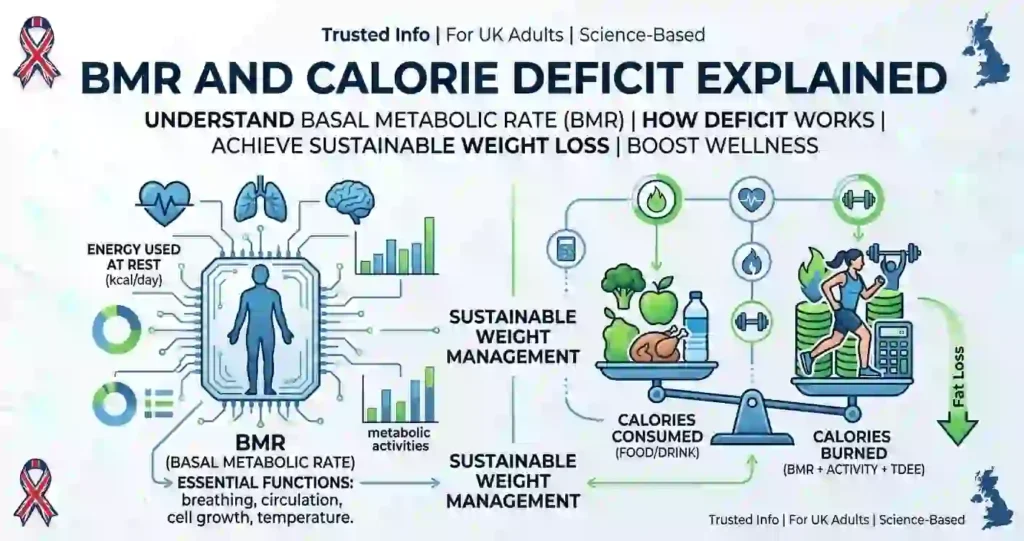
At the heart of sustainable weight management are two foundational concepts: Basal Metabolic Rate (BMR) and a calorie deficit.
Understanding how your body burns energy at rest (BMR) gives you the baseline you need to determine how much energy you burn across an entire day (TDEE). From there, you can establish an intelligent, sustainable calorie deficit that promotes fat loss without sacrificing your energy, health, or relationship with food.
Key Takeaway: BMR is the energy your body needs just to stay alive. It is not the total number of calories you burn in a day, nor is it the target number of calories you should eat to lose weight.
While creating a calorie deficit is a proven method for driving body fat reduction, individual results will always vary. Factors such as genetics, activity levels, sleep quality, and body composition all play a role in how your body responds. Let us break down the science of BMR and calorie deficits so you can build a weight-loss strategy that actually works for your life.
What Is BMR?
Basal Metabolic Rate (BMR) represents the absolute minimum amount of energy (measured in calories) your body needs to maintain basic life-sustaining functions while completely at rest.
Think of your body as a car engine. Even when the car is parked at a red light with the foot off the accelerator, the engine is still idling and consuming fuel. Your BMR is your body’s “idling speed.”
Often used interchangeably with resting metabolism or resting energy expenditure (REE), BMR accounts for the calories burned at rest over a 24-hour period. For most people, BMR makes up the largest slice of their total daily energy output—typically accounting for 60% to 75% of all the calories burned in a single day.
+-----------------------------------------------------------------------+
|                    TOTAL DAILY ENERGY EXPENDITURE                     |
|                                                                       |
|  +-----------------------------------+ +---------+ +-------+ +-----+  |
|  |     Basal Metabolic Rate (BMR)    | |  NEAT   | |  EAT  | | TEF |  |
|  |             60% - 75%             | | 15%-20% | | 5%-10%| | ~10%|  |
|  +-----------------------------------+ +---------+ +-------+ +-----+  |
|               Resting                   Non-Exercise  Exercise  Digestion
+-----------------------------------------------------------------------+
What Does BMR Include?
Your body is constantly working behind the scenes. Even when you are lying completely still in a dark room, your organs are consuming significant amounts of fuel to keep you alive.
Your BMR covers the energy required for:
- Respiration: The muscular work of your lungs expanding and contracting.
- Circulation: Your heart pumping blood throughout your cardiovascular system.
- Cellular production and repair: Synthesising proteins, replacing old cells, and maintaining ion gradients across cell membranes.
- Brain function: Your nervous system using glucose to transmit signals.
- Organ maintenance: The continuous metabolic processes of your liver, kidneys, and internal organs.
- Thermoregulation: Maintaining a stable internal body temperature (around 37°C).
Because these biological processes never take a break, your BMR continues uninterrupted even while you are asleep or completely inactive.
What BMR Does Not Include
It is equally important to understand what BMR leaves out. BMR does not include:
- Walking across a room, brushing your teeth, or fidgeting (Non-Exercise Activity Thermogenesis, or NEAT).
- Planned physical exercise like running, weightlifting, or swimming (Exercise Activity Thermogenesis, or EAT).
- The energy required to digest, absorb, and metabolise the food you eat (Thermic Effect of Food, or TEF).
What Is a Calorie Deficit?
A calorie deficit occurs when you consume fewer calories from food and drink than your body expends through all its physiological functions and physical movements over a given period.
The fundamental law of energy balance governs weight management:
$$\text{Energy In} < \text{Energy Out} = \text{Calorie Deficit}$$
When you maintain an energy deficit over time, your body must source the extra energy it needs from internal stores—primarily stored body fat.
       CALORIE BALANCE                CALORIE DEFICIT (Weight Loss)

     [ Food & Drink In ]                  [ Food & Drink In ]
            ||                                   |
            ||                                   v
            \/                            +--------------+
     +--------------+                     | ENERGY IN    |
     | ENERGY IN    |                     +--------------+
     +--------------+                            |
            ||                                   | (Energy Shortfall)
            ||                                   v
     +--------------+                     +--------------+
     | ENERGY OUT   |                     | STORED FAT   |
     +--------------+                     | RELEASES     |
            ||                            | ENERGY       |
            \/                            +--------------+
   (Weight Stays Same)                           |
                                                 v
                                          +--------------+
                                          | ENERGY OUT   |
                                          +--------------+
How Does a Calorie Deficit Cause Weight Loss?
When your body detects an energy shortfall, it mobilises triacylglycerols (stored triglycerides) from adipose (fat) tissue. Enzymes break these fat cells down into fatty acids and glycerol, which enter the bloodstream to be converted into usable adenosine triphosphate (ATP)—the currency of cellular energy.
However, it is crucial to distinguish between fat loss and scale weight loss:
- Short-term scale weight changes: Dropping 2 kg in three days is rarely pure fat loss. Scale fluctuations on a day-to-day basis are primarily driven by shifts in water weight, intestinal contents, and stored carbohydrate reserves (glycogen). Every gram of glycogen stored in human muscle and liver tissue holds roughly 3 to 4 grams of water. When you start eating fewer calories or carbohydrates, your body burns through glycogen, dropping water weight quickly.
- Long-term body composition changes: True body fat reduction is a gradual process. It requires a consistent, sustained calorie deficit over weeks and months rather than days.
BMR vs Calorie Deficit: What’s the Difference?
A common point of confusion for beginners is mixing up BMR with a calorie deficit.
- BMR is a metric or estimation of your baseline metabolic expenditure at complete rest. It tells you what your body burns just staying alive.
- A Calorie Deficit is an actionable strategy where you consume less energy than your total daily burn.
Eating below your BMR is not the same thing as creating a safe, effective calorie deficit. Eating fewer calories than your BMR deprives your body of the baseline energy required for basic organ function, which can lead to severe fatigue, muscle loss, and nutrient deficiencies.
To understand how these metrics relate to one another, review this comparison:
| Metric | Full Name / Concept | What It Measures | Typical Role in Weight Loss |
| BMR | Basal Metabolic Rate | Calories burned at absolute rest for organ survival. | Sets the floor for your baseline energy needs. |
| TDEE | Total Daily Energy Expenditure | Total calories burned in 24 hours (BMR + all activity + digestion). | Represents your actual daily energy output. |
| Maintenance Calories | Maintenance Energy Requirement | The exact calorie intake required to keep your body weight stable. | Equal to your TDEE. |
| Calorie Deficit | Energy Shortfall | Consuming fewer calories than your TDEE/Maintenance level. | The mechanism that forces your body to burn stored body fat. |
BMR vs TDEE
To plan an effective weight-loss diet, Total Daily Energy Expenditure (TDEE) is a far more useful figure than BMR alone.
$$TDEE = BMR + NEAT + EAT + TEF$$
Where:
- BMR: Basal Metabolic Rate
- NEAT: Non-Exercise Activity Thermogenesis (walking, standing, chores)
- EAT: Exercise Activity Thermogenesis (gym workouts, sports, intentional exercise)
- TEF: Thermic Effect of Food (energy spent digesting macronutrients)
+--------------------------------------------------------------------+
|                HOW TDEE IS CALCULATED (TOTAL BURN)                 |
|                                                                    |
|  [ BMR ~65% ]  +  [ NEAT ~15% ]  +  [ EAT ~10% ]  +  [ TEF ~10% ]    |
|  Resting Organs    Daily Movement     Exercise         Digestion   |
|                                                                    |
|  ================================================================  |
|                      = YOUR TDEE (e.g., 2,200 kcal)                |
+--------------------------------------------------------------------+
Because TDEE accounts for your movement throughout the day, your daily calorie needs for maintenance match your TDEE. Setting your weight-loss target relative to TDEE ensures you account for all the movement and activity you do in a day.
How to Calculate Your BMR
You can estimate your BMR using validated mathematical equations that take into account your age, biological sex, height, and weight. While clinical laboratories measure exact resting metabolism using indirect calorimetry (measuring oxygen consumed and carbon dioxide exhaled), predictive equations offer a practical, highly accurate starting point for home use.
The most widely accepted and accurate equation for the general population is the Mifflin-St Jeor Equation, developed in 1990.
BMR Calculation Formula
The Mifflin-St Jeor formula calculates BMR in kilocalories (kcal) per day using weight in kilograms (kg), height in centimetres (cm), and age in years:
For Men:
$$\text{BMR} = (10 \times \text{weight in kg}) + (6.25 \times \text{height in cm}) – (5 \times \text{age in years}) + 5$$
For Women:
$$\text{BMR} = (10 \times \text{weight in kg}) + (6.25 \times \text{height in cm}) – (5 \times \text{age in years}) – 161$$
How do you calculate BMR?
To calculate BMR manually using the Mifflin-St Jeor equation:
- Multiply your weight in kilograms by 10.
- Multiply your height in centimetres by 6.25 and add it to the first number.
- Multiply your age in years by 5 and subtract it from the total.
- For men, add 5; for women, subtract 161.
The resulting number is an estimate of your daily resting metabolic expenditure.
Why These Inputs Matter:
- Body Weight: More total tissue requires more metabolic energy to support.
- Height: Taller individuals have a larger surface area and lean body mass, raising baseline energy expenditure.
- Age: As human beings age, baseline metabolic rate gradually drops, largely due to age-related muscle loss (sarcopenia).
- Sex: Men typically possess higher proportions of lean skeletal muscle mass and lower essential fat percentages than women, resulting in a slightly higher average BMR per kilogram of body weight.
Example BMR Calculation
Let us walk through an example using a hypothetical individual, Sarah:
- Sex: Female
- Age: 35 years old
- Height: 168 cm (5 ft 6 in)
- Weight: 70 kg (11 st 0 lb / 154 lbs)
Step-by-step application of the Mifflin-St Jeor formula:
$$\text{BMR} = (10 \times 70) + (6.25 \times 168) – (5 \times 35) – 161$$
$$\text{BMR} = 700 + 1050 – 175 – 161$$
$$\text{BMR} = 1,414 \text{ kcal/day}$$
What this result means: Sarah’s body burns approximately 1,414 calories per day at complete rest.
If Sarah stayed in bed all day without moving a muscle, she would still need roughly 1,414 calories to support her vital organs. This number is not her target intake for weight loss—it is simply her metabolic starting point.
How to Calculate a Calorie Deficit Using BMR
To set a practical weight-loss target, follow a simple three-step process:
[ Step 1: Calculate BMR ]
           │
           ▼
[ Step 2: Multiply by Activity Level to find TDEE ]
           │
           ▼
[ Step 3: Subtract Deficit from TDEE = Daily Target ]
Directly subtracting 500 calories from your BMR is a critical mistake that results in an excessively severe, unmaintainable calorie restriction. Always work backward from TDEE, not BMR.
Step 1 – Calculate Your BMR
Using the Mifflin-St Jeor equation (or an online BMR calculator), establish your baseline resting metabolism.
Using Sarah’s numbers from above, her BMR = 1,414 kcal.
Step 2 – Estimate Your TDEE
To convert your resting baseline (BMR) into your total daily burn (TDEE), multiply your BMR by a standard Physical Activity Level (PAL) factor:
| Activity Level | Description | Multiplier |
| Sedentary | Desk job, little to no deliberate exercise, minimal daily walking. | BMR × 1.2 |
| Lightly Active | Light exercise or sports 1–3 days/week, moderate walking. | BMR × 1.375 |
| Moderately Active | Moderate exercise or sports 3–5 days/week, active daily routine. | BMR × 1.55 |
| Very Active | Hard exercise or physical sports 6–7 days/week, active physical job. | BMR × 1.725 |
| Extra Active | Very heavy physical job or twice-daily intensive training sessions. | BMR × 1.9 |
Assuming Sarah works an office job in London but goes to the gym 3 times a week, she fits the Lightly Active profile:
$$\text{TDEE} = 1,414 \text{ (BMR)} \times 1.375 \text{ (Activity Factor)} = 1,944 \text{ kcal/day}$$
Sarah burns approximately 1,944 calories per day in total. This is her maintenance calorie requirement.
Step 3 – Create a Calorie Deficit
Subtract a moderate number of calories from your TDEE to establish a safe daily intake target.
A moderate, effective deficit ranges from 15% to 20% below TDEE (or roughly 300 to 500 calories per day for most people).
   SARAH'S DAILY ENERGY BUDGET (1,944 kcal TDEE)
   +---------------------------------------+-------------+
   |   TARGET INTAKE (1,444 kcal/day)      | DEFICIT     |
   |   Food and drink consumed             | 500 kcal    |
   +---------------------------------------+-------------+
   |<----------- Energy In ----------->|<-- Body Fat -->|
For Sarah:
$$\text{Daily Weight Loss Target} = 1,944 \text{ (TDEE)} – 500 \text{ (Deficit)} = 1,444 \text{ kcal/day}$$
By eating 1,444 calories daily, Sarah creates a sustainable 500-calorie daily deficit without dipping below her resting baseline (BMR: 1,414 kcal).
How Many Calories Should You Eat Below Your BMR?
You should generally not eat below your calculated BMR.
BMR represents what your body requires for vital organ operations at rest. When you restrict your food intake below your BMR for extended periods, your body is forced to adapt to severe energy scarcity.
Can You Eat Below Your BMR?
While eating below your BMR for a day or two will not cause permanent damage, doing so over weeks or months can trigger several unwanted side effects:
- Pervasive Fatigue and Brain Fog: Your central nervous system operates on reduced energy, leaving you sluggish, irritable, and unfocused.
- Elevated Hunger and Craving Signals: Severe calorie restriction spikes ghrelin (the hunger hormone) while suppressing leptin (the satiety hormone), driving intense cravings.
- Loss of Muscle Mass: When energy intake is critically low, the body breaks down skeletal muscle tissue alongside fat to supply necessary amino acids and glucose.
- Decreased Daily Movement (NEAT): Your body subconsciously reduces fidgeting, pacing, and general posture maintenance to conserve energy, lowering your overall daily energy burn.
                  THE RESTRICTIVE DIETING TRAP

          +----------------------------------+
          | Consistently Eat Below BMR       |
          +----------------------------------+
                           |
                           v
          +----------------------------------+
          | Severe Fatigue & Rising Ghrelin  |
          +----------------------------------+
                           |
                           v
          +----------------------------------+
          | Body Cuts NEAT (Fidgeting/Movement)|
          +----------------------------------+
                           |
                           v
          +----------------------------------+
          | TDEE Drops & Binge Risks Increase |
          +----------------------------------+
Always use your TDEE/Maintenance level as your ceiling and your BMR as your general floor when setting a daily calorie target.
How Big Should Your Calorie Deficit Be?
The ideal calorie deficit is one that allows you to lose weight consistently while preserving your energy levels, lean muscle mass, and mental well-being.
       CONSERVATIVE                MODERATE                   AGGRESSIVE
     10-15% Below TDEE          15-25% Below TDEE          > 25% Below TDEE
     (200-300 kcal/day)        (300-500 kcal/day)         (750+ kcal/day)
  +----------------------+   +----------------------+   +----------------------+
  | • Slowest progress   |   | • Recommended balance|   | • Fast scale weight  |
  | • Extremely easy     |   | • Manageable hunger  |   | • High muscle risk   |
  | • Minimal fatigue    |   | • Preserves muscle   |   | • Severe fatigue     |
  +----------------------+   +----------------------+   +----------------------+
Comparing Deficit Sizes
- Small Deficit (10–15% below TDEE):
- Target: ~0.25 kg (0.5 lbs) of fat loss per week.
- Pros: Minimal hunger, great athletic performance, very high long-term adherence.
- Cons: Slower visible progress on the scale.
- Moderate Deficit (15–20% below TDEE):
- Target: ~0.5 kg (1 lb) of fat loss per week.
- Pros: The optimal balance for most adults. Visible weekly progress with manageable hunger.
- Cons: Requires consistent tracking and preparation.
- Large Deficit (>25% below TDEE):
- Target: >1 kg (2+ lbs) of loss per week.
- Pros: Rapid reduction in scale weight.
- Cons: High risk of muscle loss, severe cravings, fatigue, and potential nutrient deficiencies.
Is a 500-Calorie Deficit Safe?
For most moderately active UK adults, a 500-calorie daily deficit is safe, practical, and effective. Historically, losing 1 lb of tissue (~0.45 kg) was thought to require a cumulative 3,500-calorie deficit per week ($500 \times 7 \text{ days}$). While human metabolism is dynamic rather than perfectly linear, a 500-calorie deficit remains a useful baseline.
Important Safety Note: If you have underlying health conditions, are pregnant or breastfeeding, have a history of disordered eating, or plan to drop your daily intake below 1,200 kcal (women) or 1,500 kcal (men), consult a qualified dietitian or registered healthcare professional first.
BMR, Calorie Deficit and Weight Loss Plateaus
It is common to hit a point where scale weight stops moving despite following your initial calorie target. This is known as a weight-loss plateau.
+--------------------------------------------------------------------+
|                   WHY WEIGHT LOSS PLATEAUS OCCUR                   |
|                                                                    |
|   Higher Starting Weight                 Lower Body Weight         |
|   [ BMR: 1,800 kcal ]                   [ BMR: 1,550 kcal ]       |
|   [ TDEE: 2,400 kcal ]                  [ TDEE: 2,000 kcal ]       |
|            │                                     │                 |
|            ▼                                     ▼                 |
|   1,900 kcal intake                     1,900 kcal intake          |
|   = 500 kcal Deficit                    = NO DEFICIT               |
|   (Weight Drops)                        (Plateau Reached)          |
+--------------------------------------------------------------------+
Does BMR Decrease When You Lose Weight?
Yes, BMR decreases naturally as you lose body weight.
A lighter body requires less energy to move and maintain than a heavier body. When you lose 10 kg of weight, your metabolic rate decreases simply because there is less tissue to keep alive.
This natural decline is often confused with claims that a metabolism is “broken” or operating in “starvation mode.” In reality, metabolic adaptation—the additional drop in BMR beyond what is explained by weight loss alone—is typically small (around 50 to 100 calories per day) and can be managed through smart programming:
- Perform regular resistance training: Lifting weights provides a strong signal to keep lean muscle tissue, keeping your metabolic rate higher as you drop fat.
- Eat sufficient dietary protein: Consuming 1.6 to 2.2 grams of protein per kilogram of body weight helps preserve lean mass and keeps you fuller longer.
- Recalculate calorie needs every 5–10 kg lost: As your weight drops, your TDEE drops too. Adjust your targets down slightly to maintain a consistent deficit.
Factors That Affect BMR and Calorie Needs
Predictive BMR equations give population averages, but individual metabolism varies based on several distinct factors:
+------------------------------------------------------------------+
|                    KEY FACTORS INFLUENCING BMR                   |
|                                                                  |
|   [ Body Composition ]  -->  Muscle burns more than fat at rest  |
|   [ Age ]               -->  Gradual decline due to muscle loss  |
|   [ Biological Sex ]    -->  Differences in average lean mass    |
|   [ Height & Weight ]   -->  Larger body surface = higher burn   |
|   [ Hormonal Status ]   -->  Thyroid function, genetics          |
+------------------------------------------------------------------+
1. Muscle Mass & Body Composition
Skeletal muscle mass is far more metabolically active than adipose (fat) tissue.
- 1 kg of muscle tissue burns roughly 10 to 13 calories per day at complete rest.
- 1 kg of fat tissue burns roughly 4.5 calories per day at rest.
Building lean muscle through strength training gradually increases your baseline BMR, giving you a slightly higher metabolic engine overall.
2. Age
Starting in your late twenties or early thirties, average BMR declines by roughly 1% to 2% per decade. However, this is largely due to age-related muscle loss and lower physical activity rather than a sudden slowdown in cellular machinery. Staying active and lifting weights into older age helps preserve metabolic rate.
3. Biological Sex
On average, men have 10% to 15% more lean muscle tissue and less essential body fat than women of the same height and weight, leading to a higher resting metabolic rate per kilogram.
4. Genetics & Medical Conditions
Genetic variations, endocrine function (especially thyroid hormones such as T3 and T4), chronic illnesses, and medications can all influence resting energy expenditure. Conditions like hypothyroidism lower BMR, whereas hyperthyroidism elevates it.
Common Mistakes When Using BMR for Weight Loss
Avoid these three frequent pitfalls when using BMR and calorie targets for weight loss:
+--------------------------------------------------------------------+
|                      3 MAJOR BMR MISTAKES                          |
|                                                                    |
|  [ MISTAKE 1 ] Treating BMR as your daily intake target.           |
|  [ MISTAKE 2 ] Overestimating activity levels (bloating TDEE).     |
|  [ MISTAKE 3 ] Assuming online calculators are 100% exact.         |
+--------------------------------------------------------------------+
Mistake 1: Confusing BMR With Maintenance Calories
Treating BMR as your total calorie target causes you to ignore all non-exercise movement, walking, and physical workouts. If your BMR is 1,500 kcal and your TDEE is 2,200 kcal, eating 1,500 kcal creates an aggressive 700-calorie deficit. For most people, setting an intake target right at BMR leads to unnecessary hunger, poor gym performance, and rapid burnout.
Mistake 2: Relying Too Heavily on Calculator Results
A BMR or TDEE formula provides an estimate, not a clinical guarantee. Most formulas carry an error margin of roughly $\pm 10\%$. If a calculator estimates your TDEE at 2,200 calories, your actual burn could easily be 2,000 or 2,400 calories.
Always treat your initial calculator output as a starting hypothesis. Track your average body weight and daily intake over 2 to 3 weeks, then adjust based on real-world trends.
Mistake 3: Overestimating Physical Activity Levels
It is easy to select “Very Active” on a calculator because you work out for an hour 4 days a week. However, if you sit at a desk for the remaining 23 hours of the day, your overall profile is closer to “Lightly Active.” Overestimating activity inflates your TDEE, leading to a calorie target that is too high to create a real deficit.
How to Use a BMR Calculator for Weight Loss
Using an online BMR calculator is the fastest way to kickstart your plan. Here is how to gather your details and track your results effectively.
What Information Do You Need for a BMR Calculator?
To get an accurate result, collect the following data points before using a calculator:
- Age: Measured in exact years.
- Biological Sex: Needed for accurate hormonal and body composition assumptions in equations.
- Height: Measured accurately in centimetres or feet/inches without shoes.
- Weight: Measured in kilograms or pounds on a digital scale in the morning after using the bathroom and before eating.
- Activity Level: An honest assessment of your non-exercise movement and weekly workout routine.
How Often Should You Recalculate BMR?
There is no need to recalculate your BMR every single week. Minor scale fluctuations are driven by water weight rather than structural tissue changes.
Recalculate your BMR and TDEE when:
- You have lost 5% to 10% of your total body weight (e.g., losing 5 kg to 8 kg).
- Your weekly weight loss average flatlines for 3 consecutive weeks despite consistent logging.
- Your daily physical activity or occupational activity changes significantly (e.g., changing from a desk job to an active job).
BMR and Calorie Deficit: A Practical Example
Let us bring all these concepts together with a practical example using a hypothetical person named David.
Profile:
- Sex: Male | Age: 40 | Height: 180 cm (5 ft 11 in) | Weight: 90 kg (14 st 2 lb / 198 lbs)
- Activity: Desk-bound job in Manchester, lifts weights 3 times a week.
+--------------------------------------------------------------------+
|                   DAVID'S CALORIE STEP-BY-STEP                     |
|                                                                    |
|  1. BMR Calculation:                                               |
|     (10 x 90) + (6.25 x 180) - (5 x 40) + 5 = 1,830 kcal           |
|                                                                    |
|  2. TDEE Calculation (Lightly Active PAL 1.375):                   |
|     1,830 x 1.375 = 2,516 kcal Maintenance                         |
|                                                                    |
|  3. Calorie Deficit Target (Moderate ~500 kcal drop):              |
|     2,516 - 500 = 2,016 kcal Weight-Loss Target                    |
+--------------------------------------------------------------------+
The Strategy Breakdown:
- BMR Baseline: David burns 1,830 calories at rest.
- Maintenance Target: David burns 2,516 calories in total throughout the day.
- Weight Loss Target: By eating ~2,000 calories daily, David creates a manageable 500-calorie deficit. He remains comfortably above his BMR (1,830 kcal), ensuring his body receives enough energy for basic functions while steadily burning fat.
BMR and Calorie Deficit FAQs
Is a calorie deficit based on BMR or TDEE?
A calorie deficit is always calculated relative to your TDEE (Total Daily Energy Expenditure), which represents your total daily burn. BMR measures only resting energy requirements, so subtracting calories from BMR alone creates an overly restrictive, unsustainable target.
How many calories below BMR should I eat?
In most cases, you should not eat below your calculated BMR. Your daily calorie target should fall between your BMR (your baseline floor) and your TDEE (your maintenance ceiling).
Can I lose weight if I eat below my BMR?
You will lose scale weight rapidly by eating below your BMR, but much of that weight will come from water and muscle tissue rather than just fat. Extremely low calorie intakes lead to intense hunger, lethargy, muscle loss, and severe long-term adherence struggles.
Is a 500-calorie deficit enough to lose weight?
Yes. A daily deficit of 500 calories is a standard, sustainable recommendation for healthy adults. It typically yields approximately 0.5 kg (1 lb) of fat loss per week without causing severe fatigue or muscle wasting.
What is the difference between BMR and TDEE?
BMR is the number of calories your body burns at complete rest just staying alive. TDEE is your total daily burn, including BMR plus walking, working, exercising, and digesting food.
Does BMR increase when you build muscle?
Yes. Muscle tissue is more metabolically active than fat tissue. Gaining skeletal muscle increases your overall BMR, allowing you to burn slightly more calories at rest.
Does BMR decrease when you lose weight?
Yes. A smaller body requires less total energy to maintain. As you lose weight, your BMR naturally decreases, which is why periodic recalculations of your TDEE are essential during longer weight-loss journeys.
How accurate are BMR calculators?
Predictive equations like the Mifflin-St Jeor formula are generally accurate within $\pm 10\%$ for the majority of healthy adults. They serve as an excellent baseline, though individual real-world progress should always dictate subsequent adjustments.
What is the best calorie deficit for weight loss?
The best calorie deficit is a moderate deficit of 15% to 20% below your TDEE. This range promotes steady fat loss while keeping hunger manageable, preserving muscle tissue, and maintaining overall energy levels.
Should I recalculate my BMR as I lose weight?
Yes. It is good practice to recalculate your BMR and TDEE whenever you experience a noticeable drop in body weight (around 5% to 10% of total body mass) or when your weight loss reaches a plateau for several weeks.
Conclusion: Understanding BMR Makes Calorie Tracking Easier
Successful, sustainable fat loss does not require extreme starvation diets or guessing games. By taking the time to understand your metabolic foundations, you transform weight loss into an manageable equation:
- BMR tells you what your body needs at absolute rest.
- TDEE accounts for your total daily movement and lifestyle to establish your maintenance baseline.
- A moderate calorie deficit subtracted from your TDEE encourages your body to burn stored fat while keeping your health, performance, and daily energy intact.
Avoid using your BMR as an ultra-low intake target. Instead, use it as a reliable starting point, build a moderate daily deficit relative to your total burn, prioritize protein and strength training, and focus on steady progress over quick fixes.

Ehatasamul Alom is a dedicated health-tech enthusiast and the co-founder of BMRCalculator. With a passion for metabolic science, he focuses on providing accurate health data for the UK community. Ehatasamul ensures that every tool and guide aligns with NHS standards and public health research. His mission is to simplify complex biological data, helping British residents make informed decisions about their fitness, calorie needs, and long-term wellness. When not analyzing health trends, he explores the latest innovations in wearable fitness technology.