Calculating daily calorie targets can feel overwhelming when starting a body transformation. Countless calculators, conflicting social media advice, and complex jargon often lead to confusion rather than clarity.
At the center of energy intake management is Basal Metabolic Rate (BMR). BMR represents the baseline energy your body requires simply to stay alive. Understanding BMR—and how it differs from total daily energy demands—is essential whether your goal is dropping body fat, building lean muscle mass, or transforming your overall body composition.
To reach specific fitness targets, calorie intake must be adjusted relative to total energy expenditure:
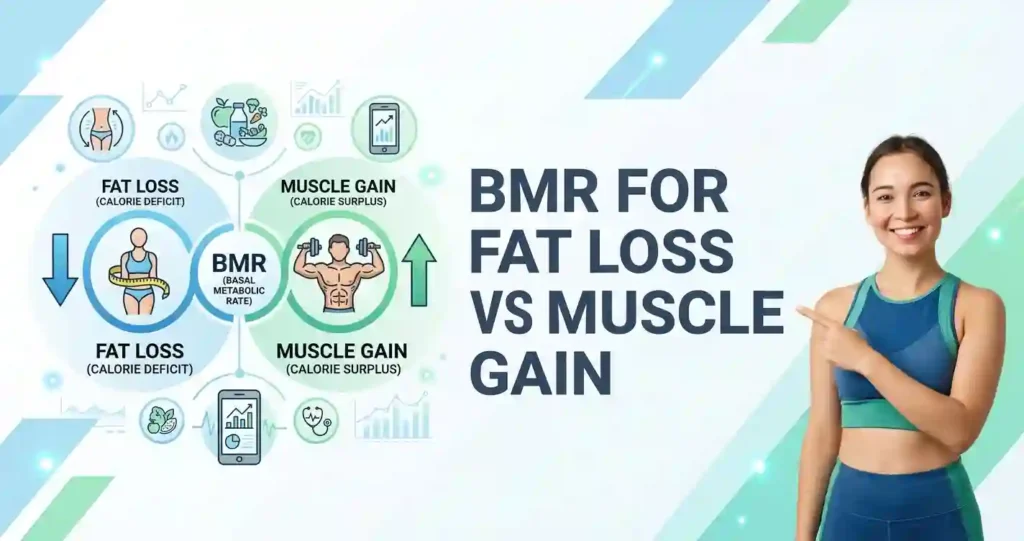
- Fat Loss: Requires a controlled calorie deficit (consuming fewer calories than burned), prompting the body to convert stored energy—primarily fat—into usable fuel.
- Muscle Gain: Requires a calorie surplus (consuming slightly more calories than burned), providing the extra energy needed to construct new muscle tissue efficiently.
- Maintenance Calories: The exact number of calories consumed to match total energy expenditure, keeping body weight stable.
Key Rule: Your BMR is a starting calculation, not a final diet plan. Eating directly at your BMR ignores daily physical activity, movement, and exercise, often leading to inaccurate calorie targets.
What Is BMR and Why Does It Matter?
Basal Metabolic Rate (BMR) is the minimum amount of energy (measured in calories or kilojoules) your body burns at rest over 24 hours to maintain vital, life-sustaining functions. Even during complete rest in a temperature-controlled environment, your body constantly expends energy on processes such as:
- Continuous heart pumping and blood circulation
- Lungs contracting and expanding to inhale oxygen
- Brain and neurological signaling
- Cell repair, protein turnover, and hormone synthesis
- Core body temperature regulation
  ┌──────────────────────────────────────────────────────────┐
  │                 Basal Metabolic Rate (BMR)               │
  │     (Essential survival functions: breathing, organs)    │
  └────────────────────────────┬─────────────────────────────┘
                               │
                               ▼  + Non-Exercise Movement (NEAT)
                               ▼  + Exercise / Sports (EAT)
                               ▼  + Digestion Cost (TEF)
  ┌──────────────────────────────────────────────────────────┐
  │           Total Daily Energy Expenditure (TDEE)          │
  │               (= Your Maintenance Calories)              │
  └──────────────────────────────────────────────────────────┘
Key Factors Influencing BMR
BMR varies widely between individuals due to biological and physiological differences:
- Body Size and Surface Area: Larger individuals have higher resting energy demands because they possess more tissue requiring cellular maintenance.
- Body Composition: Muscle mass is significantly more metabolically active at rest than fat mass. An individual with higher muscle mass maintains a higher BMR than a same-weight counterpart with higher body fat.
- Biological Sex: Men generally possess higher lean muscle mass and lower average body fat percentages than women, resulting in a BMR that is typically 5% to 10% higher on average.
- Age: BMR gradually decreases with age. This reduction is primarily driven by natural losses in lean muscle mass (sarcopenia) and shifting hormonal profiles.
- Genetics and Thyroid Function: Inherited metabolic variance and thyroid hormone levels ($T_3$ and $T_4$) directly regulate resting cellular respiration rates.
Disambiguating Metabolic Terms
| Term | Full Name | Definition | Practical Application |
| BMR | Basal Metabolic Rate | Baseline calories burned strictly at rest under laboratory conditions. | Serves as the foundation for metabolic calculations. |
| RMR | Resting Metabolic Rate | Similar to BMR, but measured under less strict, real-world resting conditions. | Slightly higher than BMR; used interchangeably in practice. |
| TDEE | Total Daily Energy Expenditure | Total calories burned in 24 hours across all activities and bodily processes. | The true baseline for setting fat loss or muscle gain targets. |
| Maintenance Calories | — | The exact calorie intake required to match your TDEE and keep weight stable. | The reference point from which deficits or surpluses are applied. |
BMR vs TDEE: What Is the Difference?
To calculate daily calorie needs accurately, you must distinguish between baseline metabolic survival needs and total daily energy expenditure.
$$\text{TDEE} = \text{BMR} + \text{NEAT} + \text{EAT} + \text{TEF}$$
- BMR (Basal Metabolic Rate): Accounts for approximately 60% to 70% of total daily energy expenditure in average individuals.
- NEAT (Non-Exercise Activity Thermogenesis): Energy expended through non-structured daily movement—walking to the high street, cleaning, fidgeting, carrying shopping bags, or standing. NEAT accounts for 15% to 30% of daily energy expenditure.
- EAT (Exercise Activity Thermogenesis): Energy burned during structured physical workouts, such as weightlifting sessions, running, or cycling classes (typically 5% to 15% of daily expenditure).
- TEF (Thermic Effect of Food): Energy expended digesting, absorbing, and processing dietary nutrients (roughly 10% of total intake, with protein requiring the most energy to break down).
   Total Daily Energy Expenditure Breakdown
   ┌───────────────────────────────────────────────┐
   │ BMR (~60-70%)                                 │
   ├───────────────────────────────────────────────┤
   │ NEAT (~15-20%)                                │
   ├───────────────────────────────────────────────┤
   │ TEF (~10%)                                    │
   ├───────────────────────────────────────────────┤
   │ EAT (~5-10%)                                  │
   └───────────────────────────────────────────────┘
Using BMR alone to establish daily targets creates an unintentional calorie deficit that is far too steep. Under-eating to match resting BMR ignores all physical activity, leading to chronic fatigue, muscle loss, nutrient deficiencies, and poor workout recovery.
Can BMR Tell You How Many Calories to Eat?
No. BMR alone cannot serve as a daily calorie target.
BMR represents energy expenditure if you were confined to bed for 24 hours without moving, eating, or digesting food. Using BMR as a direct daily target overlooks everyday energy expenditure.
Establishing an effective nutritional plan requires a sequential approach:
- Estimate BMR using validated metabolic formulas.
- Multiply BMR by an activity factor to establish TDEE (Maintenance Calories).
- Adjust calorie targets up or down from TDEE based on specific goals (fat loss or muscle gain).
BMR for Fat Loss
Fat loss requires a sustained calorie deficit, forcing the body to mobilize stored energy—primarily body fat—to bridge the gap between daily energy intake and expenditure.
Because BMR represents essential baseline energy expenditure, a safe calorie target should be calculated from TDEE rather than BMR alone.
                  ┌──────────────────────────────┐
                  │          TDEE Level          │
                  └──────────────┬───────────────┘
                                 │
                   ─── ─── ─── ──┼─── ─── ─── ───  <-- Calorie Deficit Target
                                 │                  (Safe Fat Loss Zone)
                                 │
                  ┌──────────────┴───────────────┐
                  │          BMR Level           │
                  └──────────────────────────────┘
When entering a calorie deficit, prioritize two main variables to ensure energy comes from fat storage rather than muscle mass:
- Adequate Protein Intake: Consuming sufficient protein supports muscle protein synthesis (MPS) and protects lean mass during energy deficits.
- Progressive Resistance Training: Lifting weights sends a strong mechanical signal to the body to retain functional muscle mass while burning body fat.
How to Calculate Calories for Fat Loss
Setting up a safe, effective, and sustainable fat loss plan follows a three-step process:
Step 1: Calculate BMR ──► Step 2: Estimate TDEE ──► Step 3: Deduct 10–20%
Step 1: Establish Baseline BMR
Use a standardized equation (such as Mifflins-St Jeor) to estimate baseline resting expenditure.
Step 2: Calculate TDEE
Multiply BMR by a realistic activity factor reflecting job demands, daily step counts, and structured workouts.
Step 3: Apply a Moderate Calorie Deficit
Subtract 10% to 20% (typically 300 to 500 kcal) from total estimated TDEE.
Example: An individual with an estimated BMR of 1,600 kcal and a calculated TDEE of 2,300 kcal should target approximately 1,800 kcal per day for gradual, sustainable fat loss.
Avoid severe calorie restriction. Unnecessarily aggressive deficits increase muscle wasting, spike hunger hormones like ghrelin, lower daily movement (NEAT), and impair long-term diet adherence.
Does a Calorie Deficit Lower BMR?
Yes, prolonged weight loss causes a natural reduction in BMR.
This reduction stems from two distinct mechanisms:
- Loss of Total Mass: A smaller body requires fewer calories to move and maintain. Losing 10 kg of weight naturally lowers daily resting energy needs.
- Adaptive Thermogenesis: Often called “metabolic adaptation,” this represents a protective evolutionary response. When energy intake drops for extended periods, the body conserves energy by suppressing thyroid activity, decreasing heart rate, reducing core temperature, and lowering unconscious movement (NEAT).
Metabolic adaptation does not mean your metabolism is permanently damaged. It simply indicates that energy expenditure has adapted to a lower body weight and restricted energy intake.
Periodically recalculating BMR and TDEE every 4 to 6 kg of weight loss helps prevent progress plateaus and keeps calorie targets aligned with current body mass.
BMR for Muscle Gain
Building lean tissue requires consistent physical stimuli, recovery resources, and sufficient energy availability. To build muscle efficiently, you must combine:
- Progressive overload through resistance training
- Sufficient daily protein intake
- A controlled calorie surplus
                  ┌──────────────────────────────┐
                  │   Calorie Surplus Target     │  <-- Lean Muscle Gain Zone
                  ─── ─── ─── ──┼─── ─── ─── ───
                                │
                  ┌─────────────┴────────────────┐
                  │          TDEE Level          │
                  └──────────────────────────────┘
Eating at or below TDEE forces the body to build muscle using internal energy stores, which significantly slows down growth. A surplus supplies the raw fuel needed to synthesize new muscular proteins without forcing the body to break down existing tissues.
However, unlimited eating does not speed up muscle growth. The human body can only build a finite amount of muscle tissue each month. Consuming an excessively high surplus simply accelerates fat storage.
How to Calculate Calories for Muscle Gain
To support hypertrophy while minimizing unnecessary fat gain, follow a structured, incremental approach:
- Calculate BMR and estimate TDEE (Maintenance Calories).
- Add a controlled surplus of 5% to 10% above maintenance (typically 200 to 300 kcal daily).
- Monitor real-world progress over time rather than relying solely on initial formulas.
Recommended Rates of Weight Gain
- Beginners: Target a gain of approximately 1% to 1.5% of total body weight per month.
- Intermediate/Advanced: Target a gain of approximately 0.5% to 1% of total body weight per month.
Track body weight trends, gym performance, and waist measurements bi-weekly. If strength increases in key exercises while waist measurements remain stable, your calorie surplus is supporting lean muscle growth.
How Much Protein Do You Need to Build Muscle?
Protein supplies essential amino acids—the fundamental structural building blocks required for repair and muscle protein synthesis.
Dietary Protein Intake ──► Broken down into Amino Acids ──► Muscle Repair & Hypertrophy
For active individuals, research-backed daily protein targets range between 1.6 and 2.2 grams per kilogram of total body weight.
Great Protein Sources (UK Focus)
- Animal-Based: Free-range eggs, Greek yogurt, skyr, cottage cheese, lean beef mince (5% fat), chicken breast, turkey breast, salmon fillets, cod, canned tuna in spring water.
- Plant-Based: Firm tofu, tempeh, green lentils, chickpeas, edamame beans, kidney beans, quinoa, high-protein plant milk, vegan protein powders (pea/hemp isolates).
Focus on meeting overall daily protein targets through whole foods, spacing intake across 3 to 5 meals throughout the day. Supplements like whey or plant-protein powders are convenient tools, but they should complement a varied whole-food diet rather than replace it.
BMR for Fat Loss vs Muscle Gain: Key Differences
While your physical BMR value remains identical at any given weight regardless of your fitness goal, the overall nutritional and calorie strategy changes completely.
| Parameter | Fat Loss Goal | Muscle Gain Goal | Body Recomposition |
| Calorie Target | Calorie Deficit (10–20% below TDEE) | Calorie Surplus (5–10% above TDEE) | Around Maintenance ($\pm 5\%$ TDEE) |
| Primary Goal | Mobilize stored body fat | Synthesize new muscle mass | Drop fat and gain muscle concurrently |
| Protein Requirement | High (1.8–2.4 g/kg to preserve muscle) | Moderate-High (1.6–2.2 g/kg for growth) | Very High (2.0–2.4 g/kg for recovery) |
| Resistance Training | Essential for signaling muscle retention | Primary driver of progressive overload | Essential driver for both stimuli |
| Cardiovascular Activity | Useful tool to increase total TDEE | Kept moderate to avoid burning surplus | Moderate levels for heart health |
| BMR Behavior | Decreases over time as body mass drops | Increases gradually as lean mass grows | Remains relatively stable |
What Is Body Recomposition?
Body recomposition is the process of losing body fat while simultaneously building muscle mass.
       Fat Loss (- Fat Mass)  +  Hypertrophy (+ Muscle Mass)
       ─────────────────────────────────────────────────────
                   = Body Recomposition
While traditional fitness advice suggests dividing training into strict “bulking” and “cutting” cycles, certain groups can achieve simultaneous fat loss and muscle gain:
- Resistance Training Beginners: Individuals new to lifting respond rapidly to mechanical stimuli due to high neuromuscular sensitivity (“newbie gains”).
- Deconditioned Lifters: Returning lifters who previously held significant muscle mass can rebuild lost tissue quickly thanks to muscle memory.
- Individuals with High Body Fat Levels: High internal body fat stores provide ample energy to drive muscle growth even in a moderate calorie deficit.
Achieving body recomposition requires consistent resistance training, high daily protein intake ($2.0\text{–}2.4\text{ g/kg}$), sufficient rest, and managed stress levels.
Should You Use a Calorie Deficit or Surplus for Recomposition?
Choosing a calorie target for body recomposition depends on your starting body composition and training experience:
                  ┌──────────────────────────────┐
                  │  Determining Recomp Caloric  │
                  │           Strategy           │
                  └──────────────┬───────────────┘
                                 │
           ┌─────────────────────┴─────────────────────┐
           ▼                                           ▼
  Higher Body Fat Level                       Lower Body Fat Level
  (Small Deficit: ~10% below TDEE)            (Maintenance / Small Surplus: +5%)
- Higher Body Fat Levels: Set a small deficit (around 10% below TDEE). The body mobilizes energy from stored body fat to cover the energy gap while using dietary protein to build muscle.
- Lean / Experienced Lifters: Set calories directly at maintenance or a slight surplus (+5% TDEE). Leaner individuals have fewer fat reserves to fuel muscle growth in a deficit.
To track recomposition progress accurately, move beyond scale weight. Scale weight may stay flat while your body transforms. Track progress using waist and limb measurements, progress photos, and gym performance gains.
How to Use BMR to Set Your Calorie Target
Setting up an actionable daily nutrition plan involves three steps.
Step 1 — Calculate Your BMR
Use the validated Mifflin-St Jeor Equation to calculate baseline resting requirements:
$$\text{For Men: } \text{BMR} = (10 \times \text{weight in kg}) + (6.25 \times \text{height in cm}) – (5 \times \text{age in years}) + 5$$
$$\text{For Women: } \text{BMR} = (10 \times \text{weight in kg}) + (6.25 \times \text{height in cm}) – (5 \times \text{age in years}) – 161$$
Worked Example:
- Female, 30 years old, 70 kg, 168 cm tall
- $\text{BMR} = (10 \times 70) + (6.25 \times 168) – (5 \times 30) – 161$
- $\text{BMR} = 700 + 1050 – 150 – 161 = \mathbf{1,439\text{ kcal/day}}$
Step 2 — Estimate Your TDEE
Multiply your calculated BMR by a PAL (Physical Activity Level) multiplier that reflects your lifestyle:
| Activity Level | Description | PAL Multiplier |
| Sedentary | Desk job, little to no exercise, low step count (< 4,000 steps) | $\text{BMR} \times 1.2$ |
| Lightly Active | Light walking, desk job with 1–3 light workouts per week | $\text{BMR} \times 1.375$ |
| Moderately Active | Moderate activity, standing job or 3–5 workouts per week | $\text{BMR} \times 1.55$ |
| Very Active | Physical job, heavy training 6–7 days per week | $\text{BMR} \times 1.725$ |
Continuing the Example:
- BMR = 1,439 kcal
- Activity Level: Moderately Active ($\times 1.55$)
- $\text{TDEE} = 1,439 \times 1.55 = \mathbf{2,230\text{ kcal/day}}$ (Maintenance Target)
Step 3 — Adjust Calories for Your Goal
Adjust your estimated TDEE based on your specific target:
                          Estimated TDEE (e.g., 2,230 kcal)
                                         │
        ┌────────────────────────────────┼────────────────────────────────┐
        ▼                                ▼                                ▼
  Fat Loss Target               Recomposition Target              Muscle Gain Target
  (15% Deficit)                 (At Maintenance)                  (10% Surplus)
  2,230 - 335                     2,230 kcal                        2,230 + 223
  = 1,895 kcal/day                                                = 2,453 kcal/day
How Exercise Affects BMR and Calorie Needs
Exercise impacts energy expenditure through two pathways:
- Direct Burn (EAT): Calories expended directly during a workout session.
- Post-Exercise Oxygen Consumption (EPOC): Energy burned after exercise while the body restores oxygen levels, clears lactate, and repairs tissue.
Heavy resistance training also boosts Non-Exercise Activity Thermogenesis (NEAT) indirectly by elevating overall recovery demands.
Resistance Training ──► Builds Muscle Tissue ──► Slightly Increases Baseline BMR
Does Building Muscle Increase BMR?
Yes, but the effect is often exaggerated.
Muscle tissue is metabolically active, burning approximately 10 to 13 kcal per kilogram per day at rest, compared to body fat, which burns roughly 4.5 kcal per kilogram.
  1 kg of Muscle at Rest = ~10-13 kcal/day
  1 kg of Fat at Rest    = ~4.5 kcal/day
Adding 3 kg of muscle increases resting expenditure by 30 to 40 calories per day. While this increase seems small, building muscle delivers cumulative long-term metabolic benefits:
- Improves insulin sensitivity and nutrient partitioning
- Increases calorie capacity during workouts and active recovery
- Helps prevent weight regain after fat loss
How to Track Progress When Cutting or Bulking
Relying solely on daily scale weight can cause frustration. Body weight fluctuates naturally day-to-day due to water retention, glycogen storage, bowel movements, and dietary sodium.
  Daily Fluctuations (Water/Sodium/Glycogen) ──► Ignore daily noise
  Weekly Average Trend (3 to 4 Weeks)         ──► Evaluate real progress
Comprehensive Tracking Framework
- Calculate Weekly Averages: Weigh yourself daily under identical conditions (morning, post-washroom, fasting). Average these 7 entries to track weekly weight trends.
- Take Body Measurements: Record waist, hip, chest, and thigh measurements every 2 weeks using a flexible tape measure.
- Capture Progress Photos: Take front, side, and back photos under consistent lighting every 4 weeks.
- Track Performance: Log gym performance indicators, such as strength gains and training volume.
When Should You Adjust Your Calories?
Evaluate progress across 3- to 4-week blocks before adjusting your intake:
- Fat Loss Stall: If weekly average weight and waist measurements remain flat for 3 consecutive weeks, reduce intake by 100 to 150 kcal daily or increase daily steps by 1,500 to 2,000.
- Excessive Weight Gain during Bulking: If scale weight increases faster than 1.5% of total body weight per month (accompanied by rapid waist expansion), reduce intake by 100 to 150 kcal daily.
- Make Small Adjustments: Avoid radical calorie drops or spikes. Small, gradual changes help preserve muscle mass, protect performance, and keep energy levels stable.
Common BMR and Calorie-Tracking Mistakes
Avoid these four common metabolic tracking pitfalls:
- Eating Directly at BMR: Eating at your baseline BMR ignores daily physical activity, creating an excessively steep calorie deficit that leads to fatigue, muscle loss, and poor recovery.
- Treating Online Formulas as Fact: BMR and TDEE equations provide helpful baseline estimates, not absolute lab measurements. Treat initial numbers as starting points and adjust based on real-world weight trends.
- Eating Below BMR for Accelerated Fat Loss: Dropping calories well below BMR triggers severe hunger spikes, lowers spontaneous movement (NEAT), and compromises metabolic health.
- Ignoring Food Quality and Protein: A calorie deficit determines total weight loss, but macro composition determines what you lose. Low protein intake leads to muscle loss rather than fat loss.
BMR for Fat Loss vs Muscle Gain: Quick Answer
Quick Summary:
- For Fat Loss: Calculate your BMR, multiply by an activity factor to find your TDEE, and subtract 10% to 20% to create a safe calorie deficit. Combine this with high protein intake and resistance training.
- For Muscle Gain: Calculate your BMR, find your TDEE, and add 5% to 10% to create a controlled calorie surplus. Pair this with progressive strength training.
- The Core Takeaway: Your physical BMR remains identical at any given body weight; your overall goal determines how you adjust calories relative to TDEE.
Frequently Asked Questions
Is BMR the same for fat loss and muscle gain?
Yes. Your BMR represents resting energy expenditure at your current body weight, height, age, and sex. BMR itself does not change based on your goals. The difference lies in whether you set daily calorie targets above TDEE (muscle gain) or below TDEE (fat loss).
Should I eat below my BMR to lose fat?
No. Eating below your BMR deprives the body of the baseline energy required for core biological functions. It causes severe fatigue, prompts muscle tissue breakdown, and triggers steep drops in non-exercise activity (NEAT). Always set your deficit relative to your TDEE, keeping intake above baseline BMR wherever possible.
Can I build muscle while in a calorie deficit?
Yes, this is known as body recomposition. It is most common among strength training beginners, individuals returning from a break, or those carrying higher body fat levels. Achieving this requires keeping the deficit moderate, prioritizing protein intake ($2.0\text{–}2.4\text{ g/kg}$), and following a progressive lifting program.
How much of a calorie deficit should I use for fat loss?
A deficit of 10% to 20% below estimated TDEE (typically 300 to 500 kcal daily) is safe and sustainable for most adults. This supports steady fat loss of 0.5% to 1% of total body weight per week while preserving lean muscle mass.
How many calories should I eat above maintenance to gain muscle?
A controlled surplus of 5% to 10% above TDEE (typically 200 to 300 kcal daily) provides enough fuel for muscle growth while minimizing unnecessary fat accumulation.
Does gaining muscle increase BMR?
Yes. Muscle tissue is more metabolically active at rest than fat mass. Adding 1 kg of lean muscle mass increases BMR by approximately 10 to 13 kcal per day.
Does BMR decrease when you lose weight?
Yes. As total body mass drops, your body requires less energy to function and move. A smaller body naturally has a lower BMR. Recalculating your BMR every 4 to 6 kg of weight loss keeps your calorie targets accurate.
What is more important for fat loss: BMR or TDEE?
TDEE is more important. BMR only accounts for resting energy needs, while TDEE measures total daily expenditure (including movement, digestion, and exercise). Calorie targets must always be established using TDEE.
Can a BMR calculator help me gain muscle?
Yes. A BMR calculator provides the baseline number needed to estimate your total daily expenditure (TDEE). Adding a small surplus to your TDEE creates the energy environment needed for muscle hypertrophy.
How often should I recalculate my BMR?
Recalculate your BMR whenever you experience a weight change of 4 to 6 kg, or when your daily activity levels shift significantly (such as starting a physical job or changing your workout routine).
Conclusion: Use Your BMR to Support Your Fitness Goal
Basal Metabolic Rate provides the foundation for setting accurate, personalized calorie targets. However, BMR is only the starting point. Calculating your Total Daily Energy Expenditure (TDEE) accounts for lifestyle, movement, and exercise, giving you the real baseline needed to achieve your goals:
- For Fat Loss: Apply a moderate 10% to 20% deficit below TDEE, prioritize protein intake, and lift weights to preserve lean mass.
- For Muscle Gain: Apply a controlled 5% to 10% surplus above TDEE, eat sufficient protein, and focus on progressive overload in the gym.
- For Body Recomposition: Eat around maintenance calories, maintain high protein intake, and challenge your muscles with structured resistance training.

Ehatasamul Alom is a dedicated health-tech enthusiast and the co-founder of BMRCalculator. With a passion for metabolic science, he focuses on providing accurate health data for the UK community. Ehatasamul ensures that every tool and guide aligns with NHS standards and public health research. His mission is to simplify complex biological data, helping British residents make informed decisions about their fitness, calorie needs, and long-term wellness. When not analyzing health trends, he explores the latest innovations in wearable fitness technology.