When you decide to change your body shape, manage your weight, or boost your fitness, counting calories is often one of the first strategies you encounter. However, plugging your details into an online calculator or fitness app often leads to immediate confusion. You might be asked to select your Basal Metabolic Rate (BMR) or choose an activity multiplier to determine your Total Daily Energy Expenditure (TDEE).
So, what is the exact relationship between BMR and exercise? Does working out increase your baseline metabolic rate, or does it simply burn calories while you are moving? Understanding BMR and exercise explained in simple terms can mean the difference between a successful, sustainable health routine and months of frustrating plateaus.
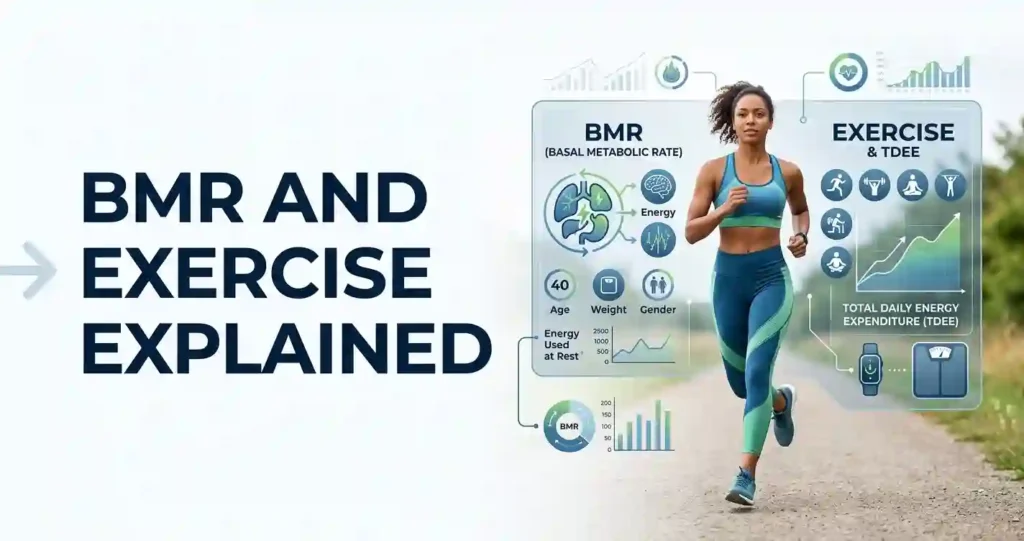
Your Basal Metabolic Rate (BMR) represents the energy your body burns at rest just to keep you alive. Exercise, on the other hand, contributes to your overall Total Daily Energy Expenditure (TDEE). Balancing both is key to setting appropriate calorie goals—whether your objective is weight loss, weight maintenance, muscle gain, or improving your athletic performance.
This guide breaks down how BMR works, how different types of exercise affect your metabolism, and how to use both metrics to tailor a realistic, evidence-based nutrition plan.
What Is BMR?
Basal Metabolic Rate (BMR) is the estimated number of calories your body burns at complete rest over 24 hours to support essential life-sustaining functions. Even when you are sleeping or lying still in bed, your body requires a continuous supply of energy to keep your heart pumping blood, lungs expanding, liver processing toxins, brain firing signals, and kidneys filtering waste.
+-------------------------------------------------------------------------+
|                      BASAL METABOLIC RATE (BMR)                         |
|                     (Energy Burned at Baseline Rest)                    |
+-------------------------------------------------------------------------+
|  Heart & Circulation | Brain & Nervous System | Lungs & Respiration     |
|  Liver & Kidneys     | Cellular Repair        | Body Temperature Control|
+-------------------------------------------------------------------------+
Several key biological factors influence your baseline BMR:
- Body Composition: Muscle tissue is more metabolically active than fat mass. People with higher lean body mass generally have higher BMRs.
- Body Size (Height and Weight): Larger bodies require more energy to maintain organ tissue and drive basic physiological systems.
- Biological Sex: On average, men tend to have higher BMRs than women of similar weight due to having a higher proportion of lean muscle tissue.
- Age: BMR gradually declines with age, largely because people tend to lose lean muscle mass as they grow older (sarcopenia) alongside subtle shifts in hormonal activity.
- Genetics and Health Factors: Thyroid hormone levels, genetic predispositions, and cellular efficiency create slight variances between individuals.
In scientific literature and clinical nutrition, you may also encounter terms like Resting Metabolic Rate (RMR) or Resting Energy Expenditure (REE). While BMR is strictly measured under clinical conditions immediately after waking up following an overnight fast, RMR is measured under less stringent conditions throughout the day. For general calorie tracking and fitness planning, BMR and RMR are often used interchangeably.
What Does BMR Include?
Your BMR reflects the baseline workload of your internal organs and basic metabolic processes.
+--------------------------+--------------------------------------------------+
| Physiological System     | Estimated Contribution to BMR Output             |
+--------------------------+--------------------------------------------------+
| Liver                    | ~21% of resting energy use                       |
| Brain                    | ~19% of resting energy use                       |
| Heart                    | ~7% of resting energy use                        |
| Kidneys                  | ~8% of resting energy use                        |
| Skeletal Muscle (Resting)| ~18% of resting energy use                        |
| Adipose Tissue (Fat Mass)| ~5% of resting energy use                        |
| Other Organs & Tissues   | ~22% of resting energy use                       |
+--------------------------+--------------------------------------------------+
It is vital to realize that BMR does not include any movement or physical task. Walking across a room, standing up, cooking dinner, typing on a keyboard, and planned physical exercise are completely excluded from this figure.
Because BMR represents only baseline physiological upkeep, your calculated BMR should never automatically be used as your daily calorie target. Eating only your BMR calories while living a normal daily life puts you in a severe calorie deficit, which can lead to rapid fatigue, nutrient deficiencies, lost muscle mass, and impaired recovery over time.
BMR vs TDEE: What’s the Difference?
To calculate how many calories you actually need to consume per day, you must differentiate between BMR and Total Daily Energy Expenditure (TDEE).
       [ BMR ] = Resting energy needed for baseline organ function
          +
       [ TEF ] = Energy used to digest and process food (~10%)
          +
       [ NEAT ] = Everyday spontaneous movement (walking, standing, chores)
          +
       [ EAT ] = Planned workouts and structured exercise
       ____________________________________________________________________
       = [ TDEE ] (Your actual Total Daily Calorie Expenditure)
Featured Snippet Summary: BMR vs TDEE
- Basal Metabolic Rate (BMR): The energy your body burns strictly at rest. It typically accounts for 60% to 75% of your total daily calorie burn.
- Total Daily Energy Expenditure (TDEE): The total number of calories you burn across 24 hours, calculated by adding physical activity (exercise and daily movement) and food digestion to your BMR.
- Which should you use? You should always use TDEE—not BMR—when setting daily targets for fat loss, muscle retention, or weight maintenance calories.
How Does Exercise Affect BMR?
A common belief in fitness culture is that a vigorous workout “boosts your metabolism” for the rest of the day or permanently skyrockets your BMR. While exercise fundamentally alters your daily calorie expenditure, its relationship with BMR is more subtle than many people think.
                               EXERCISE INPUT
                                     |
      +------------------------------+------------------------------+
      |                                                             |
[ Immediate Active Burn (EAT) ]                            [ Long-Term Body Composition ]
  Calories burned during the workout                         Building lean muscle tissue
  (e.g., 300 kcal running).                                  slightly raises resting BMR.
      |                                                             |
      +------------------------------+------------------------------+
                                     |
                       [ TOTAL DAILY EXPENDITURE (TDEE) ]
Exercise primarily affects energy balance by burning calories while you are active (Exercise Activity Thermogenesis). It does not automatically scale your BMR up by a fixed percentage after every session.
While heavy physical exertion causes a brief, temporary increase in post-exercise oxygen consumption (EPOC)—sometimes called the “afterburn effect”—this temporary elevation lasts only a few hours and represents a small fraction of the calories burned during the workout itself. The primary way exercise influences resting BMR over the long term is through changes in body composition—specifically by building or preserving lean muscle mass.
Does Exercise Increase Your BMR?
Exercise increases your baseline BMR primarily when it leads to structural changes in your tissue—namely, gaining lean skeletal muscle.
Muscle tissue is more metabolically active than fat tissue. At rest, one kilogram of skeletal muscle burns approximately 10 to 15 calories per day, whereas one kilogram of body fat burns about 4.5 calories per day.
+--------------------------+--------------------------------------------------+
| Tissue Type              | Estimated Resting Energy Expenditure             |
+--------------------------+--------------------------------------------------+
| Muscle Tissue            | ~10–15 kcal / kg / day at rest                   |
| Adipose (Fat) Tissue     | ~4.5 kcal / kg / day at rest                     |
+--------------------------+--------------------------------------------------+
While building muscle raises resting energy expenditure, the increase is gradual. Gaining 2 to 3 kg of solid muscle mass will increase your resting metabolism by about 30 to 45 calories per day. While this modest change supports long-term weight management and metabolic health, it does not mean gaining a small amount of muscle allows you to eat unlimited food without gaining weight.
Does Cardio Increase BMR?
Cardiovascular activities like running, cycling, swimming, rowing, and brisk walking are exceptional tools for cardiovascular fitness, heart health, and burning calories during the exercise session itself.
   Cardiovascular Exercise                         Resistance Exercise
  +--------------------------+                   +--------------------------+
  | High energy burn DURING  |                   | Moderate energy burn     |
  | the workout session.     |                   | DURING the session.      |
  | Minimal impact on long-  |                   | Stimulates muscle growth |
  | term resting BMR.        |                   | to support long-term BMR.|
  +--------------------------+                   +--------------------------+
However, cardio exercise does not directly increase resting BMR in the long term because it does not typically build significant amounts of new muscle tissue. Instead, aerobic training increases your daily TDEE through the direct caloric cost of the workout.
Cardio remains a valuable tool for creating a calorie deficit and maintaining metabolic health, but it works by increasing your total daily energy output rather than altering your resting metabolic rate.
How Exercise Contributes to TDEE
To understand how calories are burned throughout the day, it helps to view Total Daily Energy Expenditure (TDEE) as four distinct components:
+-----------------------------------------------------------------------+
|                 TOTAL DAILY ENERGY EXPENDITURE (TDEE)                 |
+-----------------------------------------------------------------------+
|  Basal Metabolic Rate (BMR)   | ~60–75% (Vital organ maintenance)    |
|  NEAT (Everyday Movement)     | ~15–30% (Walking, standing, tasks)   |
|  Thermic Effect of Food (TEF) | ~10% (Digesting & absorbing nutrients)|
|  Exercise Activity (EAT)      | ~5–15% (Planned structured workouts)  |
+-----------------------------------------------------------------------+
Two people of identical age, sex, height, and weight will have virtually identical BMR calculations. However, if one person works a desk job and watches television in the evening, while the other works on a construction site and trains for marathons, their daily calorie needs will differ by thousands of calories because of their TDEE components.
Exercise Activity (EAT)
Exercise Activity Thermogenesis (EAT) covers all planned, structured fitness sessions—such as weightlifting, group fitness classes, running, football, or swimming.
+---------------------------+-------------------+----------------------------+
| Activity Example          | Duration          | Estimated Calorie Output*  |
+---------------------------+-------------------+----------------------------+
| Weight Training           | 50 minutes        | ~180 – 300 kcal            |
| Moderate Cycling          | 45 minutes        | ~300 – 450 kcal            |
| Running (8 km/h)          | 30 minutes        | ~280 – 380 kcal            |
| High-Intensity Interval   | 25 minutes        | ~200 – 320 kcal            |
+---------------------------+-------------------+----------------------------+
*Estimates vary widely based on individual body weight, intensity, and muscle mass.
The total calorie burn from structured exercise depends heavily on body mass, exercise intensity, and total duration. Importantly, popular fitness trackers and cardio machines frequently overestimate exercise calorie burn by 15% to 30%. Treating tracker burn figures as absolute truth can easily cause you to accidentally overeat.
NEAT and Everyday Movement
Non-Exercise Activity Thermogenesis (NEAT) represents the energy expended for everything that is not sleeping, eating, or sports-like exercise. It includes walking to the shop, climbing stairs, gardening, cleaning, standing at a desk, and fidgeting.
   Low-NEAT Profile (Sedentary)                  High-NEAT Profile (Active Daily)
  +----------------------------+                +----------------------------+
  | Desk job, drive to work,   |                | Active job, walk to shop,  |
  | ~3,000 daily steps.        |                | ~11,000 daily steps.       |
  | NEAT = ~200 kcal/day       |                | NEAT = ~700 kcal/day       |
  +----------------------------+                +----------------------------+
NEAT is often the most variable component of daily energy expenditure between individuals. An active daily lifestyle can account for a difference of 300 to 800 calories per day. Increasing your general everyday movement—such as aiming for 8,000 to 10,000 daily steps—is often a more sustainable way to increase your calorie deficit than adding an extra hour of exhausting cardio workouts.
How to Calculate BMR and Exercise Calories
Determining your daily calorie requirements follows a clear, three-step framework:
[ STEP 1: Calculate BMR ] ==> [ STEP 2: Multiply for TDEE ] ==> [ STEP 3: Adjust for Goal ]
(Baseline Resting Need)       (Add Daily Activity Level)       (Deficit, Surplus, or Maintenance)
Step 1 — Calculate Your BMR
To estimate your resting metabolic rate, use a validated predictive formula like the Mifflin-St Jeor Equation, which is widely regarded in clinical research as one of the most accurate formulas available:
- For Men: $\text{BMR} = (10 \times \text{weight in kg}) + (6.25 \times \text{height in cm}) – (5 \times \text{age in years}) + 5$
- For Women: $\text{BMR} = (10 \times \text{weight in kg}) + (6.25 \times \text{height in cm}) – (5 \times \text{age in years}) – 161$
Worked Example:
A 35-year-old female who weighs 70 kg and is 168 cm tall:
- $\text{BMR} = (10 \times 70) + (6.25 \times 168) – (5 \times 35) – 161$
- $\text{BMR} = 700 + 1050 – 175 – 161 = \mathbf{1{,}414\text{ kcal/day}}$
This 1,414 kcal figure represents the baseline energy her body uses strictly at rest.
Step 2 — Estimate Your TDEE
Next, multiply your calculated BMR by a standard Physical Activity Level (PAL) multiplier to estimate your overall TDEE:
+---------------------+-----------------------------------+--------------------------+
| Activity Level      | Lifestyle Description             | BMR Multiplier           |
+---------------------+-----------------------------------+--------------------------+
| Sedentary           | Desk job, minimal walking/exercise| BMR x 1.2                |
| Lightly Active      | Light walking or exercise 1-3x/wk | BMR x 1.375              |
| Moderately Active   | Moderate exercise/sports 3-5x/wk  | BMR x 1.55               |
| Very Active         | Hard exercise/sports 6-7x/wk      | BMR x 1.725              |
| Extra Active        | Physical job + hard training daily| BMR x 1.9                |
+---------------------+-----------------------------------+--------------------------+
Using our example of a 1,414 kcal BMR for a moderately active individual:
$$\text{TDEE} = 1{,}414 \times 1.55 = \mathbf{2{,}191\text{ kcal/day}}$$
Her estimated maintenance requirement to stay at her current body weight is approximately 2,190 calories per day.
Step 3 — Adjust Calories for Your Goal
Once you know your estimated TDEE, you can adjust your daily calorie intake based on your primary objective:
+-----------------------+----------------------------------+-------------------------+
| Goal                  | Calorie Adjustment               | Example Target (TDEE=2190)
+-----------------------+----------------------------------+-------------------------+
| Fat Loss              | 15–20% deficit below TDEE        | ~1,750 kcal / day       |
| Muscle Gain           | 5–10% surplus above TDEE         | ~2,350 kcal / day       |
| Weight Maintenance    | Match estimated TDEE             | ~2,190 kcal / day       |
+-----------------------+----------------------------------+-------------------------+
BMR and Exercise for Weight Loss
When your goal is fat loss, exercise and calorie control should work together as complementary tools.
                                  ENERGY BALANCE
                                        |
                 +----------------------+----------------------+
                 |                                             |
       [ CALORIE INTAKE ]                           [ ENERGY EXPENDITURE ]
     (Food and drink consumed)                   (BMR + NEAT + TEF + Exercise)
                 |                                             |
                 +----------------------+----------------------+
                                        |
                         CALORIE DEFICIT = FAT LOSS
A common mistake made by beginners is using intense exercise to “pay for” or “burn off” bad dietary habits. However, it takes seconds to consume 500 calories in processed snacks, but it can take 45 to 60 minutes of strenuous running to burn off those same calories.
It is much simpler to create the majority of a calorie deficit through nutritional awareness while using exercise to improve fitness, preserve lean mass, and increase your overall TDEE.
Should You Exercise Below Your BMR?
No. You should not attempt to limit your food intake below your baseline BMR while adding high volumes of exercise.
When you eat less than your BMR while forcing your body to complete demanding workouts, you create an excessively large energy deficit. This approach can lead to several health issues:
- Chronic lethargy and severe daytime fatigue.
- Muscle mass loss, as the body breaks down muscle tissue for energy.
- Disrupted hormonal health and poor recovery.
- High levels of hunger that often lead to binge eating.
Instead, create a modest, sustainable calorie deficit (typically 300 to 500 calories below your TDEE) while keeping your intake safely above your calculated baseline BMR.
How Much Exercise Do You Need to Lose Weight?
There is no universal exercise target that guarantees weight loss because overall energy balance determines fat loss. However, combining cardiovascular training and resistance exercise supports a balanced routine.
+-------------------------+-------------------------+--------------------------------+
| Physical Activity Type  | Weekly Recommendation   | Health & Fat Loss Role         |
+-------------------------+-------------------------+--------------------------------+
| Resistance Training     | 2 to 4 sessions / week  | Preserves muscle, supports BMR |
| Aerobic Exercise        | 150 mins moderate / week| Heart health, increases TDEE   |
| Daily Step Count        | 7,000 to 10,000 steps   | Sustained NEAT calorie output  |
+-------------------------+-------------------------+--------------------------------+
The NHS recommends that adults perform at least 150 minutes of moderate-intensity activity per week, alongside muscle-strengthening activities on two or more days. Consistency matters far more than extreme workouts you cannot sustain over time.
BMR and Strength Training
Resistance training—such as lifting weights, using gym machines, or performing bodyweight exercises like push-ups and squats—plays a unique role in managing your metabolism during weight loss.
                         PROGRESSIVE RESISTANCE TRAINING
                                        |
       +--------------------------------+--------------------------------+
       |                                                                 |
[ Preserves Muscle Tissue ]                                     [ Stimulates Muscle Protein ]
  Prevents metabolic slowdown                                     Requires protein and rest
  during calorie deficits.                                        for tissue repair.
When you lose body mass without resistance training, a significant portion of the weight lost can come from lean skeletal muscle tissue. Losing muscle drops your baseline BMR, which lowers your TDEE and makes long-term weight maintenance harder. Resistance training signals to your body that it needs to keep its muscle mass, forcing it to burn stored body fat for energy instead.
Does Building Muscle Increase Calorie Needs?
Yes, but it is important to have realistic expectations. Gaining muscle mass raises your baseline calorie needs because lean tissue requires energy to maintain itself even when you are at rest.
+--------------------+------------------------+-------------------------------------+
| Muscle Mass Gained | Estimated Daily BMR    | Estimated Annual Calorie Impact     |
|                    | Increase               |                                     |
+--------------------+------------------------+-------------------------------------+
| + 1 kg Muscle      | ~10 to 15 kcal / day   | ~3,650 to 5,475 kcal / year         |
| + 3 kg Muscle      | ~30 to 45 kcal / day   | ~10,950 to 16,425 kcal / year       |
| + 5 kg Muscle      | ~50 to 75 kcal / day   | ~18,250 to 27,375 kcal / year       |
+--------------------+------------------------+-------------------------------------+
While adding a few kilograms of muscle tissue will not double your metabolic rate, the cumulative effect over several months supports a healthier, more resilient baseline metabolism.
BMR, Protein and Muscle Recovery
To repair and build muscle tissue effectively, your body needs adequate dietary protein alongside the stimulus of strength training.
+---------------------------+--------------------------------------------------------+
| Nutrient Source           | Recommended UK Food Examples                           |
+---------------------------+--------------------------------------------------------+
| Animal-Based Proteins     | Eggs, skinless chicken breast, turkey, cod, salmon,    |
|                           | Greek yogurt, cottage cheese, lean beef.               |
+---------------------------+--------------------------------------------------------+
| Plant-Based Proteins      | Tofu, tempeh, lentils, chickpeas, kidney beans, edamame,|
|                           | quinoa, hemp seeds, meat-free plant protein options.   |
+---------------------------+--------------------------------------------------------+
During weight loss or muscle-building phases, aim for roughly 1.6 to 2.2 grams of protein per kilogram of body weight daily. Dividing your protein intake evenly across your main meals provides a steady supply of amino acids to support muscle recovery and keep you feeling full.
BMR and Cardio: Which Is Better for Weight Loss?
Rather than viewing cardio and resistance training as opposites, it is helpful to see them as complementary tools with different strengths:
+------------------------+-----------------------------+-----------------------------+
| Feature                | Cardiovascular Exercise     | Resistance Training         |
+------------------------+-----------------------------+-----------------------------+
| Primary Calorie Burn   | High burn DURING session    | Moderate burn DURING session|
| Impact on BMR          | Low long-term impact        | Moderate positive impact    |
| Primary Benefit        | Heart health & stamina      | Muscle preservation & shape |
| Energy Source          | Fat & glycogen oxidation    | Glygocen stores             |
+------------------------+-----------------------------+-----------------------------+
A well-balanced routine includes both: strength training to maintain muscle tissue and resting metabolic rate, paired with cardio to support cardiovascular health and increase total daily calorie burn.
Walking and BMR
Walking is one of the most accessible and effective forms of physical activity available.
  Daily Walking (e.g., 8,000 steps)
  +--------------------------------------------------+
  | Burns 250 - 400 kcal without severe fatigue     |
  | Minimal impact on central nervous system          |
  | Easy to maintain alongside busy schedules        |
  +--------------------------------------------------+
While walking does not directly alter your resting BMR, it increases your daily NEAT calorie burn without causing extreme fatigue or spikes in hunger. Adding a 30-minute walk to your daily routine can easily burn an extra 130 to 200 calories per day, supporting a healthy weight loss goal.
Running and BMR
Running is a high-intensity cardio option that burns a significant number of calories in a short period. A person weighing 70 kg running at a moderate pace can burn approximately 300 to 400 calories in 30 minutes.
While intense running increases calorie expenditure during the workout and causes a brief temporary increase in post-exercise oxygen consumption (EPOC), it does not permanently raise baseline BMR. Proper recovery, adequate nutrition, and sensible progression are essential when running regularly to prevent overuse injuries and fatigue.
Can Exercise Slow Down Your BMR?
Exercise itself does not slow down your BMR. However, sustained weight loss and severe calorie deficits do cause a natural reduction in resting metabolic rate. This biological response is known as metabolic adaptation.
                        SUSTAINED WEIGHT LOSS
                                  |
     +----------------------------+----------------------------+
     |                                                         |
[ Lighter Body Mass ]                             [ Adaptive Thermogenesis ]
  A smaller frame uses fewer                        Cells become slightly more
  calories to function at rest.                     efficient to preserve energy.
     |                                                         |
     +----------------------------+----------------------------+
                                  |
                       [ REDUCED BMR EXPENSE ]
When you lose body mass, your BMR naturally decreases because your frame requires less energy to maintain vital organs and move around. This reduction in metabolic rate is a normal survival mechanism, not permanent “metabolic damage.”
Does a Calorie Deficit Lower BMR?
Yes. Prolonged energy restriction triggers physiological adjustments that conserve energy:
- Decreased thyroid hormone production: Reduces overall metabolic rate slightly.
- Unconscious drop in NEAT: You may sit more often, fidget less, and feel less inclined to move around.
- Increased energy efficiency: Muscles become more efficient, using fewer calories to perform the same amount of work.
To minimize metabolic slowdown during weight loss, avoid overly aggressive calorie deficits, prioritize resistance training, keep protein intake high, and take planned diet breaks at maintenance calories every few months.
Should You Recalculate BMR After Losing Weight?
Yes. As you lose weight, your BMR and TDEE will gradually decrease.
   Starting Point: 90 kg                         After Losing 10 kg: 80 kg
  +------------------------------+             +------------------------------+
  | BMR: ~1,850 kcal             |   ======>   | BMR: ~1,680 kcal             |
  | TDEE (Active): ~2,800 kcal   |  Weight Loss| TDEE (Active): ~2,500 kcal   |
  | Deficit Intake: 2,200 kcal   |             | Previous Deficit Is New TDEE!|
  +------------------------------+             +------------------------------+
If you lose 5 to 10 kg of body mass, your original calorie targets will no longer create the same calorie deficit. Recalculating your BMR and TDEE every 5 kg to 10 kg of weight loss allows you to adjust your intake and prevent progress from stalling.
How Accurate Are BMR and Exercise Calorie Calculations?
All BMR formulas, fitness apps, and smartwatch calorie trackers provide predictive estimates, not exact clinical measurements.
+------------------------------+-----------------------------------------------------+
| Calculation Tool             | Real-World Error Margin Potential                   |
+------------------------------+-----------------------------------------------------+
| BMR Formulas (Mifflin-St Jeor)| ~5% to 10% variance from true metabolic measurement |
| Wearable Trackers / Watches  | ~15% to 30% overestimation of workout calorie burn  |
| Gym Cardio Machine Displays  | ~20% to 40% overestimation of active calorie burn   |
+------------------------------+-----------------------------------------------------+
Are Fitness Trackers Accurate for Calories Burned?
While wearable devices excel at tracking heart rate trends, workout duration, and daily step totals, they are notoriously imprecise at calculating exact calories burned.
Smartwatches estimate calorie expenditure using generalized algorithms based on your heart rate, age, sex, and weight. They often miscalculate exercise expenditure and can double-count your background BMR calories during a workout session. Use fitness tracker data as a general reference for daily activity levels rather than an absolute guide for how much extra food you can eat.
Why Your Actual Calorie Needs May Differ
Calculated energy requirements can differ from your actual daily needs due to several biological factors:
- Muscle-to-fat ratio: Two people of identical height and weight can have different metabolic rates if one has significantly more muscle mass.
- Non-exercise activity variance: Differences in fidgeting, posture, and occupational movement create large variations in daily energy expenditure.
- Digestive efficiency: Variations in gut microbiomes and digestive health affect how many calories your body absorbs from food.
Treat all online calculator outputs as a starting baseline. Monitor your average scale weight, body measurements, and energy levels over 3 to 4 weeks, then adjust your intake based on your real-world progress.
Common BMR and Exercise Mistakes
Avoid these frequent mistakes when using BMR and exercise calculations to build your nutrition routine:
                  COMMON CALORIE TRACKING MISTAKES
                                  |
     +----------------------------+----------------------------+
     |                            |                            |
[ Eating Back All Workout ]  [ Confusing BMR with ]     [ Relying Only on ]
  Calorie Estimates            Maintenance Calories       Workouts for Deficit
Mistake 1: Eating Back All Exercise Calories
Many health apps automatically add estimated exercise calories back into your daily food allowance. If a fitness tracker estimates that a run burned 500 calories, the app may increase your daily calorie target by 500.
Because fitness trackers often overestimate workout calorie burn, eating back all your estimated exercise calories can easily eliminate your calorie deficit and lead to a plateau.
Mistake 2: Assuming More Exercise Always Means More Weight Loss
Exercising excessively without managing your nutrition often leads to disappointing fat loss results. Extreme workout schedules can dramatically increase appetite, leading to unrecorded overeating. Very heavy exercise can also cause fatigue that leads you to move less during the rest of the day, lowering your overall NEAT and canceling out the calories burned during your workout.
Mistake 3: Focusing Only on BMR
Confusing BMR with total daily calorie needs is a widespread error. Treating your baseline BMR as your daily intake goal creates an excessively steep deficit, while treating your BMR as your total calorie burn underestimates your real energy needs. Always use TDEE when planning your nutrition goals.
How to Use BMR and Exercise Together for Different Goals
Here is how to combine BMR, TDEE, and exercise strategies based on your primary fitness objective:
+------------------------------------------------------------------------------------+
|                         STRATEGY FRAMEWORK BY GOAL                                 |
+------------------------------------------------------------------------------------+
| FAT LOSS           | TDEE - 15–20% | Resistance Training + Walking | High Protein |
| MUSCLE GAIN        | TDEE + 5–10%  | Heavy Progressive Lifting     | High Protein |
| MAINTENANCE        | Match TDEE    | Mixed Cardio & Resistance     | Balanced     |
| RECOMPOSITION      | Match TDEE    | Intense Resistance Training   | High Protein |
+------------------------------------------------------------------------------------+
For Fat Loss
- Calorie Goal: Set your daily intake 300 to 500 calories below your estimated TDEE, keeping intake safely above your BMR.
- Exercise Focus: Prioritize progressive resistance training 2 to 4 times per week to preserve muscle tissue.
- Activity Focus: Aim for 8,000 to 10,000 daily steps to keep your NEAT elevated.
- Nutrition Focus: Consume 1.6 to 2.2g of protein per kilogram of body weight to support muscle retention and fullness.
For Muscle Gain
- Calorie Goal: Set your intake 200 to 300 calories above your estimated TDEE (a mild, controlled calorie surplus).
- Exercise Focus: Focus on progressive resistance training, gradually increasing weight or reps over time.
- Activity Focus: Keep light cardio in your routine for recovery and heart health.
- Nutrition Focus: Pair a slight calorie surplus with adequate daily protein to support new muscle tissue growth.
For Body Recomposition
- Calorie Goal: Eat at or very close to your maintenance TDEE.
- Exercise Focus: Train with heavy resistance exercises 3 to 5 times per week.
- Target Group: Ideal for beginners, those returning after a long break, or individuals with higher body fat percentages.
- Outcome: Allows you to build muscle mass and burn body fat simultaneously, improving your body composition while your scale weight remains relatively stable.
Quick Answer: How Does Exercise Affect BMR?
Exercise primarily increases your Total Daily Energy Expenditure (TDEE) by burning calories while you are moving. It does not directly add calories to your baseline BMR during or immediately after a workout.
Over the long term, regular resistance training can help build or maintain lean muscle tissue, which subtly increases your resting BMR. For fat loss and fitness planning, calculate your BMR as a starting baseline, use your activity level to determine your overall TDEE, and set your daily calorie target based on your TDEE.
Frequently Asked Questions About BMR and Exercise
Does exercise increase BMR?
Directly, no. Exercise burns calories while you move, which increases your overall TDEE. However, over time, performing regular resistance training helps build lean muscle tissue. Because muscle burns more energy at rest than fat tissue, gaining muscle mass subtly increases your baseline BMR over time.
How does exercise affect BMR and TDEE?
Exercise affects TDEE directly by burning calories during your workout session. It affects BMR indirectly over time by altering your body composition. Gaining lean muscle mass increases resting energy expenditure, while losing muscle mass can decrease it.
Should I use BMR or TDEE to calculate calories?
You should always use TDEE to set your daily calorie targets. BMR only calculates the resting energy needed to support vital organ functions. TDEE includes BMR plus all physical movement, exercise, and digestion, giving you an accurate picture of your total daily energy needs.
Does cardio increase your metabolic rate?
Cardio burns a significant number of calories during the exercise session itself, increasing your total daily expenditure (TDEE). However, cardio does not build large amounts of muscle, so it has minimal impact on long-term resting metabolic rate (BMR).
Does strength training increase BMR?
Yes, indirectly. Strength training stimulates muscle protein synthesis, helping you build or preserve lean muscle mass. Because skeletal muscle tissue is metabolically active, having more lean muscle supports a higher resting metabolic rate.
How many calories does exercise burn?
Calorie burn depends on body weight, muscle mass, exercise intensity, and duration. For example, a 70 kg person typically burns roughly 200 to 300 calories during a 45-minute weightlifting session, or 300 to 450 calories during a 45-minute brisk run.
Should I eat back calories burned through exercise?
In most cases, no. Activity multipliers used in TDEE calculators already account for your exercise sessions. If you add exercise calories back into your daily food budget on top of your TDEE, you run the risk of overeating because smartwatch and tracker calorie estimates are often higher than actual exercise expenditure.
Can exercise lower BMR?
No, exercise itself does not lower BMR. However, if intense exercise is paired with severe calorie restriction over several months, significant body mass loss can lower your BMR. This natural reduction in resting expenditure is a normal biological response to a smaller body mass.
How often should I recalculate my BMR?
Recalculate your BMR and TDEE whenever you experience a significant change in body weight (such as losing or gaining 5 to 10 kg) or when your daily activity levels shift substantially (such as changing from a active job to a desk job).
What is the best exercise for boosting metabolism?
A balanced combination of progressive resistance training (to build muscle mass and support long-term BMR) and daily walking or cardio (to increase TDEE and support heart health) is the most effective approach for long-term metabolic health.
Conclusion: Understand BMR to Make Exercise and Calorie Tracking Work Together
Understanding how BMR and exercise work together allows you to build an effective, evidence-based strategy for your health and fitness goals. Your Basal Metabolic Rate provides the baseline resting cost of keeping your organs functioning, while exercise and daily movement build your Total Daily Energy Expenditure.
                      TAKEAWAY FRAMEWORK FOR SUCCESS

     1. Calculate BMR as your baseline resting requirement.
     2. Factor in exercise and daily movement to find your TDEE.
     3. Eat relative to your TDEE—never drop intake below your BMR.
     4. Combine resistance training with daily movement for long-term health.
Rather than treating exercise as a punishment to “burn off” food or relying on extreme diet restrictions below your BMR, use your BMR as a starting baseline. Calculate your TDEE based on your actual lifestyle, maintain a sensible nutrition plan, lift weights to protect your muscle mass, and use daily movement to support a healthy, sustainable metabolism.

Ehatasamul Alom is a dedicated health-tech enthusiast and the co-founder of BMRCalculator. With a passion for metabolic science, he focuses on providing accurate health data for the UK community. Ehatasamul ensures that every tool and guide aligns with NHS standards and public health research. His mission is to simplify complex biological data, helping British residents make informed decisions about their fitness, calorie needs, and long-term wellness. When not analyzing health trends, he explores the latest innovations in wearable fitness technology.