When you embark on a weight loss journey, manage your health, or focus on athletic performance, one term inevitably dominates the conversation: metabolism. It’s the invisible force we often blame when progress stalls or celebrate when we can eat more food than expected.
In this discussion, one acronym stands above the rest—BMR, or Basal Metabolic Rate. BMR forms the foundation of your daily energy expenditure, representing a significant portion of the calories you burn each day. Many people believe that BMR is a static, immutable figure determined by genetics alone. If you have a “slow metabolism” (a low BMR), you are seemingly destined to struggle with weight management forever.
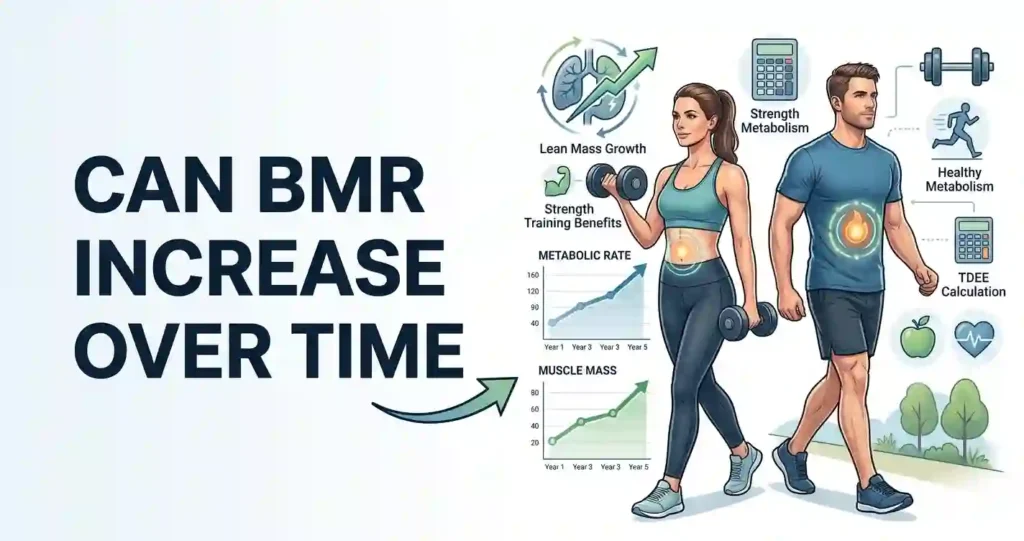
However, this isn’t strictly true. A critical question for many is: Can BMR increase over time?
The quick answer is yes, BMR can increase (or decrease) over time. While genetics provide the baseline, your BMR is not fixed for life. Changes in your body composition (especially lean muscle mass), total body weight, age, and overall health all significantly influence your resting metabolic rate.
This means you are not entirely powerless. By understanding the physiological mechanisms behind BMR, you can implement sustainable lifestyle strategies to support a healthy metabolic rate.
Key Takeaway: BMR vs TDEE
Increasing your resting metabolism (BMR) is often presented as the ultimate fitness goal, but it is not the only way—or even the most efficient way—to manage your calorie balance. The most effective strategy is focusing on your Total Daily Energy Expenditure (TDEE).
TDEE includes your BMR plus the energy you use through scheduled exercise, spontaneous daily movement (walking, standing, chores), and the digestion of food. While changing your baseline BMR is a slow process, you have immediate, significant control over your TDEE by increasing your physical activity levels.
This article provides a comprehensive, evidence-based exploration of how to increase BMR over time and, crucially, how to use that knowledge effectively in your everyday health and fitness planning.
What Is BMR and How Does It Work?
To understand how BMR can increase, we must first understand exactly what it measures. Basal Metabolic Rate (BMR) represents the minimum number of calories your body requires strictly at rest in 24 hours to perform essential, life-sustaining functions.
Even when you are lying completely motionless in bed, your body is working tirelessly to maintain its baseline state. This resting energy expenditure is not just passive maintenance; it is a continuously active process.
Essential bodily functions driven by your BMR include:
- Cell Production and Repair: Maintaining, growing, and repairing body tissues.
- Respiration: The complex muscle actions needed for breathing and oxygen circulation.
- Circulation: The work your heart performs to pump blood throughout your system.
- Organ Function: The continuous energy needed for brain, kidney, and liver processing.
- Temperature Regulation: Keeping your internal body temperature within a safe range (approximately 37°C).
+-------------------------------------------------------------+
|               CALORIES INTAKE (FOOD & DRINK)                |
+------------------------------+------------------------------+
                               |
                               v
+------------------------------+------------------------------+
|        TOTAL DAILY ENERGY EXPENDITURE (TDEE) COMPONENTS      |
+------------------------------+------------------------------+
|  Basal Metabolic Rate (BMR)  | ~60–75% (Essential Functions)|
|  Physical Activity (EAT)     | ~10–20% (Workouts/Movement) |
|  Non-Exercise Activity (NEAT)| ~10–20% (Spontaneous Motion)|
|  Thermic Effect of Food (TEF)| ~10%    (Digestion)          |
+------------------------------+------------------------------+
BMR forms the massive bulk of your TDEE—accounting for roughly 60% to 75% for most individuals. This is why having a healthy BMR is so desirable for weight management. BMR calculators generally provide an estimate of this baseline by analyzing your:
- Age: Metabolism often changes across different life stages.
- Sex: On average, biological males tend to have higher BMRs than females of a similar weight, primarily due to higher muscle mass.
- Height and Weight: Your overall body size and current weight are major components.
BMR vs RMR: What’s the Difference?
When you search for information on metabolic rate, you will often find BMR and Resting Metabolic Rate (RMR) used interchangeably. While they are very similar, there are subtle technical differences.
- BMR (Basal Metabolic Rate): Must be measured in a highly controlled, clinical setting. The test must be taken immediately after waking up following an overnight fast (typically 12 hours) and done in a temperature-controlled room with the individual in a state of absolute rest. This is the absolute minimum energy expense to keep your organs alive at baseline.
- RMR (Resting Metabolic Rate): A slightly less restrictive measurement. It measures energy expenditure when at rest but without the severe controls of a strict BMR test. It might be taken after a 4-hour fast, for example, or later in the day. RMR usually accounts for a slightly higher calorie burn because it might include minor environmental factors or residual digestive activity.
For general calorie tracking, weight loss, or fitness planning, the difference between BMR and RMR is negligible. Online calorie calculators frequently use the term BMR when they are strictly measuring RMR, but the results are practically useful estimates either way.
BMR vs TDEE
Understanding the difference between BMR and TDEE is critical for realistic goal setting.
- Basal Metabolic Rate (BMR): Energy used when you are at absolute, motionless rest (baseline physiological processes).
- Total Daily Energy Expenditure (TDEE): The total number of calories you burn across 24 hours. TDEE is your BMR plus planned physical exercise, spontaneous movement, and the energy to digest food.
+------------------+------------------------------+--------------------------+
| Measure          | What It Represents           | Main Use                 |
+------------------+------------------------------+--------------------------+
| BMR              | Calories used at rest        | Estimate baseline needs  |
| TDEE             | Total calories used each day | Set daily calorie targets|
| Maintenance cals | Calories needed to keep weight| Weight management        |
| Calorie Deficit  | Eating below expenditure     | Fat loss                 |
| Calorie Surplus  | Eating above expenditure     | Muscle gain / Weight gain|
+------------------+------------------------------+--------------------------+
While you are trying to understand how to increase BMR naturally over months, you can immediately and significantly increase your TDEE. Increasing daily movement (such as adding a walk or taking the stairs) raises your daily calorie expenditure without substantially affecting your baseline resting BMR. TDEE is almost always the better figure to focus on for daily calorie target planning.
Can BMR Increase Over Time?
The fundamental physiological principle behind metabolism is this: BMR is a measure of the metabolic activity of your body tissues at rest. Because your body tissue composition and size are not fixed for life, your BMR is not fixed for life.
       Start Weight: 90kg                       New Weight: 80kg
  +---------------------------+             +---------------------------+
  |  BMR: ~1,850 kcal/day     |             |  BMR: ~1,680 kcal/day     |
  |  Organs burn cals         |   =======>  |  Organs need fewer cals   |
  |  Muscle mass provides need| Weight Loss |  Total need decreases     |
  +---------------------------+             +---------------------------+
It is a proven scientific fact that BMR can increase naturally over time when certain parameters change. However, this is almost always a very gradual shift, not a dramatic overnight “metabolism boost.”
The major drivers of a BMR increase include:
- Body Composition: Gaining lean body mass (skeletal muscle) while minimizing fat gain.
- Body Weight: Carrying a significantly larger body (whether from muscle, bone, or fat) increases energy demands at rest.
- Health Status: Certain medical conditions (like an overactive thyroid) can cause a dramatic BMR increase, although this is pathological, not a healthy fitness boost.
Importantly, BMR often decreases with age or prolonged, aggressive dieting. We explore these nuances below.
Can Building Muscle Increase BMR?
This is perhaps the most significant physiological factor within your direct control when trying to figure out how to increase BMR. There is a direct relationship between lean body mass and resting energy expenditure.
Skeletal muscle is a metabolically active tissue. This means muscle cells consume more energy just to exist than fat cells do.
+-------------------------+--------------------------------------------------+
| Tissue Type             | Estimated Resting Energy Expenditure             |
+-------------------------+--------------------------------------------------+
| Muscle Tissue           | ~10–15 kcal / kg / day at rest                  |
| Adipose (Fat) Tissue    | ~4.5 kcal / kg / day at rest                    |
+-------------------------+--------------------------------------------------+
Estimates vary widely in scientific literature, but muscle is consistently 3 to 4 times more active than fat at rest.
However, it is important to manage expectations. Popular fitness media often makes exaggerated claims, suggesting that adding a small amount of muscle mass will allow you to eat unlimited food. A realistic BMR increase from gaining muscle is modest. Gaining a significant 2 to 3 kg of solid lean muscle mass would increase your daily resting burn by roughly 30 to 45 calories per day. While this is helpful over time and promotes long-term weight maintenance, it does not dramatically change your overall energy requirements.
Can Weight Gain Increase BMR?
Yes. Carrying a significantly larger body generally requires more energy at rest, regardless of the tissue composition.
+------------------------+--------------------------------------------------------+
| Gaining Muscle Mass    | Directly increases BMR due to adding highly metabolically |
|                        | active tissue.                                          |
+------------------------+--------------------------------------------------------+
| Gaining Body Fat       | Does increase estimated BMR, simply because the body     |
|                        | is larger, but fat tissue is minimally active at rest. |
+------------------------+--------------------------------------------------------+
While gaining significant weight will show an increased BMR on predictive calculators, it is crucial to distinguish between healthy muscle gain and excessive accumulation of body fat. A higher body weight does not automatically mean a “faster” or healthier metabolism. In the context of overall wellbeing, focusing on a healthy body composition (maximizing lean mass, minimizing excessive fat storage) is always preferable to pursuing higher weight just to elevate an estimated BMR.
What Factors Can Increase BMR Naturally?
While your BMR is influenced by genetics, there are powerful physiological and lifestyle factors that can increase your resting energy expenditure gradually over months or years.
The major factors with the strongest scientific evidence are:
- Gaining and maintaining skeletal muscle mass.
- Increases in total body mass.
- Substantial increases in height (only applies to growing children/adolescents).
- Natural recovery from substantial illness or injury (temporary BMR spike during recovery).
We must distinguish between factors that directly affect BMR and those that primarily increase TDEE. For example, doing a daily HIIT session can increase your total daily calorie burn significantly (TDEE), but it will only change your baseline BMR if it contributes to structural changes in your body composition (like building muscle mass).
Muscle Mass and Lean Body Mass
Lean body mass—everything in your body that isn’t fat (bone, organs, muscle, water)—is the primary driver of your resting metabolic rate. Organ tissue (heart, liver, lungs, brain) is exceptionally metabolically active, but these are generally fixed in size. Skeletal muscle is the main variable you can directly influence.
Metabolically active tissues are energetically expensive. Maintaining muscle cells requires constant energy (calories) even when you are motionless.
The primary strategy for managing how to increase BMR Naturally is consistently performing progressive resistance training (lifting weights). Resistance exercise provides the stimulus your body needs to maintain its existing muscle mass—particularly crucial when you are in a calorie deficit for weight loss—or build new lean mass. Preserving muscle is particularly relevant during weight loss, as the body often breaks down both muscle and fat for energy when in a deficit.
Age and Metabolism
It is widely accepted that metabolism slows down with age. This common knowledge sometimes creates the misconception that metabolism simply “stops” working after a certain age, making weight gain inevitable.
+----------------------+----------------------------------------------------------+
| Life Stage           | Estimated Annual BMR Change                              |
+----------------------+----------------------------------------------------------+
| Childhood to Teens   | High, rapid increase as body grows.                      |
| Ages 20–60           | Surprisingly stable, minimal age-related decline.        |
| Ages 60+             | Gradual, consistent, but small BMR decline (roughly      |
|                      | 0.7% to 1% decline per year).                           |
+----------------------+----------------------------------------------------------+
Research from 2021 (the high-profile Pontzer study) indicates that a person’s metabolism is actually remarkably stable between the ages of 20 and 60. The common “slowing metabolism” people experience often has more to do with changes in body composition (gradual muscle loss) and activity levels (reduced NEAT and movement) than just chronological age alone. This is excellent news: it means you can fight back against age-related metabolic slowdown by staying active and performing consistent strength training as you age.
Does Exercise Increase BMR?
Exercise is arguably the single most effective tool for managing body composition and energy expenditure, but its relationship with BMR is nuanced.
+--------------------------------------------------------------------------+
|                 EXERCISE & METABOLIC RATE (BMR vs TDEE)                   |
+--------------------------------------------------------------------------+
|                                     |                                     |
|        RESISTANCE TRAINING          |         CARDIOVASCULAR EXERCISE       |
|  (e.g., Weights, Bodyweight)        | (e.g., Running, Cycling, Swimming)    |
|                                     |                                     |
|         PRIMARY EFFECT              |           PRIMARY EFFECT            |
|       Increases TDEE *and*          |           Increases TDEE            |
|       Gradually supports BMR        |          (Very High output          |
|        through muscle gain.         |          during the workout)        |
|                                     |                                     |
+--------------------------------------------------------------------------+
It is crucial to differentiate between the short-term calorie burn during exercise and a lasting change in your resting metabolic rate. Regular strength training and intense cardio may increase your overall TDEE significantly, but they may change your baseline BMR very little in the short term.
Does Strength Training Boost Metabolism?
Yes, strength training (resistance exercise) is the key strategy when exploring how to increase BMR.
Strength training supports BMR by:
- Preserving Muscle: Telling your body that it needs to keep its skeletal muscle mass, crucial when in a calorie deficit for weight loss.
- Supporting Growth: Stimulating muscle protein synthesis to build new lean mass (muscle gain) when paired with adequate nutrition.
Progressive overload (gradually increasing the stimulus), proper recovery, and consuming adequate protein are absolutely critical components of any effective strength training program designed to manage BMR naturally.
Does Cardio Increase BMR?
Cardiovascular activities like running, cycling, swimming, rowing, and brisk walking are phenomenal tools for cardiovascular fitness, heart health, and high calorie expenditure during the activity. A demanding 45-minute spin class can burn hundreds of calories.
       Cardiovascular Exercise                        Resistance Exercise
  +-------------------------------+              +-------------------------------+
  | High energy burn DURING session |              | Moderate energy burn DURING   |
  | Minimal impact on long-term    |              | session                      |
  | resting BMR                   |              | Stimulates long-term BMR     |
  |                               |              | indirect increase via muscle |
  +-------------------------------+              +-------------------------------+
However, cardio exercise does not typically create a large, permanent increase in BMR. High-volume aerobic training does not build significant amounts of new muscle tissue and, if overly excessive without proper nutrition, can sometimes lead to muscle loss. Cardio should be used to manage overall weekly TDEE output and support aerobic fitness, rather than being prioritized as a primary mechanism to “boost metabolism” or raise resting BMR.
Does Walking Increase BMR?
Walking is a practical way to manage overall energy expenditure, but it has minimal direct effect on your resting BMR.
Walking increases energy expenditure primarily through Non-Exercise Activity Thermogenesis (NEAT)—the movement you do that isn’t sleeping, eating, or dedicated “exercise.” NEAT is a massive variable in daily calorie burn. A very active lifestyle (frequent walking, standing desk, manual chores) can add hundreds of extra calories to your TDEE compared to a sedentary desk job.
While walking primarily increases daily activity and TDEE, a consistent, moderate walking routine is still highly supportive of a healthy overall metabolism and body composition over time.
Can Eating More Increase Your BMR?
There is a popular notion that you can “fix” or “kick-start” a broken metabolism by simply eating more calories. Simply eating more food does not create a permanent, healthy increase in BMR.
Myth: "Eating breakfast is crucial to kick-starting your metabolism."
Fact: Metabolism is always on. The "kick-start" is just the thermic effect of digesting food (TEF), not a permanent boost.
Your body uses energy to process all incoming food. This is called the Thermic Effect of Food (TEF). This represents approximately 10% of your daily TDEE expense. TEF causes a temporary calorie burn, but it should not be confused with a substantial long-term BMR increase.
Adequate nutrition (avoiding extreme, prolonged low-calorie diets) is essential to support normal physiological and organ function, but consuming excess calories without an overall health and fitness strategy is not a metabolism “hack.”
Can More Protein Increase Calorie Burning?
Yes, but temporarily. The high thermic effect of protein is one of the reasons high-protein diets are often recommended for weight management.
Protein generally has a much higher TEF expense than carbohydrates or fat. Your body must work harder (burning more calories) to break down and process dietary protein. Protein also plays an indispensable role in maintaining and building muscle tissue. Pairing a high-protein intake with resistance training is the key to managing BMR naturally over the long term.
Here are some excellent whole-food sources suitable for typical UK diets:
- Eggs (especially egg whites)
- Greek Yoghurt (high protein, low sugar varieties)
- Fish (cod, haddock, salmon, tuna)
- Poultry (chicken breast, turkey mince)
- Legumes (lentils, chickpeas, kidney beans, baked beans in moderation)
- Tofu and Tempeh
Can Eating Too Little Lower BMR?
Yes. Prolonged energy restriction and aggressive weight loss can cause a decrease in overall energy expenditure that is disproportionately larger than what is explained by the decrease in body weight alone. This biological response is called adaptive thermogenesis or metabolic adaptation.
              AGGRESSIVE CALORIE RESTRICTION
                            |
      +---------------------+---------------------+
      |                                           |
[ Lower Resting Energy ]                  [ Increased Efficiency ]
  BMR drops slightly to                      NEAT drops as body moves
  preserve energy power.                     less to save energy.
      |                                           |
      +---------------------+---------------------+
                            |
                     [ LOWER TDEE OUTPUT ]
When you severely restrict calories (going well below your BMR), your body views this as a potential starvation scenario. It responds by becoming more efficient at using the limited fuel it has—namely by decreasing its baseline resting metabolic rate (BMR) and lowering spontaneous daily movement (NEAT).
This is a normal biological adaptation, not a pathological state. Metabolism is not “damaged”—it has successfully adapted to low-energy intake. You can combat excessive metabolic adaptation by using moderate calorie deficits, performing resistance training to protect muscle, and taking planned diet breaks every few months.
Can BMR Increase After Weight Loss?
This is a complex question with a simple biological answer: Generally, your BMR will decrease after meaningful weight loss.
+----------------------+---------------------------+---------------------------------+
| Starting Weight      | 100 kg                    | Base state                      |
| Final Weight         | 80 kg                     | Post-Weight Loss state          |
+----------------------+---------------------------+---------------------------------+
| Measured BMR         | 2,010 kcal / day          | 1,730 kcal / day                |
| The change           | -14% BMR decrease         | (Predicted BMR decline)         |
+----------------------+---------------------------+---------------------------------+
| Adaptation           | Measured BMR < Predicted  | Measured BMR is often 5-10%     |
|                      | BMR                       | below prediction due to adaptive|
|                      |                           | thermogenesis.                  |
+----------------------+---------------------------+---------------------------------+
It is a proven scientific principle that a lighter body requires fewer calories to exist at rest than a larger body. If you lose significant mass, your organs require less baseline maintenance. Therefore, a person will need fewer calories to maintain their new body weight even when their activity and lifestyle have not changed.
Can You Prevent BMR From Falling During Weight Loss?
You cannot completely prevent your BMR from falling as you get lighter, but you can manage the size of that decline by:
- Preserving Muscle: Consistent resistance training paired with adequate protein intake signals to your body that it needs to keep its skeletal muscle mass, minimizing the direct BMR drop.
- Adequate Nutrition: Avoiding extreme, aggressive calorie restriction (going too low) helps minimize the excessive metabolic adaptation (adaptive thermogenesis) discussed above.
- Maintaining Activity: Supporting overall TDEE output through regular NEAT and structured cardio helps offset the BMR decrease.
Encouraging sustainable weight-loss approaches rather than extreme low-calorie diets is always preferable to support healthy metabolism and body composition.
How to Increase BMR Naturally: A Real-World Plan
Forget the “metabolism hacks,” fat-burning foods, and rapid fixes promised in popular media. Improving your resting energy expenditure gradually over months requires a structured, multi-pronged approach that focuses on body composition and sustainable habits.
+------------------------------------------------------------------------------------+
|                         STRATEGY FRAMEWORK FOR METABOLISM                          |
+------------------------------------------------------------------------------------+
|                                                                                    |
|    1. Support Lean Body Mass  ==> Consistent Progressive Resistance Training       |
|    2. Protect Muscle Mass    ==> Eat Adequate Daily Protein                        |
|    3. Manage Overall Output  ==> Maximize Non-Exercise Activity (Walking, NEAT)    |
|    4. Ensure Performance     ==> Prioritize Sleep and Healthy Recovery             |
|    5. Use Calculated Deficits ==> Avoid Extreme, Very Low-Calorie Dieting            |
|                                                                                    |
+------------------------------------------------------------------------------------+
|                                                                                    |
+------------------------------------------------------------------------------------+
The key pillars are:
- Build and Maintain Muscle Mass.
- Prioritize Daily Movement (NEAT).
- Eat a Balanced, Protein-Rich Diet.
- Prioritize Sleep and Recovery.
1. Build and Maintain Muscle Mass
Resistance training targeting all major muscle groups is the foundational mechanism for maintaining and gradually supporting resting metabolic rate over time.
Practical tips for strength training:
- Focus on progressive overload: Aim to increase the weight, reps, or number of sets consistently across consecutive weeks or months.
- Consistency is key: Aim for 2 to 4 sessions per week, allowing rest days between muscle groups.
- Master the fundamentals: Target compound movements that work multiple major muscle groups (squats, deadlifts, chest press, rows).
2. Stay Physically Active
While structured exercise (EAT) has its benefits, spontaneous daily movement (NEAT) often provides a larger total calorie expenditure over the long term.
How to maximize NEAT:
- Track your daily steps: Aim for 8,000 to 12,000 daily steps.
- Add passive activity: Use a standing desk, walk during phone calls, or take short walking breaks after meals.
- Active Commuting: Walk, cycle, or use public transport instead of driving whenever practical.
3. Eat a Balanced, Protein-Rich Diet
Providing adequate nutrition and sufficient protein is essential to support the resistance training you are performing. Protein also has a powerful thermic effect, temporarily increasing energy expense.
Tips for a protein-rich diet suitable for UK lifestyles:
- Distribute protein intake: Aim for 20-30g of protein at most major meals.
- Utilize convenient sources: Eggs, Greek yoghurt, canned tuna, and poultry breast are affordable, accessible sources in the UK.
Avoid claims that specific “fat-burning” foods (like green tea, cayenne pepper, or lemon water) can dramatically increase BMR long term.
4. Prioritize Sleep and Recovery
Sleep and healthy recovery from exercise are essential, indirect supportive factors for managing a healthy metabolism.
Why sleep and recovery matter:
- Appetite Regulation: Sleep deprivation disrupts leptin and ghrelin, the hormones controlling hunger and satiety, often leading to unrecorded overeating.
- Training Performance: Healthy recovery is needed to perform demanding strength training sessions effectively, which is needed to build muscle to support BMR.
- Overall Wellbeing: Adequate rest manages stress (cortisol), which plays a role in body composition.
While prioritizing sleep does not directly produce a large, measurable increase in BMR itself, it is indispensable for sustainable healthy exercise and weight-management habits.
How to Know If Your BMR Has Changed
Since your resting metabolic rate is not a fixed number, you may be wondering how to know if your BMR has increased. There is no reliable at-home test that can directly measure BMR.
You must use a combination of predictive tools and real-world results:
- Use BMR Calculators as Estimates: An updated BMR calculator can provide a revised estimate, especially after significant changes in your total body weight, age, or known muscle gain/loss.
- Monitor Real-World Data: Track your average daily calorie intake against your rate of weight change (e.g., losing 0.5kg per week). Over 3 to 4 weeks, this comparison provides the most powerful feedback loop, allowing you to estimate your actual TDEE and refine your understanding of your metabolic needs.
- Laboratory Methods: Testing methods like indirect calorimetry (measuring oxygen consumption at rest) can provide a direct measurement of resting energy expenditure, but this is an expensive, clinical procedure mostly used in research, not everyday calorie planning.
When Should You Recalculate Your BMR?
Predictive BMR equations are convenient tools, but their estimates lose accuracy as your body changes. Consider recalculating your BMR and reassessing your TDEE after:
- Meaningful changes in total body weight (e.g., losing or gaining 5 kg).
- Significant milestones in age (recalculating every birthday is probably excessive, but every few years is useful).
- Noted changes in body composition (e.g., completing a six-month strength training program).
Avoid recalculating every few days based on minor scale fluctuations, as this will lead to constant, unhelpful changes to your calorie targets. TDEE should also be reassessed whenever your planned activity levels change significantly (e.g., changing from a sedentary office job to an active, mobile role).
BMR and TDEE: Which Should You Focus On?
While understanding BMR is valuable, for daily calorie management, Total Daily Energy Expenditure (TDEE) is almost always the better figure to focus on. BMR represents resting requirements, while TDEE accounts for exercise and all daily movement—which you have immediate, significant control over.
+----------------------+------------------------------+---------------------------+
| TDEE (Moderate Exercise)| TDEE (Very Active / NEAT)  | TDEE (Extreme Output)     |
| BMR x 1.55           | BMR x 1.725                  | BMR x 1.9                 |
+----------------------+------------------------------+---------------------------+
| Daily burn adds cals | Daily burn adds cals          | Daily burn adds cals       |
| to baseline.         | to baseline.                 | to baseline.              |
+----------------------+------------------------------+---------------------------+
Increasing daily movement (walking, standing, chores) is far more meaningful and immediate for calorie management than trying to dramatically raise resting BMR itself through muscle gain over many months. We encourage all individuals pursuing weight management to calculate their TDEE to set their daily calorie targets.
Common Myths About Increasing BMR
The health and fitness industry is saturated with misinformation promising quick fixes for a “slow” metabolism. When exploring how to increase BMR, it is vital to be skeptical.
Does Spicy Food Temporarily Increase BMR?
Certain foods—like spicy food (capsaicin), green tea, and coffee (caffeine)—can cause a subtle, brief increase in body temperature and energy expenditure. This effect is very small, temporary, and only lasts as long as the substance is active in the body. These negligible temporary spikes should absolutely not be confused with a substantial, healthy, long-term BMR increase from structural changes in muscle mass. Relying on cayenne pepper to manage weight is not an evidence-based strategy.
Do Metabolism-Boosting Supplements Work?
The phrase “metabolism boosting” on a product label is a red flag. Most supplements marketed for this purpose are essentially stimulants (caffeine) or extracts with minimal scientific backing. No supplement can replace the powerful, sustained effects of appropriate nutrition, consistent resistance training, and high daily activity. Relying on supplements to “boost” metabolism is almost always an expensive detour.
Does Eating Breakfast Boost BMR?
There is no substantial evidence supporting the common claim that eating breakfast automatically “kick-starts” your metabolism for the day. While eating triggers the thermic effect of food (TEF), this is just the energy used to digest the specific meal. Metabolism is always active. Total overall daily energy intake and consistent dietary patterns matter far more for health and metabolism than specific meal timing rules.
Quick Answer: Can BMR Increase Over Time?
Yes, BMR can increase naturally over time, primarily through structural changes in body composition (gaining skeletal muscle mass) or significant increases in total body weight (gaining mass). BMR represents the calories your body uses strictly at baseline rest to keep its organs running.
Because skeletal muscle is metabolically active, adding lean mass can gradually raise resting BMR over months or years. However, exercise mainly increases total daily energy expenditure (TDEE) through direct calorie burn during activity. For sustainable calorie management, focus on maximizing TDEE through increased activity while using resistance training and protein to maintain a healthy body composition, rather than chasing a massive, unrealistic “metabolism boost.”
Frequently Asked Questions About Increasing BMR Naturally
Does gaining muscle increase BMR?
Yes. Skeletal muscle tissue is metabolically active, consuming more energy at rest than fat tissue. Consistently performing progressive resistance training, paired with adequate protein intake, supports muscle preservation and growth, which in turn elevates resting energy expenditure naturally. The exact calorie increase varies by individual but is modest.
Can exercise permanently increase BMR?
No exercise permanently increases BMR by itself. Structured exercise, especially resistance training, supports BMR indirectly over the long term by helping you maintain or build highly metabolically active muscle tissue. The direct calorie burn from a workout is temporary TDEE expenditure, not a lasting shift in baseline resting BMR.
Does BMR increase with weight gain?
Yes. Carrying a significantly larger body (whether from muscle, bone, fat, or other tissues) generally requires more energy at rest, which elevates estimated BMR. While weight gain can elevate predictive calculator figures, healthy, functional muscle mass gain is always preferable to excessive accumulation of body fat in terms of overall wellbeing and metabolic health.
How can I increase my BMR naturally?
Forget the “metabolism hacks.” Focus on the proven evidence-aware plan: perform consistent resistance training targeting major muscle groups, maintain adequate daily protein intake (to support muscle preservation and TEF), maximize Non-Exercise Activity Thermogenesis (NEAT) through walking and movement, and prioritize sleep and healthy recovery.
Does BMR decrease as you lose weight?
Yes. Reduced body mass generally lowers your resting energy requirements because a smaller body has lower baseline maintenance costs. Furthermore, prolonged energy restriction and substantial weight loss can trigger metabolic adaptation (adaptive thermogenesis), causing BMR to decline slightly more than explained by weight loss alone to preserve energy reserves. This is a normal survival adaptation.
Conclusion: Can You Really Increase Your BMR Naturally?
Yes, you can absolutely increase BMR naturally gradually over months, but it requires a structured approach targeting body composition rather than a quick hack. Your resting metabolic rate is not a static figure; it is a measurable expression of the metabolic activity of your body tissues at rest.
By performing consistent progressive resistance training, consuming adequate dietary protein to protect muscle tissue, maximizing your daily activity levels (NEAT), and managing your overall nutritional status to minimize metabolic adaptation, you can support a healthier metabolic rate over time.
However, the most meaningful figure for immediate calorie management is your Total Daily Energy Expenditure (TDEE). While changing your baseline resting metabolism is a slow structural process, you have profound and immediate control over your TDEE through everyday movement and structured exercise. Forget the pursuit of an extreme “metabolism boost”—instead, prioritize sustainable strength training, regular activity, appropriate nutrition, and the healthy, evidence-aware habits that support long-term metabolic health and body composition.

Ehatasamul Alom is a dedicated health-tech enthusiast and the co-founder of BMRCalculator. With a passion for metabolic science, he focuses on providing accurate health data for the UK community. Ehatasamul ensures that every tool and guide aligns with NHS standards and public health research. His mission is to simplify complex biological data, helping British residents make informed decisions about their fitness, calorie needs, and long-term wellness. When not analyzing health trends, he explores the latest innovations in wearable fitness technology.