
What Is BMR?
Basal Metabolic Rate (BMR) is the minimum amount of energy your body needs to maintain essential life-sustaining functions while at complete rest in a neutral environment. Even when you are lying completely still, your body continuously expends energy to keep vital systems running.
It helps to understand how BMR fits into the broader picture of energy balance by comparing it to related metabolic metrics:
- BMR (Basal Metabolic Rate): Measured under strict laboratory conditions (immediately upon waking after an overnight fast, in a temperature-controlled room) to capture absolute minimal resting energy needs.
- RMR (Resting Metabolic Rate): Measures energy expenditure while at rest, but under less restrictive conditions (does not require an overnight laboratory stay or strict fasting).
- Maintenance Calories: The total number of daily calories required to maintain your current body weight, accounting for resting energy and all daily movement.
- TDEE (Total Daily Energy Expenditure): The overall number of calories your body burns over a 24-hour period, combining resting metabolism, daily activity, exercise, and digestion.
BMR is expressed in calories per day (kcal/day). While it represents the largest single component of your daily energy expenditure—typically accounting for 60% to 75% of total calories burned—it is only one part of your complete daily calorie requirement.
What Does BMR Actually Measure?
BMR measures the baseline energy required to fuel internal physiological processes that keep you alive. This energy expenditure includes:
- Respiration: The work of the respiratory muscles to move air in and out of the lungs.
- Circulation: The continuous pumping of the heart to transport blood, oxygen, and nutrients throughout the body.
- Cellular Maintenance & Production: Ion pumping across cell membranes, protein synthesis, and cellular repair.
- Temperature Regulation: Maintaining a stable internal core body temperature.
- Organ Function: Continuous metabolic work performed by the brain, liver, kidneys, and heart.
Because BMR reflects energy spent strictly on baseline survival, it does not include the energy used for walking, formal exercise, job-related physical labor, household chores, or the Thermic Effect of Food (TEF)—the energy required to digest and process what you eat.
BMR vs RMR: Are They the Same?
Technically, BMR and RMR are distinct measurements. True BMR requires a subject to spend the night in a testing facility, fast for 12 hours, and be measured immediately upon waking while lying completely still in a thermo-neutral room.
Resting Metabolic Rate (RMR), on the other hand, measures energy expenditure at rest without requiring an overnight stay in a clinical setting. Because RMR includes slight residual energy expenditure from light movement or digestion prior to testing, RMR values are typically 3% to 10% higher than true BMR values.
However, for practical everyday applications, personal training, and online calorie calculators, the terms BMR and RMR are frequently used interchangeably. Modern estimation formulas provide a reliable baseline for daily energy expenditure without needing clinical laboratory testing.
What Are the Main BMR Differences Between Men and Women?
Featured Snippet Answer:
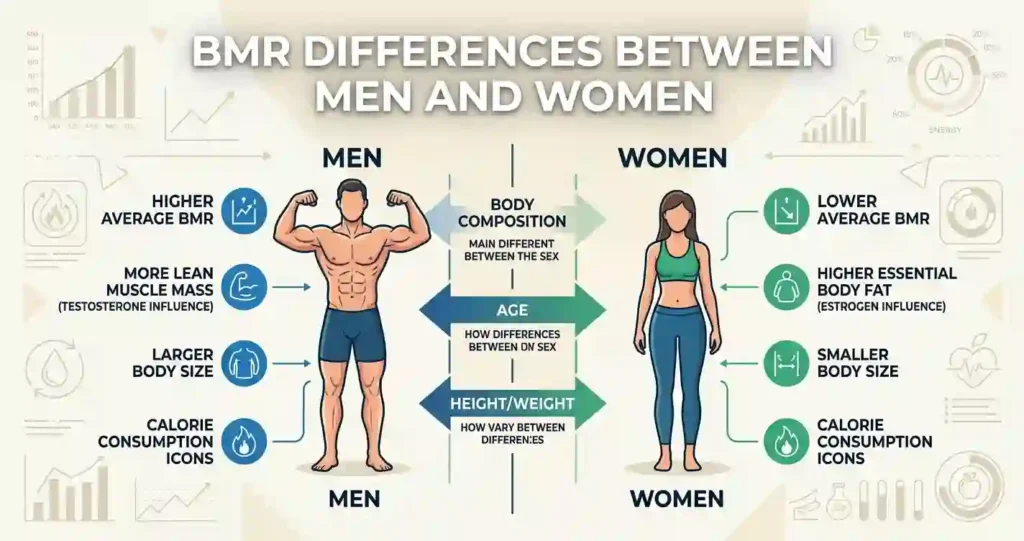
On average, men generally have a higher absolute Basal Metabolic Rate (BMR) than women of the same age and height. This difference exists primarily because men typically carry a higher proportion of lean body mass (muscle, bone, and organs) and lower average body fat. Because lean tissue is more metabolically active than fat tissue, it requires more energy to maintain at rest.
Sex is not the sole factor determining metabolic rate. An individual’s BMR is shaped by a combination of total body weight, height, age, and overall body composition.
Individual BMR varies significantly across the population. Consequently, broad gender-based averages should serve only as general context rather than fixed, personal calorie targets.
Why Do Men Usually Have a Higher BMR?
The primary driver behind sex-based metabolic differences is the relationship between lean body mass (or fat-free mass) and resting energy expenditure.
Metabolically active tissues—such as skeletal muscle, internal organs, and bone—require a steady supply of energy even when the body is completely at rest. Fat tissue is also metabolically active, but it consumes far fewer calories per kilogram than lean tissue.
Biological differences driven by hormones (such as higher natural levels of testosterone in men) mean that men generally develop a higher proportion of muscle mass and lower average body-fat percentages. As a result, a man and a woman of identical total body weight will often have different baseline energy demands if their ratio of muscle to fat tissue differs.
Do Women Have a Lower BMR?
Women often have a lower absolute BMR compared to men of similar age and height, largely because average total body size and total lean mass tend to be lower in females. Hormonally, women also naturally carry a higher percentage of essential body fat, which is vital for reproductive health and endocrine function.
This difference does not mean that women have a “slow metabolism” or an inefficient metabolic system. The female body utilizes energy with high efficiency, calibrated specifically to support human physiology and hormone balance.
An individual woman’s BMR can easily be higher than a man’s if she is taller, weighs more, carries a higher amount of lean muscle mass, or is younger than the male being compared.
BMR Comparison: Men vs Women
Comparing energy expenditure based solely on sex can lead to inaccurate assumptions. Body size and muscle mass remain the primary drivers of resting metabolism for everyone.
| Factor | Men | Women |
| Average BMR | Usually higher | Usually lower |
| Lean Body Mass | Typically higher | Typically lower |
| Average Body-Fat Percentage | Typically lower | Typically higher |
| Effect of Age | BMR generally declines | BMR generally declines |
| Individual Variation | Significant | Significant |
Comparing two individuals based strictly on sex overlooks critical personal metrics. Consider this example:
- Person A (Male): 35 years old, 175 cm tall, 70 kg, low muscle mass / sedentary background. Estimated BMR: ~1,600 kcal/day.
- Person B (Female): 28 years old, 175 cm tall, 70 kg, highly active strength athlete with significant muscle mass. Estimated BMR: ~1,580–1,620 kcal/day.
Despite the sex difference, their identical height, weight, and Person B’s higher relative lean mass result in virtually equivalent baseline calorie requirements.
What Factors Affect BMR in Men and Women?
Biological sex is just one variable used in standard predictive equations. Accurately estimating resting energy requirements requires looking at the full picture of an individual’s physical metrics.
┌─────────────────────────────────────────┐
│ Total BMR │
└────────────────────┬────────────────────┘
│
┌───────────────┬──────┴────────┬───────────────┐
│ │ │ │
┌────┴────┐ ┌────┴────┐ ┌────┴────┐ ┌────┴────┐
│ Age │ │ Height │ │ Weight │ │ Hormones│
│ & Mass │ │ & Surface│ │ & Composition│ │ & Health│
└─────────┘ └─────────┘ └─────────┘ └─────────┘
Age and BMR
BMR naturally tends to decline as we age. This gradual slowdown is primarily linked to sarcopenia—the natural loss of lean skeletal muscle mass that occurs over time, often accompanied by changes in physical activity levels.
- Muscle Retention: Engaging in regular resistance training helps preserve muscle mass as you get older.
- Protein Intake: Consuming adequate dietary protein supports muscle maintenance.
- Individual Rate of Change: Age-related changes in metabolism vary significantly from person to person based on lifestyle, strength training habits, and genetics.
Height and Body Size
Larger physical bodies require more total energy to sustain baseline physiological processes. A taller person has a larger total body surface area and a greater volume of circulatory and cellular infrastructure to maintain than a shorter person of equal weight.
Predictive formulas account for height alongside total weight to reflect these structural demands. There is also a distinction between:
- Absolute BMR: The total number of calories burned at rest per day (e.g., 1,700 kcal/day).
- Relative BMR: The calories burned per kilogram of body weight or lean mass, which allows for fairer comparisons between individuals of different heights and frames.
Body Weight and Lean Mass
Total body weight directly impacts energy expenditure: moving and maintaining a heavier body demands more energy. However, body composition determines how efficiently or rapidly those calories are burned at rest.
Fat-free mass (muscle, internal organs, bone, and fluid) is the primary driver of resting energy expenditure. Internal organs like the liver, brain, heart, and kidneys account for over half of your total resting energy burn, despite representing a small fraction of total weight. Skeletal muscle makes up most of the remaining lean mass and consumes energy continuously.
This explains why two people who weigh 80 kg can have noticeably different resting energy needs if one carries a higher proportion of muscle mass.
Hormones and Metabolic Health
The endocrine system exerts strong control over your resting metabolic rate:
- Thyroid Hormones: Triiodothyronine ($T_3$) and Thyroxine ($T_4$), produced by the thyroid gland, act as the primary regulators of metabolic velocity. An overactive thyroid (hyperthyroidism) elevates BMR, while an underactive thyroid (hypothyroidism) lowers it.
- Stress & Sex Hormones: Cortisol, adrenaline, estrogen, and testosterone influence energy balance, fat distribution, and tissue preservation.
- Medical Considerations: Certain prescription medications, chronic health conditions, or severe calorie restriction can alter hormonal output and lower metabolic rate.
Standard BMR calculators assume normal health and endocrine function; they are informational tools, not diagnostic instruments.
How to Calculate BMR for Men and Women
Because direct laboratory measurement of BMR requires specialized equipment, predictive equations are used to estimate daily resting energy expenditure based on age, sex, height, and weight.
The Mifflin-St Jeor equation is widely regarded by dietitians, healthcare professionals, and fitness experts as the most accurate modern standard for population-level BMR estimation.
Mifflin-St Jeor BMR Formula for Men
The predictive formula for adult males is structured as follows:
$$\text{BMR (Men)} = (10 \times \text{weight in kg}) + (6.25 \times \text{height in cm}) – (5 \times \text{age in years}) + 5$$
- Weight in kg: Total body weight multiplied by 10 accounts for general mass.
- Height in cm: Height multiplied by 6.25 accounts for surface area and stature.
- Age in years: Age multiplied by 5 subtracts energy demand over time to reflect natural age-related metabolic shifts.
- +5 Constant: A baseline male adjustment constant reflecting average population differences in lean body mass.
Worked Example (UK Male):
Consider James, a 32-year-old male living in Manchester:
- Weight: 82 kg
- Height: 180 cm
- Age: 32 years
$$\text{BMR} = (10 \times 82) + (6.25 \times 180) – (5 \times 32) + 5$$
$$\text{BMR} = 820 + 1,125 – 160 + 5 = \mathbf{1,790\text{ kcal/day}}$$
Mifflin-St Jeor BMR Formula for Women
The predictive formula for adult females is structured as follows:
$$\text{BMR (Women)} = (10 \times \text{weight in kg}) + (6.25 \times \text{height in cm}) – (5 \times \text{age in years}) – 161$$
The core variables for weight, height, and age remain identical to the male formula. However, the female formula applies a constant subtraction of $-161$ (instead of $+5$) to adjust for population-level differences in average baseline lean body mass and essential fat stores.
Worked Example (UK Female):
Consider Sarah, a 32-year-old female living in London:
- Weight: 65 kg
- Height: 168 cm
- Age: 32 years
$$\text{BMR} = (10 \times 65) + (6.25 \times 168) – (5 \times 32) – 161$$
$$\text{BMR} = 650 + 1,050 – 160 – 161 = \mathbf{1,379\text{ kcal/day}}$$
What If I Don’t Know My Weight in Kilograms?
In the UK, body weight is frequently measured in stones and pounds, while height is often tracked in feet and inches. To use standard BMR formulas accurately, convert your measurements into metric units first:
Weight Conversions:
- Stones to Kilograms: Multiply the number of stones by 6.35.
- Pounds to Kilograms: Divide total pounds by 2.2.
- Example: 11 stone 4 lbs = 158 lbs total. $158 \div 2.2 = \mathbf{71.8\text{ kg}}$.
Height Conversions:
- Inches to Centimetres: Multiply total inches by 2.54.
- Example: 5 feet 8 inches = 68 inches total. $68 \times 2.54 = \mathbf{172.7\text{ cm}}$.
Using consistent metric units ensures your BMR calculation is accurate.
Example of BMR Differences Between a Man and Woman
To see how sex-specific constants influence estimated baseline energy expenditure, compare two fictional adults of the exact same age, height, and overall weight.
Example Calculation
- Age: 40 years old
- Height: 175 cm
- Weight: 75 kg
Male Formula Application:
$$\text{BMR} = (10 \times 75) + (6.25 \times 175) – (5 \times 40) + 5$$
$$\text{BMR} = 750 + 1,093.75 – 200 + 5 = \mathbf{1,648.75\text{ kcal/day}}$$
Female Formula Application:
$$\text{BMR} = (10 \times 75) + (6.25 \times 175) – (5 \times 40) – 161$$
$$\text{BMR} = 750 + 1,093.75 – 200 – 161 = \mathbf{1,482.75\text{ kcal/day}}$$
Comparison Summary
| Metric | Male Profile | Female Profile | Difference |
| Age | 40 years | 40 years | 0 years |
| Height | 175 cm | 175 cm | 0 cm |
| Weight | 75 kg | 75 kg | 0 kg |
| Estimated BMR | 1,649 kcal/day | 1,483 kcal/day | 166 kcal/day |
The resulting difference of 166 kcal/day reflects the standard mathematical constant built into predictive formulas. This variance accounts for average differences in lean tissue vs. fat tissue between sexes across large population samples.
These figures remain estimates. If the woman in this comparison carries a high amount of athletic muscle mass while the man leads a sedentary lifestyle with lower relative muscle, their actual measured BMRs could be much closer—or even reversed.
Does a Higher BMR Mean You Can Eat More?
A higher BMR means that your body naturally burns more energy simply staying alive at complete rest. Consequently, a person with a high BMR requires a higher baseline intake of calories just to maintain vital functions.
However, BMR is not the total number of calories you can consume without gaining weight. Eating strictly at your BMR level would leave you in a significant calorie deficit because it ignores every form of movement and physical activity you engage in throughout the day.
To determine how many calories you actually burn daily, you need to calculate your Total Daily Energy Expenditure (TDEE).
How BMR Becomes TDEE
Your total daily energy expenditure is built on top of your BMR by layering in three additional components:
┌────────────────────────────────────────────────────────┐
│ Total Daily Energy Expenditure │
├───────────────┬─────────────────┬──────────────────────┤
│ BMR (60-75%) │ Physical Activity│ Thermic Effect │
│ │ & NEAT (15-30%) │ of Food (TEF (~10%)) │
└───────────────┴─────────────────┴──────────────────────┘
- BMR (Basal Metabolic Rate): Baseline resting energy expenditure (~60–75% of daily burn).
- NEAT (Non-Exercise Activity Thermogenesis): Energy spent on daily unstructured movement like walking, fidgeting, standing, and cleaning (~15% of daily burn).
- EAT (Exercise Activity Thermogenesis): Energy spent during structured workout sessions (~5–10% of daily burn).
- TEF (Thermic Effect of Food): Energy required to break down, absorb, and process the nutrients in your food (~10% of daily burn).
To estimate TDEE, standard physical activity multipliers are applied to your calculated BMR:
- Sedentary (desk job, minimal movement): $\text{BMR} \times 1.2$
- Lightly Active (light exercise 1–3 days/week): $\text{BMR} \times 1.375$
- Moderately Active (moderate exercise 3–5 days/week): $\text{BMR} \times 1.55$
- Very Active (hard exercise 6–7 days/week): $\text{BMR} \times 1.725$
Two individuals with the exact same BMR of 1,600 kcal/day can have vastly different daily energy requirements based on lifestyle:
- Sedentary Individual: $1,600 \times 1.2 = \mathbf{1,920\text{ kcal/day maintenance}}$
- Highly Active Individual: $1,600 \times 1.55 = \mathbf{2,480\text{ kcal/day maintenance}}$
BMR and Weight Loss for Men and Women
Understanding your BMR provides a clear starting point for calculating a safe, realistic weight-loss plan. Because BMR represents your baseline resting energy burn, calculating your full TDEE allows you to set an appropriate calorie target to achieve weight loss.
Creating a sustainable weight-loss plan requires establishing a moderate calorie deficit—eating fewer calories than your total daily energy expenditure (TDEE).
┌─────────────────────────────────────────┐
│ TDEE Level │
│ (e.g., 2,100 kcal/day) │
└────────────────────┬────────────────────┘
│
┌────────────────┴────────────────┐
│ │
┌───┴─────────────────┐ ┌─────────┴─────────┐
│ Calorie Deficit Target│ │ Total Energy Deficit│
│ (e.g., 1,600 kcal) │ │ (500 kcal/day) │
└─────────────────────┘ └───────────────────┘
Dropping calorie intake too far below your BMR for extended periods can trigger unwanted side effects, including extreme hunger, loss of lean muscle mass, fatigue, and reduced daily activity levels (NEAT). Target a manageable daily deficit of 300 to 500 calories below your TDEE, rather than severely restricting intake down to or below your BMR.
Can You Increase Your BMR?
While you cannot change core determinants like age or biological height, you can influence your resting metabolism through targeted lifestyle choices:
- Build & Preserve Lean Muscle Mass: Engaging in progressive resistance training (weight lifting, bodyweight exercises) stimulates muscle tissue growth and prevents age-related muscle loss.
- Consume Sufficient Protein: Adequate protein intake provides the necessary amino acids for muscle repair and retention, especially during weight loss. Protein also carries a higher Thermic Effect of Food (TEF) than carbohydrates or fats.
- Avoid Overly Restrictive Diets: Chronically low calorie intake can lead to muscle loss and adaptive responses that lower energy output.
Be cautious of commercial supplements, teas, or pills claiming to “boost” metabolism. These products rarely offer significant or permanent metabolic changes. Sustainable adjustments to resting metabolism come from building lean muscle tissue and maintaining healthy lifestyle habits.
BMR During a Calorie Deficit
When you maintain a calorie deficit over an extended period, your total body weight decreases. As a result, your overall baseline energy expenditure naturally declines—a process known as adaptive thermogenesis or metabolic adaptation.
Smaller bodies require less total energy to function at rest. If you drop from 85 kg to 75 kg, your new BMR will naturally be lower than when you started your weight loss journey.
To keep your progress consistent:
- Recalculate Periodically: Update your BMR and TDEE every 4 to 5 kg of weight lost.
- Prioritise Muscle Retention: Continue resistance training to minimize the portion of weight loss coming from lean muscle.
- Adjust Expectations: Recognize that as you get lighter, your daily maintenance calories will naturally adjust to your new body size.
BMR Differences During Different Life Stages
Energy needs shift over time in response to changes in body composition, physical activity, and hormonal status.
BMR in Younger Adults
During late adolescence and early adulthood (roughly ages 18 to 25), physical development, bone density growth, and naturally higher average muscle mass often contribute to a higher metabolic rate.
However, lifestyle shifts—such as transitioning into sedentary office work, reduced physical activity, or changes in diet—can lead to a drop in total daily energy expenditure during this phase. Energy needs should always be evaluated using personal activity levels and current metrics rather than age alone.
BMR During Pregnancy and Breastfeeding
During pregnancy, a woman’s body undergoes significant physiological changes. Total energy demands increase to support fetal growth, placenta development, expanded blood volume, and tissue formation.
- Pregnancy: Energy needs increase gradually, primarily during the second and third trimesters (typically requiring an additional 200 to 450 kcal/day above maintenance in later stages).
- Breastfeeding / Lactation: Milk production places significant metabolic demands on the body, requiring roughly an additional 300 to 500 kcal/day.
Standard BMR calculators are not calibrated for pregnant or lactating women. If you are pregnant or nursing, consult a doctor, midwife, or registered dietitian for personalized nutritional guidance.
BMR and Menopause
Many women experience changes in body composition during perimenopause and postmenopause, often noticing a gradual shift in weight management.
While it is common to attribute these changes entirely to a sudden decline in metabolic rate, research indicates that aging-related reductions in energy expenditure are primarily driven by:
- Loss of Lean Mass: Natural declines in muscle tissue, particularly when resistance training is reduced.
- Reductions in Daily Activity: Decreased overall movement and daily physical activity (NEAT).
- Hormonal Shifts: Fluctuations in estrogen levels, which can influence body fat distribution—often shifting fat storage toward the abdominal region.
Participating in regular strength training, staying active throughout the day, and prioritizing protein intake are effective strategies for maintaining lean muscle mass and supporting metabolic health through menopause.
Common Myths About BMR Differences Between Men and Women
Myth: Women Naturally Have a “Slow Metabolism”
Fact: A lower average absolute BMR does not mean a woman’s metabolism is sluggish, damaged, or unhealthy. Women generally burn fewer absolute calories at rest because their average total body mass and muscle volume are lower than those of men. Relative to total lean mass, female metabolic efficiency functions normally and effectively.
Myth: Muscle Automatically Gives You a Huge Metabolism Boost
Fact: Muscle tissue is metabolically active, but its effect on resting metabolism is often exaggerated. A kilogram of skeletal muscle burns approximately 10 to 15 calories per day at rest, compared to fat tissue, which burns roughly 4.5 calories per kilogram daily.
While gaining muscle helps elevate BMR over time, adding a couple of kilograms of muscle will not double your metabolic rate. Resistance training should be valued for its broader benefits: supporting strength, preserving functional independence, improving insulin sensitivity, and maintaining lean tissue during weight loss.
Myth: Your BMR Is the Number of Calories You Should Eat
Fact: Your BMR represents the calories your body burns at complete rest, excluding all movement, digestion, and daily tasks. Eating strictly at your BMR level creates an aggressive calorie deficit that ignores daily energy requirements. To set a safe target for weight loss or maintenance, always calculate your TDEE first.
How Accurate Are BMR Calculators?
Online predictive equations like the Mifflin-St Jeor formula provide a convenient estimation of resting energy expenditure for most healthy adults. However, these tools use population averages and do not directly measure your individual metabolic output.
Online formulas may overestimate or underestimate actual resting metabolic rate due to several individual factors:
- Body Composition Variances: Equations typically rely on total body weight rather than distinguishing between muscle and fat mass. An individual with an above-average amount of muscle tissue will burn more calories than the formula predicts.
- Hormonal Status: Conditions affecting thyroid hormones or adrenal function can alter energy expenditure beyond baseline mathematical predictions.
- Genetic Factors: Natural biological variations in tissue efficiency account for minor metabolic differences between individuals of similar size.
For clinical precision, indirect calorimetry measures resting metabolic rate by analyzing oxygen consumption and carbon dioxide production in a breath sample. For general fitness and weight management, online predictive formulas offer a practical baseline.
How to Get a More Accurate BMR Estimate
- Input Precise Data: Use recent, accurate values for your weight, height, age, and sex.
- Recalculate When Needed: Update your figures after noticeable changes in body composition or overall body weight.
- Track Real-World Results: Use calculated estimates as a baseline starting point. Monitor your body weight trends and dietary intake over several weeks, adjusting your calorie targets based on your progress.
BMR Calculator: Calculate Your Personal Basal Metabolic Rate
Ready to determine your baseline calorie needs? Using an online BMR calculator offers a simple way to estimate your resting daily calorie expenditure.
To calculate your estimated BMR, you will need to input four basic metrics:
- Sex (to select the appropriate predictive equation constants)
- Age (to account for biological changes over time)
- Height (in centimetres or feet/inches)
- Weight (in kilograms or stones/pounds)
Once you have your estimated BMR, multiply it by your physical activity level to calculate your Total Daily Energy Expenditure (TDEE). This figure serves as your starting point for setting calorie intake targets tailored to your goals.
BMR vs TDEE vs Maintenance Calories
This quick reference guide outlines how common energy expenditure terms compare:
| Term | What It Means | Main Use |
| BMR | Calories needed at complete rest to maintain vital life functions. | Baseline metabolic estimate |
| RMR | Estimate of resting energy burn measured in non-clinical settings. | Practical resting metabolic assessment |
| TDEE | Total calories burned in a 24-hour day across all activities. | Determining total daily energy burn |
| Maintenance Calories | Calorie intake required to maintain current weight. | Weight management planning |
| Calorie Deficit | Eating fewer calories than your total daily energy expenditure (TDEE). | Weight loss strategy |
Frequently Asked Questions About BMR Differences Between Men and Women
Is BMR higher in men than women?
On average, yes. Men generally have a higher absolute BMR than women of similar age and height. This difference exists primarily because men typically possess more lean skeletal muscle mass and less relative body fat. However, an individual woman with higher lean body mass or taller stature can have a higher BMR than a sedentary man of similar weight.
Why do men burn more calories at rest than women?
Men generally carry a higher proportion of fat-free mass (muscle, bone, and internal organs) and lower average body-fat percentage. Because lean tissue is more metabolically active than fat tissue, it requires more energy to sustain itself at rest.
Do women have slower metabolisms than men?
No. Describing a female metabolism as “slower” is an oversimplification. Women’s bodies process energy efficiently according to their specific biological requirements, lower average muscle mass, and smaller average frame size. Relative to total lean tissue, female metabolic function is effective and healthy.
Does muscle mass increase BMR?
Yes. Muscle tissue requires energy to maintain even when the body is at complete rest. While the metabolic contribution of muscle tissue is sometimes exaggerated online, preserving or building lean muscle through resistance training helps support resting energy expenditure and long-term weight management.
Does BMR decrease with age?
Yes. BMR generally declines with age, primarily due to the natural loss of lean muscle mass (sarcopenia) and potential reductions in physical activity. Regular strength training and adequate protein intake can help retain muscle mass as you get older.
Should men and women eat different numbers of calories?
Not necessarily based on sex alone. While men often have higher daily calorie requirements on average due to larger body size and higher BMR, individual calorie targets should always be based on total weight, height, age, activity levels, and personal health goals.
Can I use BMR to calculate calories for weight loss?
BMR serves as a starting point, but it should not be used as your final daily calorie target. To plan for weight loss, first calculate your Total Daily Energy Expenditure (TDEE) by multiplying your BMR by an activity factor. Then, apply a moderate calorie deficit (typically 300 to 500 calories per day below TDEE).
Can a woman’s BMR be higher than a man’s?
Yes. An individual woman’s BMR can easily be higher than a man’s if she is taller, weighs more, carries more lean muscle mass, or is significantly younger than the man being compared.
What is the most accurate way to measure BMR?
The most accurate method is indirect calorimetry, a clinical test that measures oxygen consumption and carbon dioxide production in a laboratory setting. For everyday practical tracking, established formulas such as the Mifflin-St Jeor equation provide reliable estimates.
Which BMR formula is best for men and women?
The Mifflin-St Jeor equation is widely recognized by health professionals as one of the most accurate predictive formulas for healthy adults. Using a consistent formula helps you effectively track and adjust your estimated calorie requirements over time.
Conclusion: Understanding Your BMR Can Improve Calorie Tracking
Your Basal Metabolic Rate (BMR) represents the foundation of your daily energy needs. While men generally have a higher average BMR than women due to differences in average body size and lean mass, sex is only one component of energy expenditure. Total weight, height, age, and individual body composition play central roles in determining how many calories your body burns at rest.
Rather than treating BMR as a daily eating target, use it as a starting baseline. By converting your BMR into Total Daily Energy Expenditure (TDEE), you can establish sustainable calorie targets for weight loss, weight maintenance, or muscle gain.
Ready to find out how many calories your body needs at rest? Use our BMR Calculator to calculate your estimated BMR, then use it to understand your daily calorie needs and plan your fitness or weight-management goals.
Calculate Your Personal BMR Today

Ehatasamul Alom is a dedicated health-tech enthusiast and the co-founder of BMRCalculator. With a passion for metabolic science, he focuses on providing accurate health data for the UK community. Ehatasamul ensures that every tool and guide aligns with NHS standards and public health research. His mission is to simplify complex biological data, helping British residents make informed decisions about their fitness, calorie needs, and long-term wellness. When not analyzing health trends, he explores the latest innovations in wearable fitness technology.