Basal metabolic rate (BMR) represents the baseline quantity of energy your body requires simply to stay alive. Whether your primary goal is shedding excess body fat, packing on lean tissue, or maintaining a healthy weight long-term, your BMR forms the foundational building block of your daily energy needs. Understanding how your body burns energy at rest allows you to tailor your nutrition and exercise routines with precision rather than relying on guesswork.
Featured Snippet Answer:
Muscle tissue is metabolically active, so having more lean muscle generally increases BMR, although the effect is smaller than many people assume. Skeletal muscle requires continuous energy for cellular upkeep, repair, and protein synthesis even while resting, meaning individuals with higher lean mass burn more calories around the clock.
Understanding your baseline energy needs requires distinguishing between three critical metabolic metrics:
- Basal Metabolic Rate (BMR): The absolute minimum number of calories your body burns at complete rest over 24 hours to support vital organ functions.
- Resting Metabolic Rate (RMR): A metric similar to BMR, but measured under slightly less strict conditions (e.g., without requiring an overnight stay in a clinical laboratory or strict fasting). It is often used interchangeably with BMR in everyday fitness settings.
- Total Daily Energy Expenditure (TDEE): The total number of calories you burn in a 24-hour period, comprising your BMR plus all physical movement, daily tasks, exercise, and the energy required to digest food.
What Is BMR?
Basal metabolic rate (BMR) is the amount of energy—measured in calories or kilojoules—that your body expends to maintain basic life-sustaining physiological functions during a state of complete physical and digestive rest in a thermo-neutral environment.
At rest, your body works continuously behind the scenes. BMR fuels essential internal operations including:
- Breathing and Gas Exchange: The mechanical work of the lungs and diaphragm.
- Circulation: The continuous pumping of blood by the heart to deliver oxygen and nutrients to tissues.
- Temperature Regulation: Maintaining a core body temperature around 37°C.
- Organ Function & Cellular Upkeep: The biological workloads of the brain, liver, kidneys, and gastrointestinal system, alongside active cellular transport and ion pumping.
Your unique BMR is determined by a complex interplay of physiological and biological variables:
                          ┌────────────────────────┐
                          │     Body Composition   │
                          │   (Lean Mass vs Fat)   │
                          └───────────┬────────────┘
                                      │
┌────────────────────────┐            │            ┌────────────────────────┐
│  Age, Sex, & Genetics  ├────────────┼───────────┤   Total Weight & Height │
└────────────────────────┘            │            └────────────────────────┘
                                      │
                          ┌───────────┴────────────┐
                          │ Hormones & Health Status│
                          └────────────────────────┘
BMR vs RMR vs TDEE
While BMR, RMR, and TDEE all measure energy expenditure, they apply to different physiological conditions and practical scenarios:
| Metric | Definition | Measurement Conditions | Primary Use Case |
| BMR (Basal Metabolic Rate) | Minimal energy needed for essential internal life processes. | Measured upon waking, post-fasting, in a strictly controlled thermo-neutral lab. | Scientific baseline; foundational starting point for algorithms. |
| RMR (Resting Metabolic Rate) | Minimal energy expended while resting quietly. | Measured in comfortable, non-fasted or lightly rested real-world settings. | Practical laboratory testing and clinical settings. |
| TDEE (Total Daily Energy Expenditure) | Total energy expended across a full 24-hour day. | Calculated over normal daily life incorporating all movements and meals. | Setting daily calorie targets for weight loss, maintenance, or muscle gain. |
TDEE is built upon four distinct components:
$$\text{TDEE} = \text{BMR} + \text{NEAT} + \text{EAT} + \text{TEF}$$
- BMR (Basal Metabolic Rate): Accountable for roughly 60%–75% of daily calorie burn in non-athletes.
- NEAT (Non-Exercise Activity Thermogenesis): Energy spent on unstructured daily movement such as walking to the bus, fidgeting, carrying groceries, or standing at a desk (15%–30% of TDEE).
- EAT (Exercise Activity Thermogenesis): Energy burned during deliberate workouts like running, cycling, or weightlifting (5%–15% of TDEE).
- TEF (Thermic Effect of Food): The energy required to digest, absorb, and metabolise nutrients from meals (roughly 10% of total intake).
   ┌─────────────────────────────────────────────────────────────┐
   │                       TDEE (100%)                           │
   └──────────────────────────────┬──────────────────────────────┘
                                  │
      ┌───────────────────────────┼───────────────────────────┐
      │                           │                           │
┌─────┴──────────────┐  ┌─────────┴──────────┐   ┌────────────┴─────────────┐
│    BMR (60–75%)    │  │  NEAT/EAT (15–30%) │   │        TEF (~10%)        │
│ Baseline Metabolic │  │  Daily Movement &  │   │ Energy Used to Digest    │
│    Functions       │  │     Exercise       │   │          Food            │
└────────────────────┘  └────────────────────┘   └──────────────────────────┘
Because BMR accounts only for resting cellular upkeep, online calorie calculators use your BMR as a numerical starting point. They then apply an activity multiplier to estimate your actual daily calorie requirement (TDEE). Treating BMR as your total daily calorie allowance would lead to severe under-fueling.
How Does Muscle Mass Affect BMR?
Lean body mass (LBM)—which encompasses skeletal muscle, organs, bones, and fluids, excluding essential and non-essential fat—is the primary driver of resting energy expenditure. Among the tissues you can consciously change, skeletal muscle is the most adaptable.
Muscle tissue requires continuous biochemical energy even when you are lying completely inactive. Energy is constantly consumed for:
- Protein Turnover: The endless synthesis and breakdown of structural proteins within muscle fibers.
- Cellular Ion Pumping: Maintaining sodium, potassium, and calcium gradients across muscle cell membranes to prepare them for contraction.
- Tissue Repair & Remodelling: Recovering from daily physical strain or exercise micro-trauma.
Increasing your skeletal muscle mass raises your baseline BMR, but it is important to understand that this change occurs incrementally rather than overnight.
Why Is Muscle Metabolically Active?
All living tissue requires energy to maintain cellular integrity, but tissues differ in their metabolic demands. Skeletal muscle is classified as metabolically active tissue because its cellular structure relies on active chemical pathways to function.
At rest, muscle cells must continuously consume adenosine triphosphate (ATP) to maintain their internal environment, perform routine protein repair, and handle metabolic waste. By contrast, stored adipose tissue (body fat) consists primarily of lipid droplets intended for long-term energy storage. While fat cells are active endo-metabolic units that secrete hormones, their resting structural maintenance requires far less energy than muscle tissue.
Does More Muscle Always Mean a Much Higher BMR?
A widespread myth in popular fitness culture suggests that adding a small amount of muscle turns your body into a continuous calorie-burning furnace. Claims that gaining 1 kg of muscle will burn hundreds of additional calories each day while sitting on the sofa are inaccurate.
       Popular Fitness Myth               Scientific Reality
┌────────────────────────────────┐    ┌─────────────────────────┐
│  +1 kg Muscle = +100 kcal/day  │ VS │ +1 kg Muscle ≈ 10–15    │
│   "Metabolic Furnace"      │    │    kcal/day at rest     │
└────────────────────────────────┘    └─────────────────────────┘
The true metabolic effect of gaining muscle depends on your total lean mass gain and overall body composition. Gaining 2–3 kg of lean muscle will raise your resting energy expenditure by a modest, measurable margin. However, it will not completely overhaul your daily calorie requirements on its own. The primary metabolic advantage of building muscle lies in higher physical work capacity (allowing you to burn more calories during exercise) combined with a gradual, sustained increase in baseline calorie burn.
How Much Does Muscle Increase BMR?
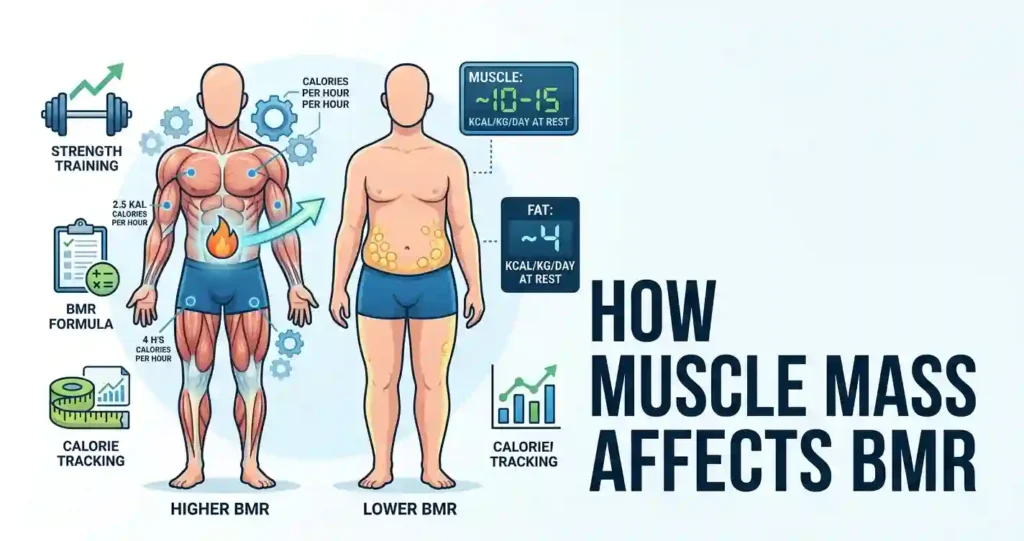
Direct physiological research shows that 1 kilogram of resting skeletal muscle burns approximately 10 to 15 calories (42 to 63 kJ) per day.
By comparison, 1 kilogram of adipose tissue burns approximately 4.5 calories (19 kJ) per day. While muscle is roughly two to three times more metabolically active at rest than fat, the absolute difference per unit of weight remains relatively small.
| Tissue Type | Estimated Resting Energy Expenditure (per kg/day) | Primary Biological Function |
| Internal Organs (Brain, Liver, Heart, Kidneys) | ~200–400+ kcal/kg | Vital systemic work, filtering, pumping, and regulation. |
| Skeletal Muscle | ~10–15 kcal/kg | Movement, structural support, protein storage, glucose handling. |
| Adipose Tissue (Body Fat) | ~4.5 kcal/kg | Energy storage, hormone regulation, thermal insulation. |
Internal organs account for roughly 60% to 70% of total BMR despite making up only around 6% of total body weight. Skeletal muscle represents roughly 40% of total body mass in healthy adults but accounts for about 20% to 25% of total resting energy expenditure.
Because you cannot deliberately expand the size of your liver or heart to raise your BMR, skeletal muscle remains the primary tissue you can safely build to support resting metabolism. Relying on fixed “calories burned per kilo of muscle” estimates can be misleading. Focusing on improving your overall lean body mass and tracking measurable strength gains provides a more reliable approach to health and fitness.
Muscle vs Fat: Which Burns More Calories at Rest?
┌─────────────────────────────────────────────────────────────────┐
│                 Resting Energy Expenditure                      │
├────────────────────────────────┬────────────────────────────────┤
│ Skeletal Muscle                │ Adipose Tissue (Fat)           │
│ 10–15 kcal/kg/day              │ 4.5 kcal/kg/day                 │
│ ■■■■■■■■■■■■■■                 │ ■■■■                           │
└────────────────────────────────┴────────────────────────────────┘
Skeletal muscle requires more calories to maintain at rest than adipose tissue. However, body fat is not inert insulation; it actively secretes signaling proteins and undergoes lipid turnover.
While muscle is more metabolically active than fat at rest, the difference during complete inactivity is measured in tens of calories per day rather than hundreds. The major metabolic disparity emerges when muscle tissue is put to work during physical movement.
Does Building Muscle Help With Weight Loss?
Building muscle supports weight management through multiple pathways:
                          ┌────────────────────────┐
                          │    Resistance Training │
                          └───────────┬────────────┘
                                      │
            ┌─────────────────────────┼─────────────────────────┐
            ▼                         ▼                         ▼
┌───────────────────────┐ ┌───────────────────────┐ ┌───────────────────────┐
│ Increases Lean Mass   │ │ Improves Insulin      │ │ Elevates Post-Workout │
│ & Resting BMR         │ │ Sensitivity & Storage │ │ Energy Expenditure    │
└───────────────────────┘ └───────────────────────┘ └───────────────────────┘
- Prevents Metabolic Slowdown: During a calorie deficit, the body may break down muscle tissue alongside fat. Maintaining lean mass through strength training keeps your baseline BMR stable.
- Improves Nutrient Partitioning: Muscular individuals exhibit higher insulin sensitivity. This means consumed carbohydrates are more readily stored as muscle glycogen rather than directed to adipose tissue.
- Elevates Post-Workout Calorie Burn: Heavy resistance exercise triggers excess post-exercise oxygen consumption (EPOC), causing your body to burn extra calories during structural muscle repair over the following 24 to 48 hours.
Relying on muscle building alone as a rapid weight-loss tool is rarely effective. Successful body transformation relies on pairing progressive strength training with an appropriate calorie target, sufficient protein, and regular movement.
What Factors Affect BMR Besides Muscle Mass?
While muscle mass is a key adjustable component of resting energy expenditure, it is only one variable among several distinct physiological drivers.
                                 ┌────────────────────────┐
                                 │     TOTAL BMR          │
                                 └───────────┬────────────┘
                                             │
      ┌───────────────────┬──────────────────┼──────────────────┬──────────────────┐
      ▼                   ▼                  ▼                  ▼                  ▼
┌───────────┐       ┌───────────┐      ┌───────────┐      ┌───────────┐      ┌───────────┐
│ Body Size │       │    Age    │      │ Biological│      │ Genetics  │      │ Hormones  │
│  & Mass   │       │           │      │    Sex    │      │           │      │ & Health  │
└───────────┘       └───────────┘      └───────────┘      └───────────┘      └───────────┘
Two individuals of the same overall scale weight can have markedly different BMRs based on how these variables interact:
- Person A: Weighs 80 kg with 15% body fat (68 kg fat-free mass).
- Person B: Weighs 80 kg with 35% body fat (52 kg fat-free mass).
Person A will have a higher BMR due to carrying 16 kg more metabolically active tissue, even though their scale weight is identical.
Body Weight and Lean Body Mass
Total body volume influences overall energy expenditure. A larger body contains more living tissue, a higher total blood volume, and larger organs, requiring more baseline energy for routine upkeep.
However, fat-free mass (FFM)—your total body mass minus all fat mass—serves as the single strongest predictor of BMR across clinical research. When calculating calorie targets, formulas that account for body composition (such as the Katch-McArdle formula) provide more precise estimates for individuals with higher or lower than average muscle mass.
Age
BMR tends to decline gradually with advancing age, typically at a rate of roughly 1% to 2% per decade after early adulthood.
Age 25 ────────────────────────────────────────► Peak Baseline BMR
Age 40 ───────────► -2% to 4% Reduction (Often tied to sedentary lifestyle)
Age 65+ ──────────► Accelerated drop if sarcopenia (muscle loss) occurs
This metabolic slowdown is driven largely by two factors: loss of skeletal muscle mass (sarcopenia) and decreased metabolic activity within internal organs. However, age-related metabolic decline is not entirely unchangeable. Engaging in lifelong resistance training and eating enough protein helps preserve muscle tissue, maintaining your baseline metabolic rate as you age.
Sex, Height and Genetics
- Biological Sex: On average, biological males possess higher BMRs (roughly 5% to 10% higher) than biological females of equal weight and age. This difference is primarily due to higher average skeletal muscle mass and lower essential fat percentage driven by testosterone.
- Height & Surface Area: Taller individuals possess larger total body surface area, leading to greater heat dissipation and requiring higher baseline energy expenditure to maintain core body temperature.
- Genetics: Inherited genetic factors influence baseline cellular efficiency, mitochondrial density, thyroid hormone conversion rates, and natural lean mass distribution.
Hormones, Health and Environment
- Thyroid Hormones: Triiodothyronine ($T_3$) and Thyroxine ($T_4$) directly regulate cellular metabolic rates across all body tissues. An underactive thyroid (hypothyroidism) lowers BMR, whereas an overactive thyroid (hyperthyroidism) elevates it.
- Immune System Response & Illness: Fever, physical trauma, surgical recovery, and chronic inflammatory conditions significantly raise energy expenditure as the body spends resources repairing tissue and mounting defense responses.
- Ambient Temperature: Prolonged exposure to extreme cold (triggering shivering and non-shivering thermogenesis via brown adipose tissue) or extreme heat (elevating cardiovascular cooling efforts) increases baseline calorie burn.
- Stress & Sleep Deprivation: Elevated cortisol levels paired with chronic sleep restriction disrupt glucose metabolism, alter appetite hormones (ghrelin and leptin), and encourage muscle protein breakdown.
Note: If you experience sudden, unexplained weight changes or extreme fatigue despite stable diet and exercise habits, consult a qualified medical professional to evaluate underlying endocrine function.
How to Increase BMR by Building Muscle
Safely increasing your baseline energy expenditure involves long-term body recomposition rather than short-term diet tricks. The most effective approach combines structured resistance training, targeted nutrition, and adequate physical recovery.
       ┌─────────────────────────────────────────────────────────────┐
       │             SUSTAINABLE BMR ELEVATION STRATEGY               │
       └──────────────────────────────┬──────────────────────────────┘
                                      │
         ┌────────────────────────────┼────────────────────────────┐
         ▼                            ▼                            ▼
┌───────────────────┐        ┌───────────────────┐        ┌───────────────────┐
│ Progressive       │        │ Targeted Protein  │        │ Sleep & Nervous   │
│ Resistance Work   │        │ & Energy Intake   │        │ System Recovery   │
└───────────────────┘        └───────────────────┘        └───────────────────┘
Prioritise Strength Training
To stimulate muscle growth (hypertrophy), your physical training must apply a structured loading stimulus to target muscle groups. Focus your workouts around compound resistance movements:
- Lower Body: Squats, Romanian Deadlifts, Lunges, Leg Presses.
- Upper Body Push: Overhead Presses, Bench Presses, Push-ups, Dips.
- Upper Body Pull: Barbell Rows, Lat Pulldowns, Pull-ups, Cable Rows.
Apply the principle of progressive overload: systematically increasing the resistance, volume, or difficulty of your exercises over time. This continuous challenge forces muscle fibers to adapt and grow. Aim for 2 to 4 structured resistance sessions per week, prioritizing proper technique and movement quality over heavy loads.
Eat Enough Protein
Dietary protein supplies the essential amino acids necessary for repairing exercise-induced muscle damage and synthesizing new structural tissue.
Incorporate high-quality protein sources throughout your meals. Common choices in UK kitchens include:
┌───────────────────────────────────┬───────────────────────────────────┐
│ Animal-Based Protein              │ Plant-Based Protein               │
├───────────────────────────────────┼───────────────────────────────────┤
│ • Eggs & Egg Whites               │ • Lentils, Chickpeas & Beans      │
│ • Greek Yogurt & Cottage Cheese   │ • Tofu, Tempeh & Edamame          │
│ • Skinless Chicken & Turkey Breast│ • Quinoa & Whole Grains           │
│ • White Fish, Salmon & Mackerel   │ • Hemp, Chia & Pumpkin Seeds      │
│ • Lean Beef Steaks & Mince        │ • High-Protein Plant Milk/Powders │
└───────────────────────────────────┴───────────────────────────────────┘
While optimal intake depends on age, body mass, and activity levels, a practical guideline for supporting muscle development is 1.2 to 2.0 grams of protein per kilogram of total body mass per day. Spacing protein intake across 3 to 4 meals throughout the day helps optimize muscle protein synthesis.
Get Enough Sleep and Recover
Muscle growth does not take place while you are training in the gym; it occurs during rest when your body is supplied with sufficient nutrients.
- Prioritise Sleep: Aim for 7 to 9 hours of quality sleep per night. Deep sleep triggers natural growth hormone release, facilitating muscle repair and tissue rebuilding.
- Manage Training Fatigue: Schedule at least 1 to 2 complete rest or active recovery days per week to prevent overtraining and joint strain.
- Fuel Your Recovery: Avoid severe, low-calorie diets while attempting to build muscle mass. Restrictive deficits compromise recovery pathways and elevate muscle tissue breakdown.
How to Calculate Your BMR
Because directly measuring BMR via laboratory indirect calorimetry is costly and complex, validated predictive equations provide reliable clinical and practical estimates.
The most widely validated formula for general populations is the Mifflin-St Jeor Equation:
$$\text{For Males: } \text{BMR (kcal/day)} = (10 \times \text{weight in kg}) + (6.25 \times \text{height in cm}) – (5 \times \text{age in yrs}) + 5$$
$$\text{For Females: } \text{BMR (kcal/day)} = (10 \times \text{weight in kg}) + (6.25 \times \text{height in cm}) – (5 \times \text{age in yrs}) – 161$$
What Information Do You Need to Calculate BMR?
To get an accurate estimate from a standard BMR calculator, you need four key inputs:
- Age (Years): Accounts for age-related baseline metabolic changes.
- Biological Sex: Adjusts for average hormonal and body composition differences.
- Height (Centimetres): Accounts for body surface area and bone structure.
- Weight (Kilograms): Measures total body volume requiring energy upkeep.
If you know your body fat percentage, advanced formulas such as the Katch-McArdle Equation derive BMR directly from your lean mass:
$$\text{BMR (kcal/day)} = 370 + (21.6 \times \text{Lean Mass in kg})$$
Remember that your calculated BMR represents your resting baseline expenditure—not your final daily calorie target.
Example of a BMR Calculation
Scenario: A 35-year-old female weighing 68 kg at a height of 168 cm.
Using the Mifflin-St Jeor Equation:
$$\text{BMR} = (10 \times 68) + (6.25 \times 168) – (5 \times 35) – 161$$
$$\text{BMR} = 680 + 1050 – 175 – 161$$
$$\text{BMR} = 1,394 \text{ kcal/day}$$
This individual requires roughly 1,394 calories per day simply to maintain baseline biological functions at complete rest.
How to Use BMR for Weight Loss
BMR serves as the starting baseline for building a practical, personalized nutrition plan.
┌──────────────┐     Multiply by     ┌──────────────┐     Apply Deficit     ┌──────────────┐
│ Calculated   │  ────── Activity ──►│   Estimated  │  ─── (-300 to -500) ──►│ Daily Calorie│
│   BMR        │      Multiplier     │    TDEE      │      kcal/day         │   Target     │
└──────────────┘                     └──────────────┘                       └──────────────┘
From BMR to TDEE
To calculate your true daily energy needs (TDEE), your resting BMR is multiplied by an Activity Factor reflecting your lifestyle and movement:
- Sedentary (Desk job, minimal exercise): $\text{BMR} \times 1.2$
- Lightly Active (Light exercise 1–3 days/week): $\text{BMR} \times 1.375$
- Moderately Active (Moderate exercise 3–5 days/week): $\text{BMR} \times 1.55$
- Very Active (Hard exercise 6–7 days/week): $\text{BMR} \times 1.725$
- Extra Active (Physical job + intense daily training): $\text{BMR} \times 1.9$
Using our previous example ($\text{BMR} = 1,394 \text{ kcal}$): If she works a desk job but trains 3 days per week (Moderately Active, $1.55$ multiplier):
$$\text{TDEE} = 1,394 \times 1.55 = 2,160 \text{ kcal/day}$$
To lose fat safely, she would apply a moderate deficit of 300 to 500 calories to her TDEE (resulting in a daily intake of 1,660–1,860 calories)—not her baseline BMR.
Should You Eat Below Your BMR to Lose Weight?
Eating below your estimated BMR for extended periods is generally unhelpful and counterproductive.
                       SEVERE CALORIE RESTRICTION
                         (< BMR for long periods)
                                    │
         ┌──────────────────────────┼──────────────────────────┐
         ▼                          ▼                          ▼
┌─────────────────┐        ┌─────────────────┐        ┌─────────────────┐
│ Muscle Tissue   │        │ Lethargy & Low  │        │ Hormones Drop   │
│ Breakdown       │        │ Daily Movement  │        │ (Thyroid, Sex)  │
└─────────────────┘        └─────────────────┘        └─────────────────┘
Regularly dropping intake below your baseline resting expenditure can lead to adverse outcomes:
- Muscle Wasting: The body breaks down lean tissue for energy, which lowers overall BMR.
- Metabolic Adaptation: Endocrine adaptations reduce thyroid output, lower body temperature, and decrease spontaneous movement (NEAT).
- Nutritional Deficiencies & Lethargy: Inadequate energy intake impairs immune function, bone density, and daily performance.
For safe fat loss, establish your deficit relative to your TDEE, ensuring your calorie target remains adequate to meet your baseline health needs.
Does Building Muscle Make You Burn More Calories All Day?
Building lean tissue expands overall daily energy expenditure through both resting metabolic rate and active exercise.
┌────────────────────────────────────────────────────────────────────────┐
│                   TOTAL METABOLIC BENEFIT OF MUSCLE                    │
├───────────────────────────────────┬────────────────────────────────────┤
│ RESTING IMPACT                    │ ACTIVE IMPACT                      │
│ • Higher Baseline BMR             │ • Higher Work Output During Exercise│
│ • Increased Protein Synthesis     │ • Increased Daily Movement (NEAT)  │
│ • Elevated Post-Exercise Oxygen   │ • Better Fuel Storage & Handling   │
│   Consumption (EPOC)              │                                    │
└───────────────────────────────────┴────────────────────────────────────┘
Muscle, Exercise and TDEE
While muscle tissue increases your resting calorie burn by a modest amount, its contribution expands when you are active. Moving a muscular body requires more mechanical energy than moving a less muscular frame of equal weight.
Furthermore, building muscle improves physical capacity, allowing you to train harder during workout sessions. This increases exercise energy expenditure (EAT) while preserving spontaneous daily movement (NEAT), leading to a meaningful overall increase in TDEE.
Common Myths About Muscle Mass and Metabolism
Myth 1: "1 lb of muscle burns 50 extra calories a day."
Reality: Muscle burns ~6 calories per pound (~10-15 kcal/kg) at rest.

Myth 2: "Cardio destroys muscle and ruins your metabolism."
Reality: Moderate cardio supports heart health without breaking down muscle when eating enough protein.

Myth 3: "A slow metabolism makes losing weight impossible."
Reality: Metabolic rate varies naturally, but fat loss remains reliable via consistent, moderate deficits.
Myth: One Pound of Muscle Burns Hundreds of Extra Calories
- The Myth: Fitness advertisements often claim that adding a single pound (0.45 kg) of muscle burns an extra 30 to 50 calories per day at rest.
- The Fact: Laboratory measurements show that one pound of resting skeletal muscle burns roughly 6 calories per day (13–15 kcal/kg). While gaining 10 pounds (4.5 kg) of muscle adds a helpful 60 calories to your daily baseline expenditure, it does not rewrite the laws of energy balance on its own.
Myth: Cardio Destroys Muscle and Slows Your Metabolism
- The Myth: Performing cardiovascular exercise causes your body to waste muscle tissue and lowers your BMR.
- The Fact: Moderate aerobic exercise supports cardiovascular health, capillary density, and recovery. Cardio only leads to muscle loss when paired with extreme calorie deficits, inadequate protein intake, or excessive training volume without proper recovery. Combined strength and endurance training provides well-rounded fitness.
Myth: A Slow Metabolism Makes Weight Loss Impossible
- The Myth: People who struggle to lose weight often attribute their progress to an inactive or “broken” metabolism.
- The Fact: Clinical studies show that baseline metabolic rates vary by roughly 5% to 8% among healthy adults of identical size and body composition. Difficulties with weight loss are more often driven by subtle overestimation of food intake or underestimation of total movement, alongside natural drops in daily non-exercise activity (NEAT).
Muscle Mass, BMR and Different Weight-Loss Goals
Adjusting your approach based on your specific body composition targets ensures better long-term results:
┌─────────────────────────┬─────────────────────────┬─────────────────────────┐
│        FAT LOSS         │    MUSCLE GAIN          │   RECOMPOSITION         │
├─────────────────────────┼─────────────────────────┼─────────────────────────┤
│ Moderate Deficit        │ Moderate Surplus        │ Maintenance Calories    │
│ (~300–500 kcal below    │ (~200–300 kcal above    │ High Protein Intake     │
│ TDEE)                   │ TDEE)                   │ Progressive Resistance  │
│ Preserve Lean Mass      │ Progressive Overload    │ Suitable for Beginners  │
└─────────────────────────┴─────────────────────────┴─────────────────────────┘
Fat Loss While Preserving Muscle
When focusing on fat loss, the objective is to maximize fat reduction while maintaining lean muscle tissue.
- Establish a Moderate Deficit: Aim for a 300 to 500 kcal daily deficit below TDEE to encourage a steady fat loss rate of 0.5% to 1% of body weight per week.
- Maintain Resistance Training: Keep lifting weights to signal to your body that muscle tissue is essential and should be preserved.
- Keep Protein High: Consume 1.6 to 2.2 g of protein per kg of total body weight daily to limit muscle tissue breakdown while in a deficit.
Track your progress using strength levels, body measurements, and progress photos rather than relying solely on the bathroom scale.
Building Muscle While Managing Body Fat
For individuals focused primarily on adding lean tissue without gaining excess body fat:
- Establish a Slight Surplus: Eat roughly 200 to 300 kcal above your maintenance TDEE to supply energy for new muscle tissue synthesis.
- Focus on Progressive Overload: Track your workout performance and aim to gradually increase weights or repetitions over time.
- Patience & Consistency: Natural muscle synthesis occurs gradually (roughly 0.5–1 kg per month for novice lifters, and significantly less for experienced lifters). Pushing for faster scale weight gain often leads to excess fat accumulation.
How the BMR Calculator Can Help
Using a reliable calculator simplifies energy expenditure estimates into an actionable starting point.
┌─────────────────────┐      ┌─────────────────────┐      ┌─────────────────────┐
│ 1. Input Personal   │ ───► │ 2. Select Activity  │ ───► │ 3. Determine Intake │
│ Data (Age,Sex,Mass) │      │ Level Multiplier    │      │ Target for Goals    │
└─────────────────────┘      └─────────────────────┘      └─────────────────────┘
Use Your BMR to Estimate Your Calorie Needs
- Calculate Your BMR: Input your biological sex, age, height, and body weight into an equation like Mifflin-St Jeor.
- Determine Your TDEE: Multiply your baseline BMR by an activity factor matching your average physical routine.
- Set Your Daily Intake Goal: Subtract 300–500 kcal for targeted fat loss, or add 200–300 kcal for deliberate muscle gain.
Reassess these values every 6 to 8 weeks, as changes in overall body mass and activity levels will shift your baseline expenditure.
Track Progress Rather Than Chasing a BMR Number
A calculated BMR is an estimate, not a direct laboratory measurement. Use your result as a initial guideline, then track real-world markers over 3 to 4 weeks:
- Weekly average scale weight trends.
- Gym performance and strength progression.
- Waist and tape measurements.
- Overall daily energy levels and sleep quality.
Adjust your calorie intake based on real-world progress rather than relying strictly on calculated estimates.
Frequently Asked Questions About Muscle Mass and BMR
Does having more muscle increase BMR?
Yes. Muscle tissue is metabolically active and requires continuous energy for cellular maintenance and protein synthesis. Greater lean muscle mass is directly associated with a higher resting metabolic rate.
How much does 1 kg of muscle increase BMR?
Research indicates that 1 kg of resting skeletal muscle burns approximately 10 to 15 calories (42 to 63 kJ) per day. This effect is modest, but it provides a meaningful, sustained contribution to baseline energy expenditure over time.
Does losing muscle lower your BMR?
Yes. Decreasing your fat-free mass reduces total metabolically active tissue, which lowers baseline BMR. This is why preserving lean tissue via strength training and adequate protein intake is valuable during weight loss.
Is muscle more metabolically active than fat?
Yes. Skeletal muscle requires roughly 10 to 15 calories per kg per day at rest, compared to approximately 4.5 calories per kg for adipose tissue. While muscle is two to three times more metabolically active at rest, both tissues burn far fewer calories than internal organs.
Can strength training increase BMR?
Yes. Resistance training increases BMR over time by building or preserving lean muscle tissue. Additionally, intense lifting sessions elevate metabolic rate for up to 24 to 48 hours post-workout during tissue recovery (EPOC).
Does BMR increase when you gain weight?
Yes. Gaining overall body weight increases your baseline BMR because a larger physical body requires more energy to maintain. However, gaining lean muscle tissue increases BMR more effectively per unit of weight than gaining fat mass.
Is BMR the same as the calories I should eat each day?
No. BMR reflects the baseline energy required to sustain vital organ functions while lying at complete rest. Your total daily calorie needs (TDEE) include physical movement, daily chores, and exercise, making your daily targets higher than your BMR.
How can I increase my BMR naturally?
The most reliable way to increase your BMR naturally is to build lean muscle mass through progressive resistance training, consume sufficient protein, stay physically active throughout the day, and get consistent, quality sleep.
Why is my BMR different from someone else’s?
BMR varies based on differences in overall body mass, fat-free mass, age, biological sex, height, genetics, thyroid function, and immune health. Two people of identical weight can have different baseline energy needs.
Can I lose weight without increasing my BMR?
Yes. Weight loss occurs by maintaining a safe calorie deficit relative to your Total Daily Energy Expenditure (TDEE). Increasing your BMR helps keep your energy baseline robust, but it is not a mandatory requirement for fat loss.
Conclusion: Understanding the Link Between Muscle Mass and BMR
Having more lean muscle tissue generally increases your Basal Metabolic Rate (BMR), as muscle requires continuous energy for repair and maintenance even while at rest. However, this effect is incremental—roughly 10 to 15 calories per kilogram of muscle per day—rather than an immediate metabolic overhaul.
The primary value of building muscle goes beyond its resting metabolic rate. Muscle tissue enhances physical work capacity, supports healthy insulin sensitivity, preserves functional independence as you age, and helps prevent metabolic slowdown during fat loss. For sustainable body composition changes, pair progressive strength training with adequate protein intake, sufficient sleep, and a well-structured calorie target based on your Total Daily Energy Expenditure (TDEE).
Calculate Your BMR Today
Understanding your personal baseline energy needs removes the guesswork from nutrition planning. Use our accurate BMR Calculator to estimate your resting calorie expenditure, determine your TDEE, and set tailored calorie targets aligned with your personal health and fitness goals.

Ehatasamul Alom is a dedicated health-tech enthusiast and the co-founder of BMRCalculator. With a passion for metabolic science, he focuses on providing accurate health data for the UK community. Ehatasamul ensures that every tool and guide aligns with NHS standards and public health research. His mission is to simplify complex biological data, helping British residents make informed decisions about their fitness, calorie needs, and long-term wellness. When not analyzing health trends, he explores the latest innovations in wearable fitness technology.