
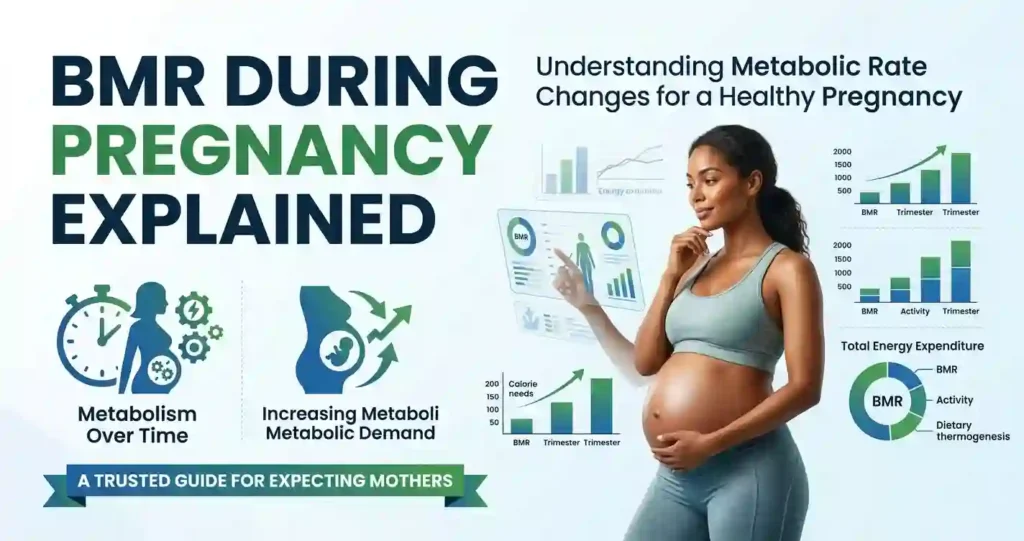
What Is BMR During Pregnancy?
Basal Metabolic Rate (BMR) represents the minimum number of calories your body burns at rest over a 24-hour period to maintain vital, life-sustaining functions. These fundamental processes include beating your heart, expanding and contracting your lungs, renewing cells, regulating internal body temperature, and keeping your liver, kidneys, and nervous system operating continuously.
In non-pregnant adults, BMR accounts for roughly 60% to 75% of daily energy usage. During pregnancy, understanding BMR during pregnancy becomes crucial because your body undergoes profound physiological transformations. Resting metabolic rate shifts significantly as maternal organs work harder, blood volume expands, and a developing fetus creates new energy demands.
However, standard energy calculations used for general weight management do not automatically translate to expectant mothers. To track energy needs safely, it is essential to distinguish between four key nutrition terms:
- Basal Metabolic Rate (BMR): The strict metabolic rate measured in a thermo-neutral state immediately upon waking after an overnight fast, accounting only for involuntary organ function.
- Resting Metabolic Rate (RMR): A practical clinical measurement of resting energy expenditure taken under less rigid conditions, typically running about 10% higher than true BMR.
- Total Daily Energy Expenditure (TDEE): The cumulative total of all calories burned in 24 hours, including resting metabolism, daily physical movement, formal exercise, and digesting food.
- Daily Calorie Needs: The overall energy intake required to support TDEE alongside stage-specific pregnancy demands, such as fetal tissue development and maternal storage.
What Does BMR Mean in Simple Terms?
In plain language, your BMR is the energy baseline your body requires just to keep the lights on if you lay completely still in bed for 24 hours without moving a single muscle.
                                  [ WHAT BMR INCLUDES ]
   Heart Rate & Blood Flow  +  Lungs & Oxygen Synthesis  +  Brain & Organ Function  +  Body Temp Control
                                             │
                                             ▼
                                 Basal Metabolic Rate (BMR)
                                             ▲
                                             │
                                  [ WHAT BMR EXCLUDES ]
   Walking / Daily Chores   +   Exercise & Sport   +   Digesting Food (TEF)   +   Workplace Activity
- What BMR includes: Automatic, involuntary biological operations (brain activity, cellular respiration, thyroid hormone production, blood filtration in the kidneys, and keeping your core body temperature at roughly $37^\circ\text{C}$).
- What BMR does NOT include: Rolling over in bed, sitting up, chewing food, walking to the kitchen, carrying groceries, or working out.
Is BMR the Same as Daily Calorie Needs?
No, BMR is only one baseline component of your daily calorie needs. Consuming only your estimated BMR calories would leave your body short on fuel for basic daily movement, exercise, and the digestive process itself.
When estimating total daily energy expenditure, your baseline resting rate is multiplied and expanded by several additional dynamic layers:
- Non-Exercise Activity Thermogenesis (NEAT): Spontaneous daily movements, standing, walking around the house, working, and fidgeting.
- Thermic Effect of Food (TEF): The metabolic energy required to chew, digest, absorb, and store nutrients from meals (roughly 10% of total daily intake).
- Exercise Activity Thermogenesis (EAT): Structured workouts, swimming, yoga, or purposeful brisk walking.
- Pregnancy-Specific Metabolic Costs: The biological energy required to synthesize new placental tissue, expand maternal blood volume, and fuel rapid fetal tissue growth.
Does BMR Increase During Pregnancy?
Featured Snippet Answer: Yes, BMR generally increases during pregnancy to support fetal growth, placental development, expanded maternal blood volume, and heightened organ workloads. However, the increase is not immediate, uniform, or identical for every person; energy requirements shift progressively across each trimester based on pre-pregnancy body composition, individual metabolic adaptations, and physical activity levels.
Maternal energy expenditure increases because your physiological systems expand dramatically to nurture developing life. The growing uterus, expanding breast tissue, increased cardiac output (your heart pumps up to 30–50% more blood during pregnancy), and the metabolic processes of the fetus and placenta all demand a higher resting calorie burn.
Expanded Blood Volume + Uterine Growth + Placenta Synthesis + Fetal Tissue Building = Increased Resting Burn
Despite these demands, there is no single universal percentage increase that applies to every expectant mother. Energy adaptation varies considerably from person to person. Factors such as pre-pregnancy Body Mass Index (BMI), baseline muscle mass, hormonal fluctuations, and natural reductions in daily physical activity mean that two women at 28 weeks of gestation can experience very different changes in baseline BMR.
How Pregnancy Can Affect Metabolism
Pregnancy triggers a series of complex biological shifts designed to prioritize fetal growth while maintaining maternal health.
Hormonal shifts lead these metabolic changes:
- Human Placental Lactogen (hPL) & Progesterone: Alter insulin sensitivity, ensuring a steady supply of glucose reaches the fetus while altering maternal fat metabolism.
- Thyroid Hormones ($T_3$ and $T_4$): Thyroid gland activity often increases during pregnancy, directly raising baseline cellular respiration and energy usage.
- Leptin & Insulin: Adjust appetite signaling, food absorption speed, and fat storage mechanisms to build necessary energy reserves for late-stage pregnancy and lactation.
These hormonal adjustments alter how your body stores and burns macronutrients. During early pregnancy, your metabolism focuses on anabolic storage (building fat reserves and tissue). In late pregnancy, it transitions into a catabolic state, mobilizing maternal nutrient stores to supply rapid fetal growth.
Does BMR Increase in Every Trimester?
Metabolic rate and calorie needs do not jump up the moment conception occurs. Instead, they follow a progressive curve across the three trimesters:
First Trimester: Minimal Baseline Change ---> Second Trimester: Moderate Rise (~340 kcal/day) ---> Third Trimester: Peak Expenditure (~450 kcal/day)
It is crucial to recognize that these shifting metabolic demands should never be used as a reason to deliberately restrict food intake or severely overeat without clinical cause. Any significant dietary adjustment during pregnancy should be discussed with a qualified healthcare professional, such as your NHS midwife, GP, or a Registered Dietitian.
How BMR Changes During Each Trimester
To manage maternal health and support fetal development, resting metabolic demands shift continuously from conception through to labor. Pre-pregnancy weight, height, age, physical activity, and gestational progress all shape these requirements.
| Trimester | Gestational Timeline | Primary Physiological Drivers | General Energy Consideration |
| First Trimester | Weeks 1 – 12 | Embryonic development, rapid hormonal shifts, uterine adaptation. | Minimal change. Total daily calorie demands remain essentially baseline. |
| Second Trimester | Weeks 13 – 27 | Placental maturation, expansion of maternal blood volume, initial rapid fetal growth. | Moderate increase. Resting metabolic demands rise; energy targets typically increase modestly. |
| Third Trimester | Weeks 28 – 40+ | Peak fetal weight gain, maximum cardiac output, heavy placental and tissue workload. | Highest increase. Resting metabolic rate peaks, though physical activity often decreases naturally. |
BMR in the First Trimester
During the first 12 weeks of pregnancy, fetal development focuses on organogenesis (forming basic structures and organs). Because the embryo is tiny, the physical energy required to fuel its growth is minimal.
As a result, your overall BMR increases very little in the first trimester. Most women do not require additional daily calories during this early window.
Furthermore, common early pregnancy symptoms often affect energy intake and expenditure:
- Morning Sickness & Nausea: Can lower actual calorie absorption and make meeting baseline energy requirements difficult.
- Progesterone-Induced Fatigue: Prompts natural rest, decreasing Non-Exercise Activity Thermogenesis (NEAT) and balancing out slight increases in internal resting metabolic demands.
- Appetite Fluctuations: Strong food aversions or cravings can temporarily alter daily macronutrient intake.
BMR in the Second Trimester
Entering the second trimester (weeks 13 to 27) brings accelerated tissue development. The placenta matures, the volume of maternal blood expands significantly, and the fetus grows from roughly the size of a plum to a head-to-heel length of over 35 cm.
This structural growth requires a measurable increase in metabolic output. NHS guidelines and UK dietary benchmarks generally note that extra energy demands become relevant from mid-pregnancy onward, requiring an additional estimated 200 to 340 extra calories per day depending on activity levels and pre-pregnancy body composition.
As energy demands increase, fatigue often eases compared to the first trimester. Many women regain physical energy, allowing them to maintain safe, moderate exercise routines that support overall TDEE and cardiovascular fitness.
BMR in the Third Trimester
The third trimester (weeks 28 to 40 and beyond) sees the highest resting energy expenditure of pregnancy. During these final weeks, the fetus builds substantial fat mass, bone density, and muscle tissue, while maternal organ workloads reach their peak.
During this stage, your BMR reaches its highest level. However, a higher resting burn does not always translate into a massive increase in total daily calorie needs.
Increased Resting BMR Burn + Decreased Daily Movement (Reduced NEAT) = Balanced Overall Energy Needs
Because carrying extra physical weight causes joint discomfort, back pressure, and general fatigue, most women naturally slow down their daily movements during the third trimester. This reduction in daily physical activity often balances out the elevated BMR, keeping total daily calorie demands stable. UK national guidelines (such as SACN recommendations) suggest that during the final trimester, energy requirements increase by an average of roughly 450 extra calories per day above pre-pregnancy maintenance targets for women who maintain their baseline activity levels.
How to Calculate BMR During Pregnancy
Standard online calculators estimate baseline BMR using formulas developed for non-pregnant adults, such as the Mifflin-St Jeor Equation:
$$\text{For Women: } \text{BMR} = (10 \times \text{weight in kg}) + (6.25 \times \text{height in cm}) – (5 \times \text{age in years}) – 161$$
While equations like Mifflin-St Jeor provide a reasonable estimate of your pre-pregnancy baseline resting burn, standard BMR formulas do not account for the additional tissue mass of pregnancy. Weight gained from amniotic fluid, maternal blood expansion, the placenta, and fetal growth does not burn energy at the same rate as typical muscle or adipose fat tissue.
Standard Calculator Output + Fixed Add-on Arbitrary Calorie Target ✘ (Inaccurate Method)
Clinical Assessment + Gestational Stage + Activity Adjustment + Pre-Pregnancy BMI ✔ (Accurate Method)
Simply taking a standard BMR estimate and adding a flat rate of extra calories can lead to under- or over-estimating energy needs. Accurate pregnancy nutrition depends on tailored adjustments made alongside your midwife, GP, or dietitian.
Can You Use a BMR Calculator While Pregnant?
Yes, you can use a standard BMR calculator as a general starting point, provided you understand its limitations:
- What it DOES provide: A rough baseline estimate of what your resting body required before pregnancy, helping you understand your baseline biological energy needs.
- What it DOES NOT provide: A medical diet prescription or a accurate daily calorie target for pregnancy.
Standard calculators cannot measure how your thyroid, body temperature, or placenta are modifying your metabolism. Use online estimates strictly for educational context, not as a rigid daily dietary rule.
What Information Does a BMR Calculator Need?
To calculate a baseline BMR estimate, standard formulas require four core data inputs:
- Age: Biological age influences metabolic speed; resting metabolic rate declines slightly with age due to natural muscle loss.
- Biological Sex: Equations use sex-specific constants to account for baseline differences in muscle mass and organ size.
- Height: Taller frames have a larger surface area and lean tissue mass, resulting in higher baseline energy expenditure.
- Pre-Pregnancy Weight: Entering your pre-pregnancy weight gives the most accurate reflection of your baseline metabolic tissue.
Activity levels are then applied to estimate TDEE rather than BMR itself.
BMR vs TDEE During Pregnancy: What’s the Difference?
Understanding the distinction between BMR and TDEE is essential to avoid underfueling or overconsuming calories during pregnancy.
┌────────────────────────────────────────────────────────────────────────┐
│                                 TDEE                                   │
│ ┌───────────────────────┬──────────────┬───────────────┬─────────────┐ │
│ │     Basal Burn        │ Daily Move   │   Exercise    │  Digestion  │ │
│ │     (BMR / RMR)       │   (NEAT)     │    (EAT)      │    (TEF)    │ │
│ └───────────────────────┴──────────────┴───────────────┴─────────────┘ │
└────────────────────────────────────────────────────────────────────────┘
- BMR (Basal Metabolic Rate): The calories burned lying down at rest. It fuels basic biological survival and accounts for the largest portion of daily energy burn.
- TDEE (Total Daily Energy Expenditure): The total calories burned in 24 hours across all functions. TDEE is calculated by multiplying BMR by an activity factor and adding pregnancy energy costs.
$$\text{TDEE} = (\text{BMR} \times \text{Activity Factor}) + \text{Trimester Energy Adjustment}$$
Why TDEE May Be More Useful for Calorie Tracking
Relying solely on BMR can lead to underfueling because BMR completely ignores daily movement. Two pregnant women with the exact same BMR can have vastly different daily energy requirements based on their lifestyle:
- Sedentary Expectant Mother: Works a desk job, commutes by car, and rests in the evening. Her TDEE multiplier sits near $1.2 \times \text{BMR}$.
- Physically Active Expectant Mother: Works on her feet (e.g., an NHS nurse or teacher), walks daily, and manages a toddler. Her TDEE multiplier sits closer to $1.55 \times \text{BMR}$.
Focusing on TDEE rather than BMR gives a far more complete picture of your actual daily energy needs.
How Many Extra Calories Do You Need During Pregnancy?
A common pregnancy myth is that expectant mothers need to “eat for two” from the moment of conception. In reality, calorie requirements increase gradually, while essential nutrient needs (like folate, iron, calcium, and iodine) increase right away.
       [ FIRST TRIMESTER ]                 [ SECOND TRIMESTER ]                [ THIRD TRIMESTER ]
   Focus on nutrient quality.          ~200 to 340 extra kcal/day.          ~450 extra kcal/day.
 No extra calories needed for most.   (Equivalent to pitta & hummus)     (Equivalent to porridge & fruit)
In the UK, official guidance from the National Institute for Health and Care Excellence (NICE) and the Scientific Advisory Committee on Nutrition (SACN) emphasizes that calorie requirements do not increase substantially until the later stages of pregnancy:
- First Trimester: 0 extra calories per day. Focus entirely on nutrient density and managing nausea.
- Second Trimester: ~200 to 340 extra calories per day above maintenance, depending on activity levels and pre-pregnancy weight.
- Third Trimester: ~450 extra calories per day (NICE guidelines historically suggest about 200 extra calories per day in the final trimester for UK women, though individual energy needs vary based on baseline BMI and daily activity).
Always consult your NHS midwife, GP, or a Registered Dietitian for personalized dietary targets tailored to your pregnancy progression.
Why Calorie Needs Vary Between Pregnant Women
No two pregnancies follow the exact same metabolic curve. Several baseline factors shape how your total energy expenditure adjusts:
- Pre-Pregnancy BMI & Body Composition: Women starting pregnancy with a lower BMI typically require slightly higher relative calorie increases to support tissue growth, whereas women starting with a higher BMI may require lower energy adjustments.
- Multiple Gestations (Twins or Triplets): Carrying multiples significantly increases baseline resting metabolic demands, organ workloads, and fetal growth requirements.
- Maternal Age: Baseline BMR decreases naturally with age, which can affect daily energy expenditure.
- Physical Activity Levels: Maintaining regular movement increases daily calorie needs compared to a sedentary lifestyle.
Should You Eat More If Your BMR Is Higher?
Not necessarily. A higher estimated BMR simply means your body requires more baseline energy to support its frame at rest. It does not mean you need to add large amounts of extra food on top of your calculated needs.
Rather than eating large portions to hit a theoretical number, focus on overall nutritional adequacy:
- Listen to natural hunger and fullness cues.
- Prioritize nutrient-dense whole foods over energy-dense, nutrient-poor options.
- Ensure steady, appropriate weight gain as monitored by your healthcare team.
Pregnancy, BMR and Healthy Weight Gain
Pregnancy weight gain is a healthy, natural physiological process. It reflects the weight of the developing fetus, placenta, amniotic fluid, expanded blood volume, enlarged uterine tissue, fluid retention, and essential maternal fat reserves.
                          [ TYPICAL PREGNANCY WEIGHT DISTRIBUTION ]
┌───────────────────────────┬───────────────────────────────────┬───────────────────────────────┐
│  Fetus: ~3.5 kg           │  Blood & Fluid Volume: ~3.0 kg     │  Uterus & Breasts: ~2.0 kg    │
├───────────────────────────┼───────────────────────────────────┼───────────────────────────────┤
│  Maternal Fat Stores: ~3.5 kg │ Placenta: ~0.7 kg                 │  Amniotic Fluid: ~0.8 kg      │
└───────────────────────────┴───────────────────────────────────┴───────────────────────────────┘
Healthy weight gain supports metabolic adaptation, whereas intentional calorie restriction can undermine fetal development and maternal energy levels.
Weight gain recommendations vary based on pre-pregnancy BMI:
- Underweight (BMI < 18.5): Recommended weight gain: 12.5 – 18 kg
- Normal Weight (BMI 18.5 – 24.9): Recommended weight gain: 11.5 – 16 kg
- Overweight (BMI 25.0 – 29.9): Recommended weight gain: 7 – 11.5 kg
- Obesity (BMI ≥ 30.0): Recommended weight gain: 5 – 9 kg
Can You Lose Weight During Pregnancy?
Intentional weight loss through restrictive calorie deficits is generally not recommended during pregnancy.
Cutting calories too low can restrict essential nutrient delivery to the placenta and developing fetus. In some cases, it can lead to ketosis (when the body breaks down fat rapidly for fuel, producing ketones), which requires careful medical monitoring during pregnancy.
If weight management or blood sugar control is necessary (for example, if you are diagnosed with Gestational Diabetes), any dietary plan must be developed and supervised directly by your NHS clinical team, obstetrician, or a Registered Dietitian.
Should You Track Calories During Pregnancy?
For most expectant mothers, strict calorie counting is unnecessary and can cause unneeded stress.
                      [ FOCUS ON HABITS OVER NUMBERS ]
   Instead of Calorie Tracking       ===>          Focus On
  ──────────────────────────────            ────────────────────────────────────
   Rigid daily calorie counting              Listening to hunger & fullness cues
   Eating to match fixed BMR math            Prioritising nutrient-dense meals
   Anxiety over scale fluctuations           Monitoring healthy weight gain trends
- Potential Benefits: Tracking can offer reassurance for women who struggle with low appetite or severe nausea, ensuring they eat enough to meet baseline needs.
- Limitations: Generic tracking apps do not account for gestational changes, fluid shifts, or trimester-specific needs.
Focusing on intuitive eating, nourishing whole foods, adequate protein, and consistent hydration is generally far more beneficial than tracking every calorie.
Factors That Affect BMR During Pregnancy
Two pregnant individuals of the same age, height, and gestational week can have noticeably different resting metabolic rates due to a combination of physiological factors:
Pre-Pregnancy Body Mass + Hormonal Output + Daily Physical Activity = Individual BMR
Pre-Pregnancy Weight and Body Composition
Your pre-pregnancy weight and ratio of muscle to fat tissue play a major role in determining your baseline BMR:
- Skeletal Muscle Mass: Metabolically active muscle tissue burns roughly 13 kcal/kg per day at rest, compared to fat tissue which burns roughly 4.5 kcal/kg per day.
- Vital Organ Mass: Organs like the liver, brain, heart, and kidneys account for up to 60–70% of resting metabolic burn. Maternal organ enlargement during pregnancy naturally increases baseline resting metabolic expenditure.
Hormones and Metabolism
Hormones drive metabolic adaptations throughout pregnancy:
- Thyroid-Stimulating Hormone (TSH) & Thyroxine ($T_4$): Directly regulate cellular metabolism across maternal tissues.
- Progesterone: Raises core body temperature slightly during early pregnancy, slightly increasing baseline calorie expenditure at rest.
- Estrogen: Influences fat distribution and helps prepare maternal tissues for milk production and lactation.
Physical Activity and Exercise
Safe, regular physical activity during pregnancy helps maintain cardiorespiratory fitness, manages blood sugar levels, supports mental health, and contributes to total daily energy expenditure (TDEE).
UK Chief Medical Officers recommend that pregnant women aim for 150 minutes of moderate-intensity physical activity per week, such as:
- Brisk walking
- Antenatal swimming
- Stationary cycling
- Modified strength or resistance training
Always consult your midwife or GP before starting a new exercise routine during pregnancy.
Common Mistakes When Calculating BMR During Pregnancy
Misinterpreting BMR calculations during pregnancy can lead to underfueling or unnecessary dietary stress. Avoiding common tracking pitfalls helps support both maternal health and fetal development.
                            [ COMMON BMR PITFALLS ]
  ┌─────────────────────────────────┬─────────────────────────────────┐
  │ ❌ Assuming BMR = Daily Calories│ ✔ TDEE includes movement/growth │
  ├─────────────────────────────────┼─────────────────────────────────┤
  │ ❌ Applying weight loss deficits│ ✔ Pregnancy needs adequate fuel │
  ├─────────────────────────────────┼─────────────────────────────────┤
  │ ❌ Focusing only on calorie counts│ ✔ Micronutrient quality matters │
  └─────────────────────────────────┴─────────────────────────────────┘
Using a Standard Weight-Loss Calculator
Conventional weight-loss calculators are built around an intentional calorie deficit (consuming fewer calories than your body expends). Applying a weight-loss deficit to a pregnancy BMR estimate is inappropriate.
Cutting calories without medical supervision can compromise fetal growth and deprive maternal tissues of essential nutrients. Pregnancy dietary planning should focus on fueling growth and supporting tissue development, not creating an energy deficit.
Ignoring Nutrient Quality
Focusing solely on energy intake ignores the quality of the food you eat. Consuming 2,200 calories of processed, nutrient-poor foods will not provide the essential vitamins and minerals required for a healthy pregnancy.
Key nutrients to prioritize alongside adequate calories include:
- Folate / Folic Acid: Essential for neural tube development (400 mcg daily supplement recommended through week 12).
- Elemental Iron: Supports expanded red blood cell volume and oxygen transport (found in lean red meat, lentils, spinach, and fortified cereals).
- Iodine & Calcium: Critical for fetal neurological growth and bone development (found in dairy, fish, and fortified plant milks).
- Vitamin D: Supports calcium absorption and immune function (10 mcg daily supplement recommended throughout pregnancy in the UK).
- Dietary Protein: Provides building blocks for fetal and maternal tissue synthesis (found in poultry, fish, eggs, tofu, and legumes).
How to Use a BMR Calculator Safely During Pregnancy
An online BMR calculator can serve as a helpful educational tool to help you understand baseline resting energy requirements. However, it should never replace personalized clinical guidance.
Step 1: Enter Baseline Stats   --->   Step 2: Note Baseline BMR   --->   Step 3: Consult Healthcare Team
(Age, Height, Pre-Preg Weight)      (Educational Estimate Only)         (Review Target & Nutrition)
Step-by-Step BMR Calculation Guide
- Input Pre-Pregnancy Stats: Enter your age, biological sex, height, and pre-pregnancy weight into the calculator.
- Review the Baseline Figure: View the calculated number as a rough baseline estimate of your resting burn before pregnancy.
- Do NOT Create a Deficit: Avoid subtracting calories from this baseline number to lose weight while pregnant.
- Discuss with Your Healthcare Team: Share the results with your midwife, GP, or dietitian to set a personalized, nutrient-rich meal plan tailored to your gestational stage.
When Should You Speak to a Healthcare Professional?
While calculating estimated energy needs can be informative, personalized clinical care remains the gold standard for pregnancy nutrition.
You should contact your NHS midwife, GP, or an obstetrician if you experience any of the following:
- Unintended Weight Loss: Losing weight during the second or third trimester without trying.
- Hyperemesis Gravidarum: Severe, persistent nausea and vomiting that prevents you from keeping food or fluids down.
- Rapid, Excessive Weight Gain: Sudden fluid retention or swelling in your hands, face, or feet (which can be a sign of pre-eclampsia).
- History of Eating Disorders: Feeling anxious, overwhelmed, or triggered by scale weight or calorie tracking.
- Diagnosis of Gestational Diabetes: Requires specialist medical nutrition therapy to manage blood glucose levels safely.
Frequently Asked Questions About BMR During Pregnancy
Does BMR increase during pregnancy?
Yes. BMR generally increases during pregnancy to support fetal growth, placental development, expanded maternal blood volume, and higher organ workloads. The increase is progressive, reaching its peak during the third trimester.
Is BMR different in the first, second and third trimester?
Yes. Resting energy demands change across trimesters. The first trimester requires minimal extra baseline calories, while the second and third trimesters see progressive increases in metabolic burn as fetal and maternal tissue growth accelerates.
Can I use a BMR calculator while pregnant?
You can use a standard BMR calculator to estimate your pre-pregnancy baseline resting burn for educational context. However, standard calculators do not account for gestational changes and should not be used as a standalone diet plan.
How many extra calories do you need during pregnancy?
Extra calorie requirements vary based on activity levels and pre-pregnancy BMI. Generally, UK guidelines suggest no extra calories in the first trimester, roughly 200 to 340 extra calories per day in the second trimester, and up to 450 extra calories per day in the final trimester for active women.
Does pregnancy slow down or speed up metabolism?
Pregnancy increases resting energy expenditure (speeding up baseline BMR) to support developing life. At the same time, progesterone-induced fatigue and physical discomfort can cause daily movement (NEAT) to slow down, helping balance overall energy expenditure.
Should I eat according to my BMR when pregnant?
No. BMR reflects energy burned strictly at rest, excluding daily movement, exercise, and digestion. Consuming only your BMR calories would leave your body short on fuel for daily activities and pregnancy demands. Your targets should be based on TDEE, adjusted for your pregnancy stage.
Can I be in a calorie deficit during pregnancy?
No. Creating an intentional calorie deficit to lose weight during pregnancy is generally not recommended unless explicitly advised and monitored by a qualified clinical specialist.
Does breastfeeding affect BMR after pregnancy?
Yes. Lactation places a high metabolic demand on the body, requiring an estimated 300 to 500 additional calories per day to produce breast milk. Post-pregnancy energy needs should be reassessed after delivery.
Does exercise increase calorie needs during pregnancy?
Yes. Engaging in pregnancy-appropriate physical exercise burns extra calories, which increases your Total Daily Energy Expenditure (TDEE). If you stay physically active during pregnancy, your total daily calorie target will be higher than if you were sedentary.
What is the best way to calculate calorie needs during pregnancy?
The most reliable method is to review your pre-pregnancy BMI, gestational progress, and activity levels with your NHS midwife, GP, or a Registered Dietitian. They can help you calculate a personalized, nutrient-rich dietary target.
Conclusion: Understanding BMR During Pregnancy
Your BMR during pregnancy reflects the remarkable physiological work your body performs to build new tissue, expand blood volume, and nurture developing life. While your resting metabolic rate increases progressively across each trimester, these changes vary significantly from person to person based on pre-pregnancy body composition, activity levels, and individual metabolic adaptations.
Key takeaways to remember:
- BMR is a baseline, not a target: BMR measures calories burned strictly at rest. Your daily energy needs depend on your Total Daily Energy Expenditure (TDEE).
- Focus on nutrition over strict counting: Prioritize nutrient-dense foods rich in folate, iron, calcium, protein, and healthy fats rather than obsessing over daily calorie numbers.
- Avoid restrictive weight-loss diets: Intentional calorie deficits during pregnancy can compromise maternal and fetal health unless supervised by a clinical specialist.
- Consult your healthcare team: Work closely with your midwife, GP, or a Registered Dietitian to monitor weight gain trends and establish an energy plan tailored to your needs.
Calculate Your BMR
Use our baseline BMR Calculator to estimate your pre-pregnancy resting energy expenditure and explore your daily maintenance requirements.
Remember: Calculator results provide educational context only. Expectant mothers should always discuss personalized dietary plans and calorie targets with a qualified healthcare professional.

Ehatasamul Alom is a dedicated health-tech enthusiast and the co-founder of BMRCalculator. With a passion for metabolic science, he focuses on providing accurate health data for the UK community. Ehatasamul ensures that every tool and guide aligns with NHS standards and public health research. His mission is to simplify complex biological data, helping British residents make informed decisions about their fitness, calorie needs, and long-term wellness. When not analyzing health trends, he explores the latest innovations in wearable fitness technology.