Introduction
Basal Metabolic Rate (BMR) represents the minimum amount of energy—measured in calories—your body requires to perform basic, life-sustaining functions while at rest. This includes fundamental physiological processes like keeping your heart pumping, lungs inhaling and exhaling, cells regenerating, and internal organs regulating body temperature. BMR typically accounts for 60% to 75% of your Total Daily Energy Expenditure (TDEE). Understanding your BMR is essential for setting realistic daily calorie targets, whether your goal is weight loss, weight maintenance, or muscle gain.
When people embark on a weight-loss journey, a common concern emerges: can diet affect BMR long term, particularly during prolonged calorie restriction?
To answer this, it is crucial to establish a key scientific distinction. There is a clear difference between:
- Temporary metabolic adaptation: The short-term physiological slowdown during active dieting.
- Longer-term changes in resting energy expenditure: Changes driven primarily by reductions in total body weight, alterations in body composition (specifically muscle mass), and lower physical energy demands.
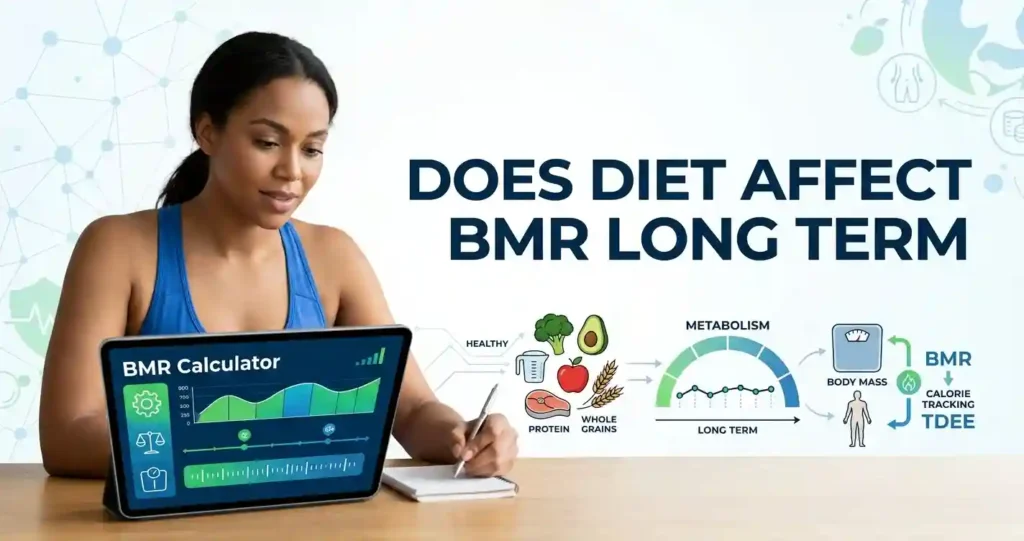
Does Diet Affect BMR Long Term?
Featured Snippet Answer: Diet can influence BMR long term primarily by changing body weight and body composition. Prolonged calorie restriction causes temporary metabolic adaptation (a modest reduction in energy expenditure beyond what is expected from weight loss alone). However, diet alone does not permanently “damage” or “break” your metabolism; resting energy expenditure adjusts naturally as body mass, calorie intake, and physical activity change.
Prolonged calorie restriction and sustained weight loss alter resting energy expenditure through two distinct mechanisms. First, as you lose weight, your physical frame shrinks, meaning your organs and tissue require less energy to function. Second, your body initiates a natural survival mechanism—adaptive thermogenesis—which conserves energy by subtly downregulating thyroid hormone production, nervous system activity, and spontaneous daily movement.
To navigate this topic clearly, it helps to understand how key metabolic terms differ:
- Basal Metabolic Rate (BMR): The absolute minimum calories burned at rest in a thermo-neutral environment, measured immediately upon waking after an overnight fast.
- Resting Metabolic Rate (RMR): A closely related, practical measurement of resting calorie expenditure, taken under less strict conditions than BMR (typically 10–15% higher than true BMR).
- Metabolism: The sum total of all chemical reactions occurring within the body to convert food into energy and sustain life.
- Total Daily Energy Expenditure (TDEE): The total calories burned in 24 hours, combining BMR/RMR, the Thermic Effect of Food (TEF), Exercise Activity Thermogenesis (EAT), and Non-Exercise Activity Thermogenesis (NEAT).
Can Eating Too Little Slow Your BMR?
Prolonged energy restriction forces the human body to become more efficient with the energy it receives. When you consume significantly fewer calories than you burn over an extended period, the body activates protective metabolic mechanisms to reduce total energy expenditure.
This physiological slowing is driven by several factors:
- Reduction in Body Mass: A smaller body burns fewer calories resting and moving.
- Loss of Lean Tissue: Cutting calories too aggressively can cause the body to break down muscle tissue alongside fat mass, lowering resting energy expenditure.
- Hormonal Downregulation: Decreases in active thyroid hormones ($T_3$), leptin, and testosterone, coupled with elevated cortisol, signal the body to conserve energy.
- Cellular Efficiency: Mitochondria (the powerhouses of your cells) become more efficient, generating the same amount of cellular energy (ATP) while burning fewer total calories.
Does a Slow Metabolism From Dieting Last Forever?
A common and persistent health myth is that severe dieting or “crashing” your calories permanently breaks or destroys your metabolic engine. Current scientific consensus confirms that dieting does not cause permanent metabolic damage.
While metabolic adaptation can persist for months after a significant diet ends—especially if a lower body weight is maintained—the adaptation is dynamic, not permanent. When energy intake increases, body weight stabilizes, and lean mass is rebuilt through adequate nutrition and strength training, metabolic rate shifts upward accordingly.
How Does Calorie Restriction Affect BMR?
When you maintain a calorie deficit, your body relies on stored tissue (fat and muscle) to meet its remaining energy demands. In response to this energy shortfall, basal calorie requirements drop.
Calorie Deficit → Weight Loss & Hormonal Shifts → Decreased Energy Expenditure (Adaptive Thermogenesis)
This relationship between sustained weight loss and reduced energy expenditure is predictable. As total body mass decreases, the energy required to circulate blood, maintain organ cellular function, and move through space decreases.
This physiological shift involves adaptive thermogenesis—a natural biological process where the body lowers its rate of energy expenditure to a level greater than can be explained by changes in body weight or lean muscle mass alone. In simple terms, your body senses a period of food scarcity and applies a slight “internal handbrake” on your calorie burn to slow further weight loss.
What Happens to Your Metabolism During a Calorie Deficit?
As body mass decreases, the body requires fewer calories to maintain its essential biological infrastructure. A liver, heart, or brain operating in a 70 kg frame requires less absolute energy than the same organs in a 90 kg frame.
Beyond reductions in resting requirements, energy expenditure drops across other components of TDEE:
- Non-Exercise Activity Thermogenesis (NEAT): Unconscious movements like fidgeting, posture maintenance, pacing, and hand gestures decrease. You may feel less inclined to walk, stand, or move around.
- Exercise Energy Expenditure: Lighter bodies burn fewer calories carrying out the exact same physical exercise (e.g., walking 5 km at 70 kg burns fewer calories than walking 5 km at 90 kg).
How Long Does Metabolic Adaptation Last?
The degree and duration of metabolic adaptation vary significantly from person to person. Factors such as genetic baseline, age, sex, total fat mass lost, and the speed of weight loss all play a role.
| Adaptation Type | Duration | Primary Driver | Reversibility |
| Short-Term Adaptation | Active diet period up to 2-4 weeks post-diet | Acute calorie deficit, hormonal changes | High (reverses quickly upon eating at maintenance) |
| Long-Term Shift | Months to years post-weight loss | Reduced overall body mass and tissue size | Structural (persists until body mass/muscle is gained) |
Can Long-Term Dieting Lower Your Metabolic Rate?
Repeated cycles of aggressive calorie restriction, severe crash diets, and yo-yo dieting can alter energy expenditure patterns, but not by permanently breaking your organs or metabolic systems.
When people cycle through repeated rounds of weight loss and rapid weight regain, their resting energy expenditure may appear lower over time. This effect is usually due to changes in body composition—specifically, losing muscle during restrictive diet phases and regaining mostly body fat during weight regain phases.
Does Yo-Yo Dieting Damage Your Metabolism?
Yo-yo dieting refers to a continuous cycle of losing weight rapidly, quitting the diet, regaining the weight (and often extra), and starting another restrictive diet.
Cyclic Restrictive Dieting → Loss of Muscle & Fat → Rapid Unstructured Regain → Higher Body Fat Ratio → Lower Baseline BMR
Each time a person loses weight without adequate protein intake or resistance training, a substantial portion of the lost weight comes from lean muscle mass. When weight is subsequently regained through overeating, the body primary stores it as fat tissue. Because muscle tissue is more metabolically active at rest than fat tissue, repeated cycles leave a person with a higher body fat percentage and less muscle mass at the same scale weight—resulting in a lower BMR than before they started dieting.
However, clinical research demonstrates that this process does not permanently destroy metabolic function. Restoring muscle tissue through progressive resistance training and proper nutrition restores metabolic rate accordingly.
Can Crash Diets Reduce BMR?
Very-low-calorie diets (VLCDs)—typically defined as consuming fewer than 800–1,000 calories per day without medical supervision—cause rapid scale weight loss, but they come at a steep metabolic cost:
- Accelerated Muscle Loss: Severe deficits force the body to break down muscle protein for gluconeogenesis (creating glucose for energy).
- Pronounced Adaptive Thermogenesis: Sharp cuts trigger stronger reductions in thyroid hormones ($T_3$) and leptin.
- Severe Fatigue: Extreme energy deprivation causes NEAT levels to drop drastically.
Sustainable, moderate calorie deficits (e.g., a 300 to 500 calorie daily deficit) preserve significantly more muscle mass and minimize steep drops in energy expenditure.
How Weight Loss Changes BMR
There is a direct, proportional relationship between total body weight and basal metabolic rate. Larger bodies contain more cells, larger vital organs, and more muscle and fat tissue, all of which require a constant stream of energy to stay alive.
Higher Body Weight / More Tissue Mass  ===>  Higher Baseline BMR
Lower Body Weight / Less Tissue Mass   ===>  Lower Baseline BMR
Key Factors Determining BMR
- Body Composition: Muscle mass burns approximately 13 kcal/kg per day at rest, whereas fat tissue burns roughly 4.5 kcal/kg per day.
- Vital Organ Mass: Organs like the liver, brain, heart, and kidneys account for roughly 60–70% of BMR despite making up only ~6% of total body weight.
- Height & Surface Area: Taller individuals have larger surface areas and larger frames, leading to higher resting heat dissipation and higher BMRs.
- Age: BMR gradually declines by about 1–2% per decade after early adulthood, largely due to age-related loss of skeletal muscle (sarcopenia).
- Sex: Males typically possess greater total muscle mass and bone density, resulting in an average BMR 5–10% higher than females of similar weight and height.
Why Does BMR Decrease After Weight Loss?
When you successfully lose weight, your BMR naturally decreases because a smaller frame requires less energy to operate.
Post-Weight Loss BMR Drop = (Reduced Organ & Muscle Mass Burn) + (Adaptive Thermogenesis Shift)
If a person loses 15 kg, their heart does not need to work as hard to pump blood, their respiratory muscles move less mass, and their legs carry less load during daily movements. A decline in BMR post-weight loss is a normal, healthy adaptation to carrying a smaller physical load.
Does Regaining Weight Increase BMR?
Yes. If weight is regained, resting calorie requirements increase because the body must once again support a larger mass of physical tissue.
However, the quality of the gained mass determines how much BMR increases:
- Gaining Muscle Mass (via Resistance Training + Protein): Substantially boosts resting metabolic rate per kilogram added.
- Gaining Primary Body Fat: Increases BMR slightly (since fat tissue still requires basic cellular maintenance), but at a much lower rate per kilogram than lean tissue.
Does Protein Intake Affect BMR?
Protein plays a critical role in preserving BMR during weight loss. Adequate dietary protein helps maintain lean body mass while increasing the energy expended during digestion.
Protein influences energy expenditure through the Thermic Effect of Food (TEF)—the metabolic energy required to digest, absorb, transport, and assimilate nutrients:
- Protein TEF: 20% to 30% of consumed protein calories are burned purely during digestion.
- Carbohydrates TEF: 5% to 10% of calories burned.
- Fats TEF: 0% to 3% of calories burned.
Consuming 100 kcal of Protein  ===>  20–30 kcal burned during digestion
Consuming 100 kcal of Fat      ===>  0–3 kcal burned during digestion
While high protein intake supports a healthier metabolism during weight loss, it is important to remember that protein is not a magic solution that permanently changes metabolic capacity. It works by preserving muscle mass and increasing daily TEF.
Can Eating More Protein Boost Metabolism?
Increasing protein intake supports metabolic rate through two primary pathways:
- Preserving Lean Tissue: Consuming sufficient protein during a calorie deficit prevents the body from breaking down skeletal muscle for fuel.
- Elevating Diet-Induced Thermogenesis: Replacing some carbohydrates or fats with lean protein slightly increases daily calorie expenditure via TEF.
Practical UK Protein Sources
- Lean Meats & Poultry: Chicken breast, turkey mince (less than 5% fat), lean beef cuts.
- Fish & Seafood: Cod, stroke-caught salmon, haddock, canned tuna in spring water.
- Plant-Based Proteins: Red lentils, chickpeas, black beans, firm tofu, tempeh, edamame beans.
- Dairy & Eggs: Free-range eggs, liquid egg whites, zero-fat Greek yoghurt, NHS-recommended low-fat cottage cheese, skyr.
How Much Protein Do You Need During Weight Loss?
Individual protein requirements depend on active status, age, current body composition, and total calorie intake.
While the standard UK Reference Nutrient Intake (RNI) for sedentary adults sits at 0.75g of protein per kilogram of body weight per day, research suggests higher targets during active weight loss:
$$\text{Sedentary Baseline (RNI)} = 0.75\text{ g/kg body weight}$$
$$\text{Weight Loss \& Resistance Training Target} = 1.6\text{ to }2.2\text{ g/kg body weight}$$
For example, an 80 kg individual aiming to preserve muscle mass while losing fat should target roughly 128g to 176g of protein daily.
Can Eating More Calories Increase BMR?
Increasing calorie intake alone does not produce an immediate or permanent jump in BMR. However, moving from an aggressive calorie deficit to maintenance calories removes the metabolic “handbrake” caused by energy scarcity.
Providing your body with sufficient energy restores normal physiological functions:
- Thyroid hormone ($T_3$) levels normalize.
- Reproductive hormones increase back to healthy baselines.
- Sympathetic nervous system activity picks up.
- Unconscious daily movement (NEAT) increases back to normal levels.
It is critical to distinguish between increasing TDEE (burning more total calories through increased movement and digestion) versus increasing baseline BMR (which requires adding physical tissue mass like muscle).
Can Reverse Dieting Increase BMR?
Reverse dieting is the practice of slowly increasing calorie intake (typically by 50–100 calories per week) over several weeks or months after a period of weight loss. Proponents claim it “builds” metabolism back up without causing fat gain.
While reverse dieting can help individuals safely transition back to higher calorie levels, the scientific evidence for a dramatic BMR “boost” is limited:
Stepwise Calorie Increase → Restored NEAT + Increased TEF + Restored Glygogen → Higher TDEE
The increase in energy expenditure seen during reverse dieting is mostly explained by:
- Increased TEF: Eating more total food requires more energy to digest.
- Restored NEAT: Having more available energy causes people to unconsciously move, walk, and fidget more.
- Weight Stabilization: Rebuilding lost glycogen stores and restoring hydration slightly increases total body mass.
What Foods Help Support a Healthy Metabolism?
No single food or drink will permanently alter or “speed up” your basal metabolic rate. Claims that ingredients like green tea, chilli, or grapefruit burn significant amounts of body fat are generally exaggerated.
However, consuming a nutrient-dense, balanced diet supports the physiological systems that keep your metabolic processes operating efficiently.
Best Foods for Metabolic Health
- Lean Protein Sources: Poultry, white and oily fish, legumes, eggs, and tofu (preserves muscle mass and maximizes TEF).
- Wholegrains: Oats, quinoa, brown rice, wholemeal bread, and barley (rich in B vitamins, which act as coenzymes in energy metabolism).
- Vegetables & Fruit: Berries, leafy greens (spinach, kale), broccoli, peppers, and citrus fruits (provide micronutrients essential for thyroid and cellular health).
- Healthy Fats: Extra virgin olive oil, avocados, walnuts, chia seeds, and oily fish like mackerel (supports healthy hormone production).
- Dairy or Calcium-Fortified Alternatives: Kefir, unsweetened yoghurt, semi-skimmed milk, or fortified soy milk (supplies calcium and iodine, vital for thyroid function).
Foods and Habits to Limit
Rather than labeling individual ingredients as inherently “bad,” focus on overall dietary patterns and lifestyle choices that can negatively impact metabolic efficiency:
- Chronic Severe Calorie Restriction: Prolonged intake well below BMR suppresses thyroid output and promotes muscle loss.
- Diets Deficient in Essential Micronutrients: Low intake of iodine, iron, selenium, or zinc can impair thyroid hormone production and energy transport.
- Excessive Alcohol Consumption: Alcohol disrupts sleep quality, reduces muscle protein synthesis, and takes metabolic priority over fat oxidation in the liver.
- Ultra-Processed Foods Lacking Protein & Fibre: High in calories but low in nutrients, making it easy to overeat while failing to support lean muscle preservation.
Diet vs Exercise: What Has the Biggest Effect on BMR?
While diet controls your energy intake and plays a major role in preserving muscle via protein, exercise—specifically resistance training—has the most direct influence on long-term resting metabolic rate.
    [ Diet Strategies ]                    [ Resistance Exercise ]
Preserves muscle via protein         Builds new skeletal muscle tissue
Optimises digestion energy (TEF)     Directly increases baseline BMR burn
Does Strength Training Increase BMR?
Yes. Progressive resistance training (weightlifting, bodyweight calisthenics, resistance band training) is the primary method for increasing BMR.
Strength training signals the body to adapt by repairing and building skeletal muscle fibers (hypertrophy). Because muscle tissue is metabolically active at rest, adding muscle mass directly increases resting energy expenditure.
Progressive Resistance Overload → Muscle Hypertrophy → Increased Resting Tissue Energy Burn (Higher BMR)
Crucially, during a calorie deficit, resistance training acts as an explicit signal to the body to retain muscle tissue, ensuring that weight loss comes almost entirely from stored body fat rather than metabolically active muscle.
Does Cardio Increase BMR?
Cardiovascular exercise (running, cycling, swimming, brisk walking) is effective for increasing TDEE through immediate calorie burn during activity, but its direct effect on BMR is minimal compared to resistance training.
- Acute Metabolic Boost: High-Intensity Interval Training (HIIT) produces temporary Excess Post-Exercise Oxygen Consumption (EPOC), slightly elevating calorie burn for a few hours after a workout.
- Long-Term BMR Effect: Cardio does not significantly build muscle tissue, meaning it does not permanently increase resting metabolic rate.
- Cardio’s Real Value: Improves cardiovascular fitness, supports heart health, and creates a healthy energy deficit without requiring severe dietary restrictions.
How to Calculate Your BMR After Weight Loss
Because BMR depends heavily on total body weight, any meaningful change in weight (e.g., a change of 5 kg or more) means your estimated basal calorie requirements have shifted. Recalculating your BMR ensures your daily calorie targets stay accurate.
Common BMR Formulas
The Mifflin-St Jeor Equation is widely considered by clinical dietitians to be the most accurate standard formula for estimating BMR in adults:
- For Men:$$\text{BMR} = (10 \times \text{weight in kg}) + (6.25 \times \text{height in cm}) – (5 \times \text{age in years}) + 5$$
- For Women:$$\text{BMR} = (10 \times \text{weight in kg}) + (6.25 \times \text{height in cm}) – (5 \times \text{age in years}) – 161$$
If you know your body composition, the Katch-McArdle Formula can be even more precise because it calculates BMR based directly on Lean Body Mass (LBM):
$$\text{BMR} = 370 + (21.6 \times \text{LBM in kg})$$
How Often Should You Recalculate BMR?
Avoid recalculating your BMR daily or weekly; minor scale fluctuations are usually down to water retention, sodium intake, and glycogen storage changes.
Initial BMR Calculation → Track Progress for 4–6 Weeks → Recalculate only if weight changes by ≥5 kg
- When to Recalculate: Every time you lose or gain 5 kg, or every 8 to 12 weeks during an active weight management program.
- Use as an Estimate: Online equations and mathematical formulas provide starting estimates. Monitor your real-world weight trends over 3 to 4 weeks to adjust your calorie targets based on actual progress.
BMR vs TDEE: Which Number Should You Use?
Always use TDEE—not BMR—to establish your daily calorie targets:
- BMR (Basal Metabolic Rate): The calories required if you stayed in bed all day without moving. Eating at or below your BMR for extended periods is generally not recommended without medical supervision.
- TDEE (Total Daily Energy Expenditure): BMR multiplied by an Physical Activity Level (PAL) factor that accounts for your daily life, job, and exercise.
To calculate TDEE, multiply your estimated BMR by your corresponding activity factor:
$$\text{TDEE} = \text{BMR} \times \text{Physical Activity Factor}$$
- Sedentary (desk job, little exercise): $\text{BMR} \times 1.2$
- Lightly Active (light exercise 1–3 days/week): $\text{BMR} \times 1.375$
- Moderately Active (moderate exercise 3–5 days/week): $\text{BMR} \times 1.55$
- Very Active (hard exercise 6–7 days/week): $\text{BMR} \times 1.725$
How to Lose Weight Without Excessively Lowering Your Metabolism
Minimizing metabolic adaptation during weight loss comes down to preserving lean muscle mass and avoiding extreme energy deficits.
Moderate Deficit (15-20%) + High Protein (1.6-2.2g/kg) + Progressive Resistance Training = Minimal Metabolic Adaptation
Practical Strategies for Sustainable Weight Loss
- Target a Moderate Calorie Deficit: Aim for a deficit of 300 to 500 calories per day, aiming for a sustainable weight loss rate of 0.5% to 1% of total body weight per week.
- Prioritise Protein Intake: Consume protein at every meal (target 25–40g per meal) to maintain muscle protein synthesis.
- Lift Weights 2–4 Times Per Week: Focus on compound resistance movements (squats, deadlifts, presses, rows) to signal muscle retention.
- Maintain Daily Movement (NEAT): Track your daily step count (e.g., 8,000–10,000 steps) to prevent your body from reducing unconscious movement.
- Get 7–9 Hours of Quality Sleep: Chronic sleep deprivation raises cortisol levels, increases appetite hormones (ghrelin), and accelerates muscle breakdown.
- Incorporate Diet Breaks: Periodically bringing calories up to temporary maintenance levels for 1–2 weeks during long weight-loss phases can help ease biological fatigue and mental burn-out.
Signs Your Calorie Intake May Be Too Low
If your calorie intake falls significantly below your basic energy requirements for too long, your body will output clear warning signals:
- Persistent Lethargy & Brain Fog: Feeling consistently exhausted despite adequate sleep.
- Pronounced Drops in Workout Performance: Experiencing sudden drops in strength, stamina, or workout recovery.
- Constant Coldness: Feeling cold in normal room temperatures due to downregulated thermoregulation.
- Disturbed Sleep & Waking Early: Elevated cortisol levels interfering with deep sleep cycles.
- Irregular Menstrual Cycles: Loss of periods (amenorrhea) in women due to low energy availability.
- Loss of Libido: Hormonal suppression affecting reproductive drive.
Note: These symptoms do not mean your metabolism is permanently “damaged.” Rather, they signal that your body is in an excessively low energy state. If these symptoms persist after adjusting your intake to a moderate level, consult your NHS GP or a Registered Dietitian.
Frequently Asked Questions About Diet and BMR
Does dieting permanently lower your BMR?
No. Dieting causes temporary drops in energy expenditure through metabolic adaptation and reduced body weight, but research shows metabolic function recovers as energy intake, body weight, and muscle mass normalize.
Can eating too few calories slow your metabolism?
Yes, temporarily. Eating extremely low calories triggers adaptive thermogenesis, downregulating thyroid hormones and physical movement to conserve energy.
Does BMR increase when you eat more?
Increasing calorie intake increases TDEE (via higher TEF and NEAT) and removes the metabolic slowing associated with a deficit. However, baseline BMR increases significantly only if you gain body mass, particularly skeletal muscle.
Does fasting lower BMR long term?
Intermittent fasting or short-term fasts (16–24 hours) do not lower BMR long term. In fact, short-term fasting slightly increases adrenaline and norepinephrine. However, chronic extended fasting that causes muscle loss can lower resting metabolic rate over time.
Can you increase your BMR naturally?
Yes. The most effective natural way to increase your BMR is to build lean muscle mass through progressive resistance training combined with an adequate protein intake.
Does protein increase BMR?
Protein does not directly change your baseline metabolic genetics, but it increases daily energy burn via its high Thermic Effect (20–30%) and helps preserve muscle mass during calorie deficits.
Does BMR decrease after losing weight?
Yes. A smaller physical body contains less tissue and requires fewer calories to function at rest than a larger body.
How long does it take for BMR to return to normal after dieting?
There is no single universal timeline. Short-term adaptation typically eases within a few weeks of eating at maintenance calories, while structural changes depend on rebuilding lost muscle tissue over several months.
Should I eat more to increase my metabolism?
You should increase calories if you are experiencing severe symptoms of low energy availability or have reached an unhealthily low weight. However, simply eating more without strength training or specific physical goals will generally lead to fat gain rather than a higher baseline BMR.
Should I recalculate my BMR after losing weight?
Yes. Recalculate your BMR every time you lose roughly 5 kg of body weight to keep your daily calorie targets accurate.
Conclusion: Does Diet Affect BMR Long Term?
Diet influences BMR primarily through changes in total body weight, body composition, and adaptive thermogenesis. While prolonged calorie restriction leads to temporary metabolic adaptations, dieting does not cause permanent metabolic damage. A lower BMR following successful weight loss is a normal biological response to carrying a smaller, lighter frame.
By adopting a sustainable approach—combining a moderate calorie deficit with high protein intake, regular resistance training, and consistent daily movement—you can lose body fat while preserving the lean muscle mass that keeps your metabolic rate healthy.
Calculate Your BMR and Personalise Your Calorie Goals
Estimating your Basal Metabolic Rate provides a clear, data-driven baseline for your daily calorie needs. Combine your BMR with your daily activity level to establish an accurate Total Daily Energy Expenditure (TDEE) and set calorie goals tailored to your individual progress.

Ehatasamul Alom is a dedicated health-tech enthusiast and the co-founder of BMRCalculator. With a passion for metabolic science, he focuses on providing accurate health data for the UK community. Ehatasamul ensures that every tool and guide aligns with NHS standards and public health research. His mission is to simplify complex biological data, helping British residents make informed decisions about their fitness, calorie needs, and long-term wellness. When not analyzing health trends, he explores the latest innovations in wearable fitness technology.