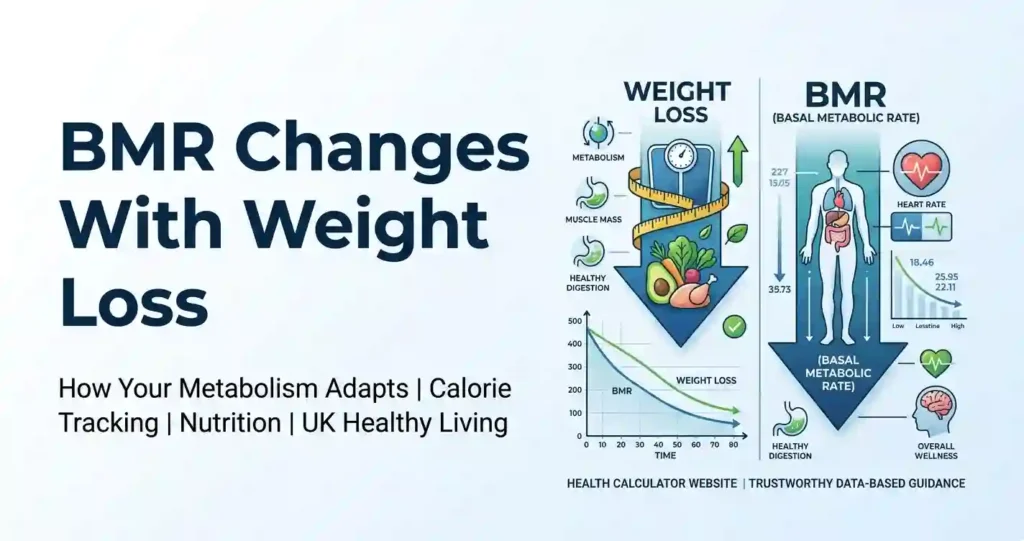
Basal metabolic rate (BMR) usually decreases as body weight decreases. If you have been following a structured weight-loss plan in the UK, eating at a calorie deficit, and taking regular walks or hitting the gym, you might notice that scale progress eventually slows down. This shift occurs because as your body frame becomes smaller, your resting energy expenditure drops accordingly.
Understanding the relationship between basal metabolic rate, body composition, and daily calorie requirements is key to avoiding prolonged weight-loss plateaus. Your BMR represents the baseline energy cost of maintaining your living tissues. Body composition—specifically the balance between lean muscle mass and fat mass—determines how high or low that baseline rests. Meanwhile, your total daily calorie requirements reflect your baseline BMR combined with your daily physical movement and exercise habits.
When setting expectations for sustainable weight loss, it helps to recognize that a drop in BMR is a normal physical response to a lighter body, not a sign that your metabolism is broken. By learning how your metabolic rate adapts to weight loss, you can adjust your nutrition with confidence, preserve lean muscle tissue, and maintain steady progress toward your health goals.
What Is BMR?
Basal metabolic rate (BMR) is the minimum amount of energy, measured in calories (or kilocalories), that your body requires at complete rest to sustain vital bodily processes. Even when you are lying still in bed, your body works continuously to support essential biological functions, including:
- Breathing and respiration
- Blood circulation and heart function
- Cell production and cellular repair
- Body temperature regulation
- Brain activity and nervous system signals
- Hormone production and liver processing
While metabolic terms are often used interchangeably, distinct physiological differences exist between resting metrics, daily movement expenditure, and dietary targets:
- BMR (Basal Metabolic Rate): The precise clinical energy cost of keeping your body alive. It is measured under strict laboratory conditions after waking from eight hours of sleep following a 12-hour fast, in a thermoneutral environment.
- RMR (Resting Metabolic Rate): An estimate of resting energy expenditure measured under less rigid clinical conditions. RMR is slightly less strict than BMR and typically yields a value about 5% to 10% higher.
- TDEE (Total Daily Energy Expenditure): The complete total of calories you burn across 24 hours. TDEE includes your resting metabolism, physical exercise, everyday movement (like walking around the house or working at a desk), and the thermic effect of food (the energy required to digest what you eat).
- Daily Calorie Needs: The specific intake target designed to help you achieve a health goal, such as maintaining your weight, losing body fat, or building muscle, based directly on your overall TDEE.
Several physiological variables determine an individual’s resting metabolic rate. Key factors affecting BMR include:
- Body Weight and Frame Size: Larger bodies contain more living cells and organ mass, requiring more baseline energy to sustain.
- Height: Taller individuals have a larger surface area and lean tissue footprint, which raises baseline energy needs.
- Age: Resting energy expenditure gradually declines as adults age, largely due to age-related muscle loss (sarcopenia) and cellular shifts.
- Biological Sex: Males typically have a higher average BMR than females of equal weight, primarily due to having higher average muscle mass and lower essential fat levels.
- Lean Body Mass: The total weight of your body minus fat mass—including muscles, organs, bones, and fluids—is the single strongest contributor to your resting expenditure.
       [ Lean Body Mass + Body Weight + Height + Sex ]
                             │
                             ▼
                  [ Basal Metabolic Rate ]
                             │  + (Physical Activity + Digestion)
                             ▼
              [ Total Daily Energy Expenditure ]
                             │  - (Calorie Deficit)
                             ▼
               [ Daily Calorie Target for Weight Loss ]
What Does BMR Mean for Weight Loss?
BMR serves as the baseline starting point when calculating your calorie requirements. Because resting metabolic expenditure accounts for the largest share of your total daily energy output—roughly 60% to 75% for most adults—estimating your BMR gives you a clear foundation for building an effective nutrition plan.
However, BMR is not the number of calories you should eat each day for weight loss. Eating strictly at your BMR while leading an active lifestyle can create an unnecessarily severe energy deficit. Over time, an overly drastic caloric restriction can lead to fatigue, muscle loss, nutrient deficiencies, and increased hunger signals.
To set a healthy daily intake target, you must account for your total daily energy expenditure (TDEE). TDEE expands upon your BMR by incorporating all daily physical activity, from structured workout sessions to unstructured movement like taking the stairs, gardening, or walking the dog. Weight-loss calorie targets are established by applying a moderate deficit to your total TDEE rather than cutting below your baseline BMR.
Does BMR Decrease With Weight Loss?
Yes, BMR generally decreases as you lose weight because a smaller body requires less energy to maintain itself at rest.
When you reduce your body mass, your physical frame requires fewer total calories to perform baseline circulatory, respiratory, and cellular tasks. Moving, breathing, and pumping blood through a lighter body simply demands less overall energy than doing so for a heavier frame.
It is helpful to distinguish a standard, healthy drop in BMR from an “unusually slow” or damaged metabolism. Reductions in resting calorie expenditure after weight loss reflect normal metabolic adaptation—a predictable biological adjustment to carrying less weight. A lower BMR following a weight-loss journey is a natural reflection of a smaller body size, not an indication that your system is impaired.
Why Does BMR Change When You Lose Weight?
Three main mechanisms drive the change in your baseline metabolism during a weight-loss journey:
1. Reductions in Total Body Mass
Every cell in the human body requires energy to live. When you lose total body mass, your overall tissue volume drops. With fewer total cells requiring cellular respiration and maintenance, your baseline energy consumption drops in direct proportion to your new, smaller body size.
2. Lean Muscle Mass vs. Fat Mass
Body composition significantly influences total energy expenditure. Skeletal muscle tissue and internal organs are metabolically active, burning considerably more calories per kilogram at rest than adipose (fat) tissue. If a weight-loss diet leads to losing lean muscle tissue alongside body fat, your BMR will fall at a faster rate than if you lose fat mass alone.
3. Adaptive Thermogenesis (Prolonged Restriction)
When you sustain a calorie deficit over weeks or months, your body undergoes adaptive thermogenesis. This natural biological defense mechanism slightly reduces metabolic expenditure to conserve energy. During prolonged dieting, your thyroid hormone levels, leptin levels, and sympathetic nervous system activity adjust downward slightly, making your physiological processes more energy-efficient.
How Much Does BMR Change With Weight Loss?
There is no universal standard for how many calories your BMR will decrease by for every kilogram lost. Energy expenditure changes vary from person to person based on their unique physical makeup and diet approach.
The exact shift in resting calorie expenditure depends on several distinct factors:
- Starting Body Weight: Individuals starting at a higher body weight generally experience larger absolute drops in baseline calories than those starting from a lower baseline weight.
- Body Composition Changes: Losing primarily adipose tissue results in a smaller reduction in BMR than losing a mix of muscle and fat.
- Biological Sex and Age: Hormonal profiles, muscle distribution, and age-related metabolic shifts influence the pace of metabolic adjustment.
- Amount of Muscle Preserved: Maintaining skeletal muscle tissue through strength training and protein intake helps buffer against sharp drops in resting metabolic rate.
Because these variables interact continuously, you should periodically recalculate your estimated BMR and daily calorie targets as your weight changes, rather than relying on calculations made at the start of your journey.
Example of BMR Changes During Weight Loss
To see how baseline requirements shift as body weight drops, consider this example calculated using the standard Mifflin-St Jeor equation.
Scenario: A 40-year-old male, 178 cm tall, working a desk job with light daily activity (using an activity multiplier of 1.375).
| Weight Stage | Body Weight (kg) | Estimated BMR (kcal/day) | Estimated TDEE (kcal/day) | Suggested Daily Target (500 kcal Deficit) |
| Starting Point | 100 kg | 1,893 kcal | 2,603 kcal | 2,103 kcal |
| 5 kg Lost | 95 kg | 1,843 kcal | 2,534 kcal | 2,034 kcal |
| 10 kg Lost | 90 kg | 1,793 kcal | 2,465 kcal | 1,965 kcal |
| 15 kg Lost | 85 kg | 1,743 kcal | 2,397 kcal | 1,897 kcal |
As the example illustrates, losing 15 kg reduces baseline BMR by roughly 150 calories per day, which shifts total daily energy expenditure (TDEE) down by over 200 calories per day. If this individual continued eating their initial target of 2,103 calories per day after losing 15 kg, their daily calorie deficit would shrink from 500 calories down to under 300 calories, naturally slowing scale progress.
Note: The figures in this table are mathematical estimates based on average population data. They serve as educational illustrations rather than personalized medical or dietary recommendations.
Does Losing Muscle Lower BMR?
Yes, losing muscle mass significantly impacts your resting energy expenditure. Skeletal muscle mass and internal organs constitute the majority of your lean body mass, which drives resting caloric burn.
When you lose body mass rapidly through crash dieting, severe caloric restrictions, or long periods of cardio without strength training, your body breaks down both fat tissue and functional muscle tissue for energy. Because muscle tissue requires continuous energy for protein synthesis and maintenance, losing skeletal muscle lowers your baseline BMR per kilogram far more than losing fat mass alone.
                  ┌─────────────────────────┐
                  │    Calorie Deficit      │
                  └────────────┬────────────┘
                               │
               ┌───────────────┴───────────────┐
               ▼                               ▼
    ┌──────────────────────┐        ┌──────────────────────┐
    │   Unstructured Plan   │        │   Structured Plan    │
    │  (Rapid / No Weights) │        │ (Moderate / Strength)│
    └──────────┬───────────┘        └──────────┬───────────┘
               │                               │
               ▼                               ▼
    ┌──────────────────────┐        ┌──────────────────────┐
    │ Fat + Muscle Loss    │        │  Fat Loss Preserved  │
    │ (BMR Drops Faster)   │        │  (BMR Drops Slower)  │
    └──────────────────────┘        └──────────────────────┘
Preserving lean mass requires a deliberate two-part approach during weight loss: consuming sufficient dietary protein and engaging in regular resistance exercise.
How to Preserve Muscle While Losing Weight
To safeguard muscle tissue while losing body fat, structure your routine around three supportive habits:
- Prioritise Progressive Resistance Training: Lift weights, perform bodyweight movements, or use resistance bands 2 to 4 times per week. Resistance exercise sends a signal to your neuromuscular system that muscle tissue is actively required, encouraging your body to draw energy from fat stores rather than breaking down muscle.
- Consume Adequate Protein: Eat protein-rich foods across your daily meals. For UK adults engaged in regular exercise, guidelines from health and sports organizations recommend aiming for roughly 1.6 to 2.2 grams of protein per kilogram of body weight during a weight-loss phase (e.g., around 112g to 154g daily for a 70 kg individual).
- Maintain a Moderate Calorie Deficit: Aim for a measured deficit of roughly 300 to 500 calories below your TDEE. A gradual pace of weight loss (about 0.5 kg or 1 lb per week) protects lean muscle tissue better than aggressive restriction.
While muscle preservation strategies stabilize your baseline metabolic rate, they will not completely stop BMR from declining. Because total mass is decreasing, some reduction in overall baseline energy cost is normal and expected.
Why Weight Loss Can Slow Your Metabolism
As weight loss progresses, biological feedback loops naturally work to protect your body’s energy reserves. This process involves adaptive thermogenesis, where your resting and non-resting energy expenditure decreases slightly more than what would be predicted by changes in body weight and composition alone.
During extended periods of weight loss, your system adjusts energy consumption across several functional pathways:
- Changes in Non-Exercise Activity Thermogenesis (NEAT): As energy stores fall, you may unconsciously reduce spontaneous movements—such as fidgeting, pacing, maintaining posture, or walking briskly. NEAT can decrease significantly without your conscious awareness, reducing daily expenditure.
- Increased Biomechanical Efficiency: Carrying a lighter frame requires less effort during daily movement and routine exercise, meaning you burn fewer calories covering the same distance on a walk or run.
- Hormonal Adjustments: Levels of circulating leptin (the satiety hormone) and active thyroid hormones ($T_3$) naturally decrease during extended calorie deficits, while ghrelin (the hunger hormone) increases. These hormonal adjustments signal the brain to conserve energy.
These metabolic responses represent a functional evolutionary mechanism designed to prevent starvation during periods of food scarcity. Experiencing adaptive thermogenesis does not mean your metabolism is broken; it shows that your body is responding predictably to energy restriction.
Signs Your Calorie Needs May Have Changed
Recognizing shifts in your daily energy requirements helps you adjust your plan before reaching a frustrating plateau. Common signs that your daily calorie needs have changed include:
- Scale Stagnation: Your average weekly body weight remains flat over 3 to 4 consecutive weeks despite consistent diet tracking.
- Decreased Daily Energy: You feel noticeably less inclined to move throughout the day, spending more time sitting or resting.
- Workout Stagnation: Exercises that felt manageable feel increasingly demanding, and your performance recovery times lengthen.
Track your body weight trends over several weeks using weekly averages rather than reacting to daily scale changes. Daily weight can swing by 1 to 2 kg due to fluid shifts, digestion speed, salt intake, and stress hormones.
How to Calculate Your BMR After Weight Loss
You can estimate your updated resting metabolic rate using established clinical formulas. The Mifflin-St Jeor equation is widely recognized by health professionals and NHS guidance frameworks as an accurate clinical tool for estimating baseline energy needs in adults.
$$\text{Mifflin-St Jeor Equation Structural Variables}$$
$$\text{For Males:} \quad \text{BMR} = (10 \times \text{weight in kg}) + (6.25 \times \text{height in cm}) – (5 \times \text{age in years}) + 5$$
$$\text{For Females:} \quad \text{BMR} = (10 \times \text{weight in kg}) + (6.25 \times \text{height in cm}) – (5 \times \text{age in years}) – 161$$
To calculate your updated baseline accurately, gather the following current inputs:
- Current Body Weight: Measured in kilograms (kg) on a reliable scale first thing in the morning.
- Height: Measured accurately in centimeters (cm).
- Age: Your current age in complete years.
- Biological Sex: Required due to average baseline differences in muscle distribution and body fat percentage.
Recalculating these numbers periodically ensures your targets match your current physical frame, keeping your nutrition plan effective.
Use a BMR Calculator to Recalculate Your Calorie Needs
Using an online BMR calculator simplifies this process. Rather than working through the math manually, you can input your current measurements to establish your updated baseline instantly.
       ┌────────────────────────────────────────────────────────┐
       │                   BMR Calculator                       │
       ├────────────────────────────────────────────────────────┤
       │ Input Statistics:                                      │
       │  • Current Weight (kg)                                 │
       │  • Height (cm)                                         │
       │  • Age (years)                                         │
       │  • Biological Sex                                      │
       ├────────────────────────────────────────────────────────┤
       │                          │                             │
       │                          ▼                             │
       │                 [ Base BMR Result ]                    │
       │                          │                             │
       │                          ▼                             │
       │           Select Physical Activity Level:              │
       │  • Sedentary (BMR × 1.2)                               │
       │  • Lightly Active (BMR × 1.375)                        │
       │  • Moderately Active (BMR × 1.55)                      │
       │  • Very Active (BMR × 1.725)                           │
       │                          │                             │
       │                          ▼                             │
       │             [ Total Estimated TDEE ]                   │
       └────────────────────────────────────────────────────────┘
Once you have determined your updated BMR result, select an activity multiplier that matches your current lifestyle:
- Sedentary (desk job, minimal movement): $\text{BMR} \times 1.2$
- Lightly Active (light walking 1–3 days/week): $\text{BMR} \times 1.375$
- Moderately Active (moderate exercise 3–5 days/week): $\text{BMR} \times 1.55$
- Very Active (intense workouts 6–7 days/week): $\text{BMR} \times 1.725$
Always input your current body weight into the calculator. Relying on your starting weight will overestimate your TDEE, while using a target weight can yield a calorie number that is unnecessarily restrictive for your current stage.
How to Adjust Calories as Your BMR Changes
A calorie intake target that produced steady weight loss at the start of your journey will become less effective as your body weight drops. As your total mass decreases, your daily energy expenditure decreases alongside it, gradually closing the gap between your intake and your output.
When adjusting your diet to keep moving forward, avoid making sudden, aggressive cuts to your food intake. Large reductions in food intake can increase hunger hormones, compromise recovery, and trigger greater losses in lean muscle tissue.
Instead, adjust your plan gradually:
- Make Minor Calorie Adjustments: When weight loss halts for 3 to 4 weeks, reduce your daily intake target by 100 to 150 calories per day, or increase your daily movement slightly to restore a moderate deficit.
- Focus on Nutrient-Dense Whole Foods: Emphasise high-volume, low-calorie-density foods like lean poultry, fish, tofu, beans, green vegetables, berries, and whole grains. These foods provide volume and micronutrients to manage hunger.
- Prioritise Dietary Fibre: Aim for at least 30 grams of fibre daily (in line with NHS dietary guidelines) to support gut health, slow digestion, and improve overall satiety.
BMR vs TDEE for Setting a Weight-Loss Calorie Target
Understanding the functional distinction between BMR and TDEE keeps your nutrition targets safe, realistic, and effective.
| Variable | Basal Metabolic Rate (BMR) | Total Daily Energy Expenditure (TDEE) |
| Primary Definition | Energy burned strictly at complete rest to support cellular life. | Total energy burned across 24 hours through rest, movement, and digestion. |
| Inclusion Criteria | Heartbeat, respiration, brain function, cellular repair, organ function. | BMR + walking, housework, job activity, workouts, digesting food. |
| Target Setting Role | Serves as the physiological baseline below which long-term intake shouldn’t drop. | Serves as the actual reference number from which you subtract calories to lose weight. |
Targeting weight loss using TDEE ensures that your energy deficit accounts for your actual lifestyle and activity level, helping you lose fat safely while protecting your daily energy and lean muscle.
Can You Increase BMR After Weight Loss?
Because BMR is closely bound to total physical body size, you cannot simply “reset” or double your baseline resting rate to match the energy burn of a much larger frame. A smaller body naturally consumes fewer resting calories than a larger body.
However, you can optimize your baseline metabolism for your new body size. Building and maintaining lean muscle mass, supporting thyroid function, and staying physically active ensure that your resting metabolism runs at its healthiest potential.
Key habits to support metabolic output after weight loss include:
- Consistent Strength Training: Engaging in progressive resistance workouts builds and maintains active skeletal muscle tissue.
- Adequate Protein and Calorie Support: Eating enough protein and stepping up to maintenance calories when dieting phases end supports tissue repair and hormone recovery.
- Quality Sleep and Stress Management: Prioritising 7 to 9 hours of quality sleep helps manage cortisol levels, helping keep appetite and metabolic signaling balanced.
Does Building Muscle Increase BMR?
Lean muscle tissue is metabolically active, consuming roughly 10 to 15 calories per kilogram per day at rest, compared to fat tissue, which consumes approximately 4.5 calories per kilogram per day.
While gaining muscle supports your baseline metabolism, muscle tissue alone does not cause a dramatic surge in baseline daily burn. Gaining 2 kg of lean muscle will increase your resting expenditure by roughly 20 to 30 calories per day—a modest direct change.
┌────────────────────────────────────────────────────────────────────────┐
│                        Role of Strength Training                       │
├────────────────────────────────────────────────────────────────────────┤
│  Direct BMR Increase:                                                  │
│   • ~10–15 kcal per kg of muscle gained daily (Modest Direct Shift)    │
│                                                                        │
│  Broader Health & Metabolic Benefits:                                  │
│   • Preserves lean mass during calorie deficits                        │
│   • Increases TDEE through exercise energy burn                        │
│   • Increases insulin sensitivity & glucose management                 │
│   • Improves joint support, bone density, and functional mobility      │
└────────────────────────────────────────────────────────────────────────┘
The real power of building muscle lies in its broader benefits for health and weight management. Strength training helps preserve your lean tissue while dieting, increases your workout energy burn, improves insulin sensitivity, and builds a strong, functional frame that makes staying active easier over time.
Factors That Affect BMR During Weight Loss
Understanding what shapes resting energy expenditure helps set clear expectations throughout your weight-loss journey:
- Total Body Weight and Frame Size: Larger bodies require more energy to perform baseline physiological functions; as you shed total mass, your baseline requirement naturally decreases.
- Lean Body Mass Ratio: Muscle tissue and internal organs burn significantly more energy at rest than fat mass. Preserving lean tissue buffers against sharp drops in baseline calories.
- Age, Sex, and Genetics: Natural variations in muscle distribution, biological sex, hormonal profiles, and inherited metabolic traits influence overall energy needs.
Other Factors That May Influence Energy Expenditure
Beyond your baseline BMR, several external and lifestyle factors alter daily calorie burn:
- Daily Physical Movement (NEAT): Unconscious shifts in daily walking, standing, pacing, and posture habits can change your daily energy output by hundreds of calories.
- Diet Severity and Duration: Prolonged calorie restriction triggers stronger metabolic adaptation than shorter, moderate dieting phases.
- Sleep and Lifestyle Habits: Chronic sleep deprivation raises stress hormones like cortisol, lowers daily energy levels, and disrupts appetite hormones, making it harder to stay active and stick to your goals.
BMR Changes With Weight Loss: Common Mistakes to Avoid
Navigating metabolic shifts during weight loss is much easier when you avoid a few common pitfalls:
- 1. Sticking to Your Initial Calorie Target IndefinitelyContinuing to use calculations from your starting weight as your frame shrinks gradually reduces your energy deficit, which can bring progress to a halt.
- 2. Conflating BMR with Total Calorie NeedsSetting your daily calorie target equal to your baseline BMR ignores physical activity and daily movement, leading to an unnecessarily severe deficit.
- 3. Making Overly Aggressive Calorie CutsCutting food intake drastically whenever scale progress slows down increases fatigue, promotes muscle loss, and triggers hunger signals, making the plan harder to sustain.
Why the Scale May Stop Moving
A plateau on the scale does not necessarily mean your calorie targets are wrong or that you have stopped losing fat:
- Fluctuations in Water Retention: Fluid retention driven by stress, workout-induced muscle soreness, or changes in dietary salt can temporarily hide body fat loss on the scale.
- Reduced Body Mass Energy Costs: Carrying a lighter body means routine daily movements and exercises burn fewer total calories than they used to.
- Unconscious Increases in Calorie Intake: Portion sizes can gradually creep up over time if foods are not weighed or tracked consistently.
Look at average body weight trends over several weeks alongside changes in waist measurements, physical energy, and how your clothes fit to gauge true progress.
How to Manage Your Calories as You Lose Weight
Managing your nutrition as your body changes is a straightforward process when you rely on consistent tracking habits:
- Reassess Baseline Metrics Periodically: Recalculate your estimated BMR and TDEE after every 5 kg to 10 kg of weight loss to keep your calorie targets aligned with your updated frame.
- Prioritise Whole, Nutrient-Dense Foods: Center your meals on high-protein options, high-fibre vegetables, fruits, legumes, and whole grains to support health and manage hunger.
- Combine Balanced Nutrition with Strength Exercise: Pair a moderate calorie deficit with regular resistance training to protect lean muscle tissue and support metabolic health.
When Should You Recalculate Your BMR?
Recalculating your baseline metrics keeps your nutrition target aligned with your current body. Plan to update your numbers:
- After Meaningful Weight Loss: Recalculate whenever you shed roughly 5% to 10% of your total starting body weight.
- During Extended Weight Plateaus: Update your calculations if your weekly average weight remains flat for 3 to 4 consecutive weeks despite consistent diet tracking.
- Following Activity Shifts: Adjust your numbers if your lifestyle or exercise habits change significantly, such as moving from an active job to a desk role or starting a new fitness routine.
Frequently Asked Questions About BMR Changes With Weight Loss
Does BMR always decrease when you lose weight?
Yes. As your total body mass shrinks, your physical frame requires less energy to perform baseline physiological tasks at rest. While preserving lean muscle through strength training helps cushion this reduction, overall baseline expenditure naturally decreases as total weight drops.
How much does BMR decrease for every kg of weight lost?
There is no fixed caloric reduction per kilogram lost. The exact shift depends on your starting body composition, how much muscle tissue you preserve, your biological sex, and individual genetic factors.
Can BMR increase while losing weight?
In rare cases, individuals who are new to strength training may build muscle mass while losing body fat (body recomposition). Because muscle tissue is metabolically active, this shift can help maintain or slightly raise resting expenditure. However, if total body weight drops significantly, overall BMR will generally decline.
Does eating less lower your BMR?
Sustained calorie deficits trigger adaptive thermogenesis, where energy expenditure drops slightly to conserve energy. Highly restrictive crash diets cause a more pronounced reduction in resting metabolic rate by promoting muscle tissue loss.
Does gaining muscle increase BMR?
Yes. Lean muscle tissue consumes more energy at rest than fat mass. However, the direct shift in resting calories is modest (roughly 10 to 15 calories per kilogram of muscle per day). The main value of muscle tissue lies in preserving baseline expenditure and supporting overall physical performance.
Should I eat below my BMR to lose weight?
No. BMR measures baseline resting energy needs without accounting for basic physical movement, exercise, or digestion. Calorie targets should be established by applying a moderate deficit to your TDEE, ensuring you provide your body with enough energy for daily life.
How often should I recalculate my BMR when losing weight?
Recalculate your baseline metrics after every 5 kg to 10 kg of weight loss, or whenever your average body weight remains unchanged for 3 to 4 consecutive weeks.
Why am I not losing weight even though my BMR has changed?
If scale progress stops, your new, lower TDEE may now match your current calorie intake, closing your energy deficit. Alternatively, temporary water retention from exercise, stress, or salt can temporarily mask fat loss on the scale.
Can BMR return to normal after weight loss?
Your post-weight-loss BMR reflects your new, smaller body size, which naturally requires fewer calories to maintain than a heavier frame. Transitioning to maintenance calories allows adaptive thermogenesis to relax, establishing a stable, healthy baseline for your current size.
Is BMR the same as metabolism?
No. BMR is simply one component of your overall metabolism. “Metabolism” refers to the full collection of chemical processes your body uses to convert nutrients into cellular energy, whereas BMR specifically measures resting calorie expenditure.
Conclusion: Understanding BMR Changes With Weight Loss
As body weight decreases, basal metabolic rate naturally decreases alongside it. This adjustment is a normal physiological response—a lighter frame simply requires less fuel to support basic cellular processes and daily movement.
Navigating this transition effectively comes down to practical habits: protect lean muscle tissue through regular resistance training and adequate protein, stay active throughout the day, and periodically recalculate your calorie targets as your frame changes. Treat predictive formulas as helpful initial estimates, and adjust your intake based on real-world weight trends over time.
Calculate Your Updated BMR
Keep your calorie targets aligned with your changing body. Enter your current body weight, height, age, and sex into a BMR calculator to determine your updated baseline resting metabolic rate. Pair your new BMR with your daily physical activity level to calculate your current TDEE and keep your nutrition plan moving forward safely and effectively.
Ready to see how your calorie needs have changed? Use our BMR Calculator to calculate your current BMR and take the next step towards a more informed weight-loss plan.

Ehatasamul Alom is a dedicated health-tech enthusiast and the co-founder of BMRCalculator. With a passion for metabolic science, he focuses on providing accurate health data for the UK community. Ehatasamul ensures that every tool and guide aligns with NHS standards and public health research. His mission is to simplify complex biological data, helping British residents make informed decisions about their fitness, calorie needs, and long-term wellness. When not analyzing health trends, he explores the latest innovations in wearable fitness technology.