Introduction
Understanding how your body uses energy is fundamental to achieving any health, fitness, or weight management goal. At the core of this process is your Basal Metabolic Rate (BMR)—the foundational measure of how many calories your body burns just to keep you alive. Whether your objective is dropping body fat, building muscle, or maintaining your current physique, BMR serves as the starting baseline for calculating your daily calorie needs.
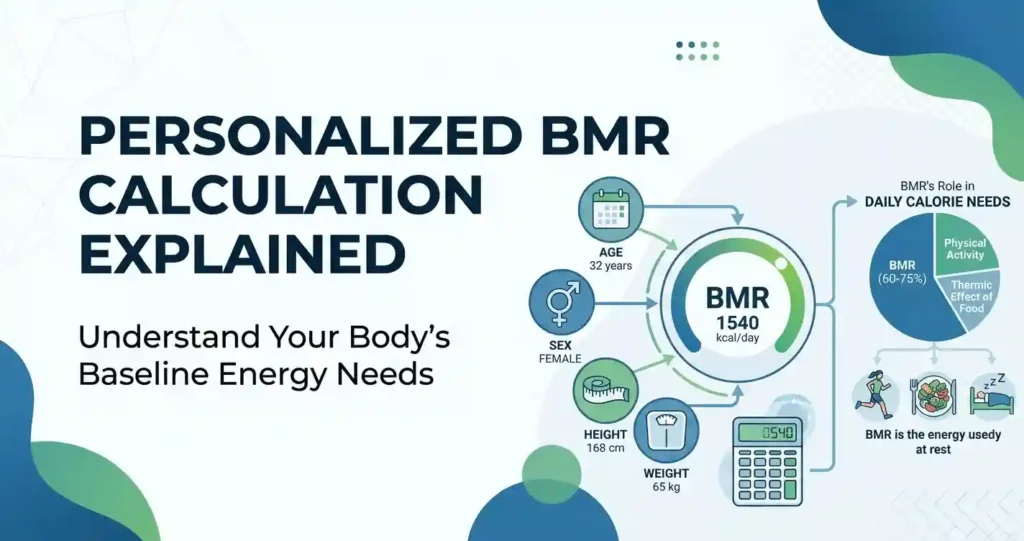
While standard calorie guidelines offer generic averages (like 2,000 kcal for women and 2,500 kcal for men), these numbers rarely reflect individual biological reality. A personalised BMR calculation provides a far more precise starting point by factoring in your unique characteristics: age, sex, height, and weight.
In this guide, you will learn:
- What personalised BMR is and how it differs from other metabolic measurements.
- The physiological factors that influence your resting energy expenditure.
- How popular BMR equations (such as Mifflin-St Jeor) calculate your needs.
- Step-by-step instructions for determining your BMR and converting it into Total Daily Energy Expenditure (TDEE).
- Practical strategies to use your BMR for sustainable weight loss, muscle gain, or maintenance.
What Is Personalised BMR Calculation?
Basal Metabolic Rate (BMR) is the estimated minimum number of calories your body requires at rest over a 24-hour period to perform vital life-sustaining functions. These essential biological tasks include continuous processes such as:
- Breathing and respiration
- Blood circulation
- Cell production and repair
- Hormone regulation and balance
- Body temperature maintenance
A personalised bmr calculation explained simply is an approach that uses individual physiological measurements rather than relying on population averages. Because two people of the same weight can have wildly different energy requirements, personalisation ensures your baseline targets reflect your actual body size and biology.
To apply metabolic metrics effectively, it is critical to distinguish between four interrelated terms:
| Metric | Definition | Practical Function |
|---|---|---|
| BMR (Basal Metabolic Rate) | Calories burned at absolute rest under strict laboratory conditions (awake, fasting, thermoneutral environment). | The biological baseline for involuntary bodily function. |
| RMR (Resting Metabolic Rate) | Calories burned at rest without strict fasting or laboratory constraints. | Slightly higher than BMR (~5–10%), but often used interchangeably in clinical practice. |
| Maintenance Calories | The total calories required to maintain current body weight. | Equals your Total Daily Energy Expenditure (TDEE). |
| TDEE (Total Daily Energy Expenditure) | BMR plus calories burned through daily movement, formal exercise, and digesting food. | The complete figure used to build calorie deficits or surpluses. |
Why Is Personalising Your BMR Important?
Calorie requirements vary significantly between individuals. A 30-year-old male construction worker weighing 80 kg requires a completely different energy intake than a 60-year-old female office worker of the exact same weight.
Generic calorie recommendations fail because resting energy expenditure is governed by total body surface area, tissue mass, biological sex, and age. Relying on average guidelines often leads to setting calorie targets that are either too restrictive—causing metabolic adaptation, fatigue, and muscle loss—or too high, preventing weight loss altogether. A personalised bmr calculation provides the tailored baseline necessary to build effective meal plans, structure workouts, and track progress accurately over time.
What Factors Affect Your Personalised BMR?
BMR is not a fixed, immutable figure; it is dynamic and controlled by a combination of scalable measurements and hardwired genetics. Common BMR equations rely on core anthropometric variables to estimate expenditure, though individual variation always exists.
Key Takeaway: Mathematical BMR equations provide high-accuracy estimates for approximately 80–85% of the population. Individual outliers may vary based on health, organ weight, and genetic predisposition.
Age
BMR generally declines with age, dropping by approximately 1–2% per decade after early adulthood. This gradual slowdown is largely driven by a natural loss of skeletal muscle mass (sarcopenia) alongside shifts in hormonal output and organ metabolic activity. Including age in BMR calculations ensures that estimated energy needs drop systematically across the lifespan, preventing overestimation in older adults.
Sex
Standard BMR formulas incorporate biological sex as a primary variable. On average, men possess a higher proportion of lean muscle tissue and larger internal organs relative to total body weight, while women naturally carry higher essential fat stores for reproductive physiology. Because lean tissue consumes significantly more energy at rest than fat tissue, men typically present a higher BMR than women of identical height and weight.
Height and Body Weight
Height and weight together dictate your body surface area and overall tissue volume. A taller or heavier frame contains a larger quantity of cells requiring oxygen, glucose, and systemic support. Consequently, a larger body demands significantly more energy to sustain basic physiological processes at rest than a smaller frame.
Muscle Mass and Body Composition
Two individuals weighing exactly 85 kg can have dramatically different metabolic rates based on their body composition:
Person A (85 kg, 12% Body Fat)  ---> High Lean Mass ---> Higher BMR (~1,950 kcal)
Person B (85 kg, 32% Body Fat)  ---> Lower Lean Mass ---> Lower BMR (~1,650 kcal)
Skeletal muscle tissue is metabolically active, burning roughly 10–15 kcal per kilogram per day at rest, compared to body fat, which burns roughly 4.5 kcal per kilogram. While internal organs (heart, liver, kidneys, brain) account for the majority (~60–70%) of BMR despite making up only 5–6% of body weight, skeletal muscle is the main variable factor you can influence through lifestyle.
Genetics, Hormones, and Health
Equation-based estimates cannot account for every biological nuance. Metabolic output is heavily regulated by endocrine function:
- Thyroid Hormones: Hyperthyroidism significantly increases resting burn, whereas hypothyroidism suppresses metabolic output.
- Hormonal Fluctuations: Variations in progesterone during the luteal phase of the menstrual cycle can increase BMR by 100–300 kcal/day.
- Illness and Recovery: Systemic infection, fever, trauma, or surgery elevates BMR substantially as the immune system works to repair tissues.
- Medications: Beta-blockers, antidepressants, and thyroid therapies can directly adjust baseline metabolic speed.
How Is BMR Calculated?
BMR equations use mathematical regressions derived from large-scale clinical studies. These formulas combine measured physical properties (height, weight, age, and sex) to approximate total resting caloric burn over 24 hours.
Featured Snippet Definition:
Personalised BMR is estimated by entering individual characteristics—including age, biological sex, height, and body weight—into a validated metabolic equation (such as the Mifflin-St Jeor formula) to calculate resting daily energy expenditure.
The Mifflin-St Jeor Equation
Published in 1990, the Mlifflin-St Jeor equation is widely regarded by dietitians, sports scientists, and clinical nutritionists as the most accurate standard formula for estimating BMR in healthy modern adults.
The formulas operate using metric units (weight in kilograms, height in centimetres, and age in years):
For Men:BMR=(10×weight in kg)+(6.25×height in cm)−(5×age in years)+5
For Women:BMR=(10×weight in kg)+(6.25×height in cm)−(5×age in years)−161
Other BMR Equations
While Mifflin-St Jeor is the standard default, alternative validated equations exist for specific populations:
- Original Harris-Benedict (1919): One of the earliest formulas. Tends to overestimate BMR in modern, more sedentary populations by about 5–15%.
- Revised Harris-Benedict (1984): Refined by Roza and Shizgal to improve accuracy, though still occasionally overestimates burn in individuals with higher body fat percentages.
- Katch-McArdle Equation: Uses Lean Body Mass (LBM) rather than total weight. Highly accurate for athletic populations or individuals who know their precise body fat percentage:BMR=370+(21.6×Lean Body Mass in kg)
Because equations rely on different population datasets, subtle variance between tools is normal. A digital calculator provides an authoritative operational estimate rather than an absolute lab-tested number.
How to Calculate Your Personalised BMR Step by Step
1
Enter Your Age
Biological age fine-tunes resting energy decline
1.Enter Your Age:Biological age fine-tunes resting energy decline.
Input your current age in years. BMR equations apply a negative multiplier to age to account for the natural biological slowdown in resting tissue metabolism over time.
2
Select Your Biological Sex
Accounts for baseline tissue mass differences
2.Select Your Biological Sex:Accounts for baseline tissue mass differences.
Choose male or female. Standard equations use biological sex to adjust for population-wide baseline differences in average muscle mass and body fat distribution.
3
Enter Your Height and Weight
Use accurate, recent measurements
3.Enter Your Height and Weight:Use accurate, recent measurements.
Measure your height without shoes and weigh yourself first thing in the morning after using the bathroom. Convert imperial units if necessary:
- Weight: Pounds ÷2.205=kg (or Stone ×6.35=kg)
- Height: Inches ×2.54=cm (or Feet ×30.48=cm)
4
Compute Your BMR Estimate
Generates your baseline resting calorie rate
4.Compute Your BMR Estimate:Generates your baseline resting calorie rate.
Pass your numbers through a validated equation like Mifflin-St Jeor to yield your baseline figure in kilocalories per day (kcal/day).
5
Apply Activity Multipliers for TDEE
Converts resting needs to functional daily targets
5.Apply Activity Multipliers for TDEE:Converts resting needs to functional daily targets.
Multiply your baseline BMR by an activity factor to determine your Total Daily Energy Expenditure (TDEE). This total figure represents your true maintenance calorie level.
BMR vs TDEE: What’s the Difference?
A common mistake in nutrition planning is treating BMR as the total number of calories you should eat each day. Eating at your BMR level long-term provides only enough energy to cover resting organ function—leaving no energy for walking, working, digesting food, or exercising.
To find your true daily energy needs (TDEE), your base BMR must be combined with three additional components:
- Non-Exercise Activity Thermogenesis (NEAT): Energy expended doing everyday movement (walking, standing, cleaning, fidgeting).
- Thermic Effect of Exercise (TEE): Energy burned during deliberate workouts or sporting activities.
- Thermic Effect of Food (TEF): Energy used to digest, absorb, and process nutrients (~10% of total daily calorie intake).
+-------------------------------------------------------+
|        Total Daily Energy Expenditure (TDEE)          |
+-------------------------------------------------------+
|  [ BMR ~60-70% ]  [ NEAT ~15% ]  [ TEE ~10% ] [ TEF ~10% ] |
+-------------------------------------------------------+
How Activity Levels Change Your Calorie Needs
To calculate TDEE, apply the standard Physical Activity Level (PAL) multiplier to your baseline BMR:
| Activity Level | PAL Multiplier | Lifestyle Example |
|---|---|---|
| Sedentary | 1.2 | Desk job (e.g., London office worker), minimal deliberate walking, no formal exercise. |
| Lightly Active | 1.375 | Light daily walking, or 1–3 days per week of moderate exercise (e.g., light jogging, yoga). |
| Moderately Active | 1.55 | Active job or 3–5 days per week of moderate-to-vigorous resistance training or cardio. |
| Highly Active | 1.725 | Physical job (e.g., construction, active trades) or 6–7 days of intense training. |
| Extremely Active | 1.9 | Professional athlete, endurance runner, or heavy manual labour combined with daily hard sport. |
How to Use Personalised BMR for Weight Loss
Your personalised BMR and calculated TDEE provide the numerical framework for managing body composition.
To lose weight, you must create an energy deficit—consuming fewer calories than your TDEE over time.
Energy Deficit = Consuming less than TDEE  ---> Body uses stored fat for fuel
Energy Surplus = Consuming more than TDEE  ---> Body stores excess energy
Creating a Calorie Deficit
A safe, sustainable calorie deficit generally ranges from 300 to 500 kcal per day below your TDEE. This range typically yields a steady, healthy loss of roughly 0.25 to 0.5 kg (0.5 to 1 lb) per week while preserving lean muscle mass.
Crucial Safety Warning: Avoid dropping your daily calorie intake below your baseline BMR for extended periods without medical supervision. Consistently eating below BMR deprives organs of fuel, triggering severe lethargy, hormonal disruption, hair thinning, loss of bone density, and adaptive thermogenesis (a sharp drop in non-exercise movement).
Alongside calorie targets, prioritize nutritional quality:
- Protein: 1.6–2.2 g per kg of body weight to retain lean muscle.
- Fibre: 30 g/day (UK Dietary Guidelines) for gut health and satiety.
- Micronutrients: Whole foods, vegetables, and fruit to maintain metabolic efficiency.
Why Your BMR May Change During Weight Loss
As you successfully lose weight, your BMR naturally decreases. A smaller body mass requires less energy to maintain itself at rest. Additionally, extended caloric restriction causes adaptive thermogenesis, where the body efficiency-tunes metabolic output to conserve energy.
To maintain weight loss progression:
- Re-calculate your BMR and TDEE after every 5–8 kg of weight loss.
- Periodically adjust your calorie targets downwards or increase your non-exercise activity (NEAT) to maintain a functional energy deficit.
Can You Increase Your BMR?
While you cannot alter biological variables like age or height, you can make targeted lifestyle choices to support and maximize your resting metabolic rate.
Building and Maintaining Muscle
Skeletal muscle requires significantly more upkeep than fat tissue. Engaging in progressive resistance training (weightlifting, bodyweight calisthenics, or gym workouts) 2–4 times per week stimulates muscle protein synthesis.
Increased Muscle Tissue ---> Higher Basal Metabolic Output ---> Elevated TDEE
Combining resistance training with adequate daily protein ensures that weight lost comes primarily from body fat reserves rather than lean muscle tissue, protecting your baseline metabolic rate.
Lifestyle Factors That Support Metabolic Health
- Sleep Optimization: Chronic sleep deprivation (<6 hours/night) alters glucose tolerance, raises cortisol, and suppresses resting metabolic performance. Aim for 7–9 hours nightly.
- Sufficient Protein Intake: Protein has a higher thermic effect of food (TEF) than carbohydrates or fats—your body burns roughly 20–30% of protein calories purely during digestion.
- Hydration: Adequate water intake is required for cellular metabolic processes. Dehydration temporarily slows down resting energy conversion.
- Treat “Metabolism Boosting” Supplements with Skepticism: Green tea extracts, chili compounds, and commercial fat burners offer at best negligible, short-term spikes in burn (<50 kcal/day) and cannot substitute for resistance training and a managed calorie deficit.
Personalised BMR Calculation Example
To see how these concepts come together, consider this practical example of a modern UK adult:
Subject Profile:
- Sex: Female
- Age: 34 years old
- Height: 168 cm (5 ft 6 in)
- Weight: 72 kg (11 st 4 lbs)
- Occupation: Desk-bound HR Manager in Manchester (Sedentary)
- Exercise: Attends a gym resistance class 3 days per week (Light-to-Moderate overall activity)
Step 1: Calculate BMR using Mifflin-St Jeor
BMR = (10 × 72) + (6.25 × 168) - (5 × 34) - 161
BMR = 720 + 1050 - 170 - 161
BMR = 1,439 kcal/day

Step 2: Calculate TDEE using Activity Factor
Lightly-to-Moderately Active Multiplier ≈ 1.45
TDEE = 1,439 × 1.45 = 2,086 kcal/day
This individual burns approximately 1,439 kcal at absolute rest, and requires ~2,085 kcal/day to maintain her current weight.
Example for Weight Loss
To achieve sustainable fat loss, she sets a moderate daily calorie deficit of 400 kcal:
Daily Target=2,086−400=1,686 kcal/day
Notice that her daily target (1,686 kcal) remains safely above her resting BMR baseline (1,439 kcal). This ensures adequate fuel for physiological health while generating an effective energy deficit for weight loss.
Common Mistakes When Calculating BMR
Avoid these common missteps when calculating and applying metabolic metrics:
- Entering Inaccurate Measurements: Guessing your height or weight leads to unreliable outputs. Use precise digital scales and measure your height accurately.
- Confusing BMR with TDEE: Eating at your BMR calorie number instead of your TDEE-derived target leads to excessive caloric restriction, extreme fatigue, and muscle loss.
- Overestimating Physical Activity Levels: Selecting “Highly Active” when working a desk job—even with 45 minutes of daily gym exercise—often results in setting calories too high for weight loss.
- Treating Formulas as Absolute Truth: Equations provide population estimates. Individual variance (up to ±10–15%) can occur due to genetics, non-exercise activity, or medical factors.
Why Online BMR Calculators Can Give Different Results
If you run your numbers through multiple online tools, you may encounter slightly different outputs. This occurs because different tools rely on different underlying formulas (e.g., Mifflin-St Jeor vs. Revised Harris-Benedict) or apply different activity multiplier categories.
To keep tracking reliable, stick with one trusted calculator using the Mifflin-St Jeor equation throughout your health journey.
How Accurate Is a Personalised BMR Calculation?
While equation-based BMR estimates are practical and useful, they remain approximations.
Estimated BMR vs Measured Metabolic Rate
+---------------------------------------------------------------------+
|                     Equation-Based BMR                              |
|  Mathematical formula (Mifflin-St Jeor)                             |
|  Margin of error: ±10% for most adults                              |
|  Cost: Free & immediate                                             |
+---------------------------------------------------------------------+
                                 vs
+---------------------------------------------------------------------+
|                  Lab-Measured RMR (Indirect Calorimetry)            |
|  Measures actual oxygen consumed and CO2 produced                   |
|  Margin of error: Near zero (Clinical Gold Standard)                |
|  Cost: Specialized clinical facility required                       |
+---------------------------------------------------------------------+
For the vast majority of fitness goals, equation-based BMR calculations are more than accurate enough to establish a working calorie baseline. Track your body weight trend over 3–4 weeks; if your weight doesn’t move as predicted by the math, adjust your calorie intake by 100–150 kcal/day based on real-world feedback.
Personalised BMR Calculation for Fitness and Calorie Tracking
Your metabolic baseline adapts based on your overarching goal:
                  +-------------------------------+
                  |  TDEE Target Adjustments     |
                  +-------------------------------+
                                  |
        +-------------------------+-------------------------+
        |                         |                         |
        v                         v                         v
  [ Muscle Gain ]         [ Maintenance ]           [ Fat Loss ]
   TDEE + 250-500           Exact TDEE             TDEE - 300-500
   (Energy Surplus)       (Energy Balance)         (Energy Deficit)
- For Muscle Gain: Combine progressive resistance training with a small energy surplus of +250 to +500 kcal above TDEE. Ensure protein intake stays between 1.6–2.2 g/kg of body weight.
- For Weight Maintenance: Consume calories matching your calculated TDEE. Adjust slightly if seasonal activity levels shift (e.g., higher step counts in summer vs. winter).
- For Fat Loss: Maintain a consistent calorie deficit of 300 to 500 kcal below TDEE. Keep protein high and track weekly body weight averages to ensure progress.
Frequently Asked Questions
What is a personalised BMR calculation?
A personalised BMR calculation estimates the baseline calories your body needs at rest by factoring in your individual age, biological sex, height, and body weight.
How do I calculate my BMR?
You can calculate your BMR by entering your age, sex, height, and weight into an validated equation like Mifflin-St Jeor, or by using a digital BMR calculator.
Is BMR the same as daily calorie needs?
No. BMR reflects energy burned strictly at rest. Your total daily calorie needs (TDEE) include BMR plus calories burned through daily movement, work, digestion, and exercise.
Does BMR change when you lose weight?
Yes. As total body weight drops, your body requires less energy to maintain itself, resulting in a lower baseline BMR.
Does muscle increase BMR?
Yes. Lean muscle tissue is metabolically active and consumes more calories at rest than fat tissue, though the baseline increase is moderate (roughly 10–15 kcal/kg of muscle per day).
Which BMR formula is most accurate?
The Mifflin-St Jeor equation is widely regarded by clinical researchers as the most accurate standard formula for modern adults.
How many calories should I eat based on my BMR?
You should calculate your TDEE first, then set your calorie targets. Avoid consistently eating below your baseline BMR without professional medical supervision.
Can BMR be different for two people with the same weight?
Yes. Differences in height, biological sex, age, muscle-to-fat ratio, and health can cause two people of identical weight to have different metabolic rates.
Should I recalculate my BMR after losing weight?
Yes. Recalculating your BMR every time you lose 5–8 kg ensures your calorie and macro targets stay aligned with your smaller body size.
Can a BMR calculator help with weight loss?
Yes. A BMR calculator provides the baseline number needed to accurately compute your TDEE and set an effective, sustainable calorie deficit.
Conclusion: Use Your Personalised BMR to Make Smarter Calorie Decisions
A personalised BMR calculation replaces generic guidelines with a clear estimate tailored to your body’s specific biological needs. By understanding your resting metabolic baseline and scaling it with your daily activity level, you can calculate your true Total Daily Energy Expenditure (TDEE). This number gives you complete control over your calorie targets—whether you want to lose body fat, build muscle, or maintain your physique sustainably.
Remember that metabolic estimates are starting points. Monitor your real-world progress over time, adjust for shifts in weight or activity, and use your BMR as an informative tool on your health journey.
Ready to take control of your diet and energy needs? Use a trusted BMR Calculator to establish your baseline today, combine it with your daily activity level, and build a personalized calorie strategy tailored to your lifestyle and fitness goals.

Ehatasamul Alom is a dedicated health-tech enthusiast and the co-founder of BMRCalculator. With a passion for metabolic science, he focuses on providing accurate health data for the UK community. Ehatasamul ensures that every tool and guide aligns with NHS standards and public health research. His mission is to simplify complex biological data, helping British residents make informed decisions about their fitness, calorie needs, and long-term wellness. When not analyzing health trends, he explores the latest innovations in wearable fitness technology.