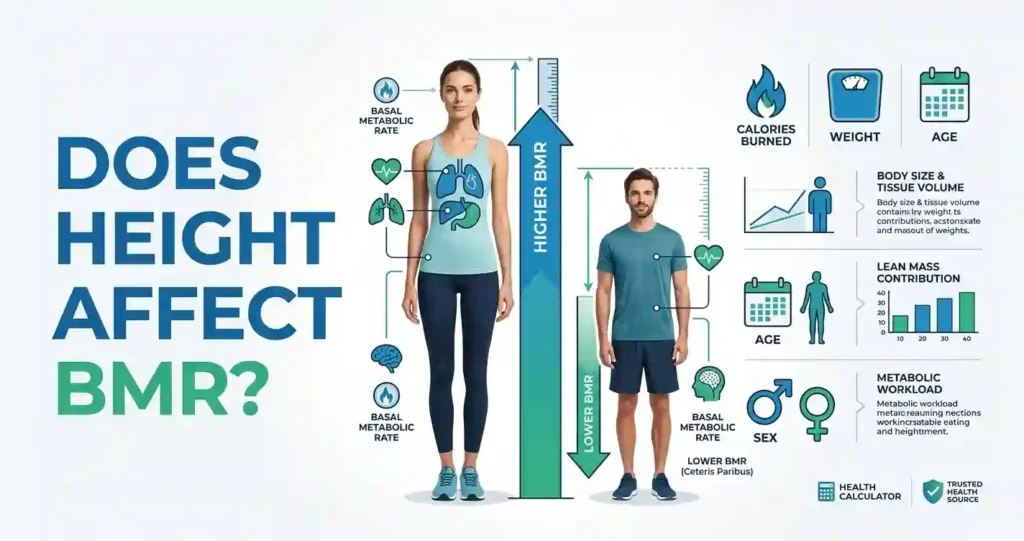
Yes, height can affect your Basal Metabolic Rate (BMR), but it is only one factor among several.
Basal Metabolic Rate represents the minimum number of calories your body requires at rest to carry out essential life-sustaining functions, such as breathing, circulating blood, cellular repair, and maintaining organ function. Understanding your BMR serves as the fundamental cornerstone for weight loss, accurate calorie tracking, and effective fitness and nutrition planning. Knowing this baseline number gives you a clear starting point for adjusting your daily energy intake to align with your health goals.
Does Height Affect BMR?
Taller individuals often have a higher BMR because height directly contributes to overall body size and total lean tissue. A taller frame typically accommodates larger internal organs, a longer circulatory system, and a greater overall volume of tissue—all of which require energy to maintain even when completely inactive.
Height alone does not dictate your metabolic rate. Your total body weight, age, biological sex, and specific body composition (the ratio of muscle to fat) play critical roles in shaping your metabolism.
When discussing resting energy needs, you will often encounter closely related terms:
- Resting Metabolic Rate (RMR): Similar to BMR, but measured under less strict conditions (such as without overnight fasting).
- Resting Calories: The energy expended while resting over a 24-hour period.
- Daily Calorie Requirements: The total energy needed to maintain your current weight, factoring in daily movement and exercise.
Why Does Height Influence Basal Metabolic Rate?
A taller body inherently possesses a larger overall surface area and structural footprint. Maintaining homeostasis across a larger physical frame demands more baseline biological work:
- Expanded Tissue Volume: Taller individuals possess longer bones, larger blood vessels, and more extensive connective tissue, all requiring ongoing cellular repair and nourishment.
- Organ Scale: Internal organs such as the heart, lungs, and kidneys scale upward with stature, consuming more energy at rest.
- Lean Mass Allocation: Even without visible muscular hypertrophy, a taller frame carries more structural muscle to support and move wider skeletal leverage.
While taller individuals generally show higher baseline energy requirements, height is not an absolute predictor. A shorter individual with substantial lean muscle mass can easily exhibit a higher BMR than a taller, sedentary individual with a lower percentage of muscle tissue.
What Factors Affect BMR?
To estimate resting metabolic expenditure, standard predictive models evaluate four primary demographic and anthropometric variables:
- Height: Measures physical dimensions and structural scale.
- Weight: Accounts for total gravitational body mass.
- Age: Tracks natural chronological shifts in metabolic tissue.
- Sex: Adjusts for typical biological differences in body density and tissue distribution.
Beyond these basic inputs, metabolic rate is modified by muscle mass and overall lean body composition, genetics, and hormonal signaling (such as thyroid hormone levels).
It is vital to distinguish BMR from Total Daily Energy Expenditure (TDEE). While BMR calculates energy burned strictly at rest, TDEE accounts for your entire daily footprint, including physical activity, digestion, and deliberate exercise.
       ┌────────────────────────────────────────────────────────┐
       │             Total Daily Energy Expenditure             │
       │                         (TDEE)                         │
       └───────────────────────────┬────────────────────────────┘
                                   │
         ┌─────────────────────────┼─────────────────────────┐
         │                         │                         │
         ▼                         ▼                         ▼
┌──────────────────┐      ┌──────────────────┐      ┌──────────────────┐
│  Basal Metabolic │      │ Physical Activity│      │ Thermic Effect   │
│    Rate (BMR)    │      │    & Exercise    │      │     of Food      │
│     (~60-75%)    │      │    (~15-30%)     │      │     (~8-10%)     │
└──────────────────┘      └──────────────────┘      └──────────────────┘
Height
Height is included in standard BMR calculations to establish physical scale. Holding weight, age, and sex constant while increasing height yields a higher estimated BMR. This occurs because the formula assumes a taller frame carries a proportional expansion of internal structures.
Weight
Body weight serves as a dominant primary predictor in resting energy equations. Moving or maintaining mass requires continuous metabolic input. Total weight does not distinguish between lean tissue and adipose tissue, even though lean mass burns substantially more energy than fat mass at rest.
Age
Basal metabolic rate gradually declines with age. This slowdown is primarily driven by progressive loss of skeletal muscle mass (sarcopenia) and shifts in tissue efficiency. Engaging in regular resistance exercise helps preserve lean tissue and support metabolic rate as you age.
Sex
BMR equations incorporate biological sex to account for typical systemic variations in body composition. On average, biological males possess higher proportions of lean muscle tissue and greater bone density relative to biological females, leading to higher average baseline energy needs.
Does Being Taller Mean You Burn More Calories?
Being taller often translates to a higher BMR, but it does not guarantee higher total daily calorie burn.
Total energy expenditure depends heavily on your daily lifestyle. A shorter, highly active individual who works a physical job and trains regularly will burn far more total daily calories than a tall, sedentary individual who sits at a desk all day.
    Basal Metabolic Rate (BMR)         Total Daily Energy Expenditure (TDEE)
┌─────────────────────────────────┐   ┌─────────────────────────────────┐
│ • Minimum energy for survival   │   │ • Includes BMR baseline         │
│ • Heartbeat, breathing, repair  │ + │ • Daily physical movement       │
│ • Measured at total rest        │   │ • Structured exercise           │
│ • Comprises ~60-75% of daily burn│   │ • Thermic effect of food (TEF)  │
└─────────────────────────────────┘   └─────────────────────────────────┘
Your total energy output consists of three main components:
- BMR: Resting energy expenditure (~60–75% of total burn).
- Physical Activity: Non-exercise movement (NEAT) plus structured exercise (~15–30%).
- Thermic Effect of Food (TEF): Energy used to digest and process nutrients (~8–10%).
BMR vs TDEE: What’s the Difference?
- BMR is the baseline energy needed to keep your body functioning while lying in bed all day without moving.
- TDEE is the total number of calories you burn across a full 24-hour period, factoring in all physical movement, work, and exercise.
Consider two individuals with identical BMRs of 1,600 kcal/day:
- Individual A (Sedentary Desk Work): TDEE ≈1,600×1.2=1,920 kcal/day
- Individual B (Active & Trains 4x/week): TDEE ≈1,600×1.55=2,480 kcal/day
Despite identical resting metabolic rates, Individual B requires 560 additional calories each day simply due to physical activity.
How Is BMR Calculated Using Height?
The Mifflin-St Jeor equation is widely regarded as one of the most reliable predictive tools for estimating BMR in healthy adults:
BMR (Men)=(10×weight in kg)+(6.25×height in cm)−(5×age in years)+5
BMR (Women)=(10×weight in kg)+(6.25×height in cm)−(5×age in years)−161
Using a reliable online BMR calculator offers a quick way to apply these calculations without manually processing the math.
Mifflin-St Jeor BMR Formula
This equation uses three standard inputs:
- Height: Entered in centimetres (cm).
- Weight: Entered in kilograms (kg).
- Age: Entered in years.
Note: These mathematical equations generate population estimates rather than direct lab-grade measurements of metabolic rate.
Example of How Height Changes BMR
To isolate the specific numerical effect of height on BMR, consider two hypothetical men with identical parameters except for height:
| Parameter | Individual A | Individual B |
|---|---|---|
| Age | 30 years | 30 years |
| Weight | 75 kg | 75 kg |
| Sex | Male | Male |
| Height | 170 cm (5 ft 7 in) | 185 cm (6 ft 1 in) |
| Calculation | (10×75)+(6.25×170)−(5×30)+5 | (10×75)+(6.25×185)−(5×30)+5 |
| Estimated BMR | 1,667 kcal/day | 1,761 kcal/day |
In this isolated comparison, an additional 15 cm in height yields an extra 94 kcal/day in estimated resting metabolic expenditure. This difference stems directly from the equation’s adjustment for structural scale.
Does Height Affect BMR More Than Weight?
While height and weight both feature prominently in metabolic modeling, weight generally exerts a stronger numerical influence in standard formulas.
In the Mifflin-St Jeor equation:
- Every 1 kg increase in weight adds 10 kcal/day to the baseline estimate.
- Every 1 cm increase in height adds 6.25 kcal/day to the baseline estimate.
Consequently, gaining or losing 5 kg of mass shifts your calculated metabolic rate more significantly than a 5 cm variation in height. However, total mass alone does not tell the whole story—body composition provides necessary context for these figures.
| Parameter | Primary Impact on BMR Calculation | Key Considerations |
|---|---|---|
| Height | Multiplied by 6.25 per cm | Fixed in adults; reflects structural scale and organ volume. |
| Weight | Multiplied by 10 per kg | Dynamic; includes metabolically active muscle and fat mass. |
| Lean Mass | Excluded from standard Mifflin-St Jeor | Highly active metabolically; requires specialized formulas (e.g., Katch-McArdle). |
Does Muscle Mass Affect BMR?
Skeletal muscle is a metabolically active tissue, consuming roughly 13 kcal per kilogram per day at rest, compared to approximately 4.5 kcal per kilogram for fat tissue.
Because standard height-weight formulas do not directly measure body composition, two people with identical heights and weights can have different true BMRs if one has a higher proportion of lean muscle mass.
       Total Body Weight (75 kg)
 ┌──────────────────┬──────────────────┐
 │  Lean Body Mass  │     Fat Mass     │
 │     (60 kg)      │     (15 kg)      │
 ├──────────────────┼──────────────────┤
 │ Highly Active    │ Low Metabolic    │
 │ Tissue           │ Activity         │
 │ (~13 kcal/kg/day)│ (~4.5 kcal/kg/day)│
 └──────────────────┴──────────────────┘
Can Building Muscle Increase BMR?
Gaining lean body mass raises your resting energy expenditure. However, its effect is often exaggerated in popular fitness media:
- Realistic Expectations: Gaining 2–3 kg of pure skeletal muscle adds roughly 25–40 extra calories to your daily resting burn.
- Compound Benefits: While the resting expenditure gain is modest, the calories burned during the resistance training required to build that muscle—combined with improved insulin sensitivity—makes weight training exceptionally valuable for long-term health and weight management.
How to Use Your BMR for Weight Loss
Your BMR is not a recommended daily intake target for weight loss. Eating at or below your BMR can leave your body under-resourced for daily activity and basic recovery.
Instead, use your calculated BMR to determine your TDEE, then apply a moderate calorie deficit to support safe, sustainable weight loss.
  ┌────────────┐      ┌──────────────────┐      ┌────────────┐
  │ Calculate  │  ──► │ Multiply by      │  ──► │ Subtract   │
  │    BMR     │      │ Activity Factor  │      │ 300-500    │
  └────────────┘      └──────────────────┘      └────────────┘
                              (TDEE)               (Deficit)
1
Calculate Your Baseline BMR
Use standard Mifflin-St Jeor metrics
1.Calculate Your Baseline BMR:Use standard Mifflin-St Jeor metrics.
Enter your precise height, weight, age, and biological sex into a standard BMR calculator to determine your resting energy needs.
2
Establish Your Activity Multiplier
Determine TDEE based on daily movement
2.Establish Your Activity Multiplier:Determine TDEE based on daily movement.
Multiply your estimated BMR by an appropriate activity multiplier:
- Sedentary (desk job, minimal movement): BMR×1.2
- Lightly Active (light exercise 1-3 days/week): BMR×1.375
- Moderately Active (moderate exercise 3-5 days/week): BMR×1.55
- Very Active (hard exercise 6-7 days/week): BMR×1.725
3
Apply a Moderate Calorie Deficit
Aim for steady, sustainable loss
3.Apply a Moderate Calorie Deficit:Aim for steady, sustainable loss.
Subtract 300 to 500 kcal from your calculated TDEE. This creates an energy deficit suited for losing roughly 0.25 to 0.5 kg (0.5 to 1 lb) per week without risking muscle loss or severe fatigue.
Should You Eat Below Your BMR to Lose Weight?
You should generally avoid eating below your BMR. Consistently eating below your resting metabolic rate can trigger undesirable physiological adaptations, including:
- Severe muscle tissue loss.
- Persistent fatigue and reduced involuntary movement (lowered NEAT).
- Hormonal disruptions affecting thyroid function and reproductive health.
- Nutritional deficiencies that undermine long-term sustainability.
Target a modest deficit relative to your TDEE, ensuring your intake provides adequate energy to support overall health and daily function.
How Accurate Are BMR Calculators?
Online BMR calculators rely on statistical population averages. While they serve as helpful starting tools, they carry an inherent margin of error of roughly ±10%.
Calculators often cannot account for:
- Individual variations in body composition (muscle mass vs. body fat ratio).
- Active thyroid conditions or broader endocrine variations.
- Genetically influenced mitochondrial efficiency.
- Prior chronic calorie restriction.
Rather than treating a calculated BMR as an absolute value, view it as a practical baseline to refine based on your real-world progress over time.
How to Get a More Accurate Estimate of Your Calorie Needs
To move beyond basic mathematical formulas and establish an accurate picture of your daily energy needs:
- Establish a Baseline: Calculate your initial BMR and TDEE using standard metrics.
- Track Daily Intake Consistently: Record all food and beverage intake using a digital scale and food tracking app for 2 to 3 weeks.
- Monitor Body Mass Trends: Weigh yourself daily under identical conditions (e.g., first thing in the morning after using the bathroom), tracking the weekly average to smooth out natural fluid fluctuations.
- Evaluate Progress & Adjust: If your average weight remains unchanged over 3 weeks, your current average intake reflects your actual maintenance TDEE. Adjust your targets based on these real-world data points.
If you have underlying health conditions or specific dietary requirements, consider consulting a registered dietitian or clinical nutritionist for tailored guidance.
BMR Calculator: Calculate Your Daily Calorie Needs
Using an online BMR calculator offers a straightforward way to establish your baseline metabolic metrics:
- Input Core Parameters: Enter your height (cm or feet/inches), total weight (kg or lbs), current age, and biological sex.
- Review Baseline BMR: Note your calculated resting energy intake requirement.
- Factor In Physical Activity: Select your typical weekly activity level to estimate your Total Daily Energy Expenditure (TDEE).
- Set Functional Goals: Use your TDEE as the starting point to structure your calorie and nutrient intake.
Frequently Asked Questions
Does height affect BMR?
Yes. Height is a standard input in predictive BMR equations (such as the Mifflin-St Jeor formula). Taller frames require more baseline energy to support their tissue volume.
Do taller people have a higher BMR?
Taller individuals often have a higher BMR when comparing people of similar age, sex, and body composition. However, an active shorter person with higher muscle mass can have a higher true resting metabolic rate than a sedentary taller person.
Does height affect how many calories I need per day?
Yes, height influences your baseline BMR, which forms the foundation of your total daily calorie requirements. However, daily activity, weight, age, and muscle mass play equally important roles.
Does weight affect BMR more than height?
In most standard BMR equations, weight exerts a stronger numerical influence per unit than height. For example, in the Mifflin-St Jeor equation, each kilogram adds 10 calories to the estimate, whereas each centimetre adds 6.25 calories.
Can gaining muscle increase BMR?
Yes. Lean muscle tissue is metabolically active and consumes more energy at rest than fat tissue. Building muscle raises your BMR, though its primary contribution to fat loss comes from the energy expended during training.
Does BMR decrease with age?
Yes. BMR generally declines with age, largely due to age-related muscle loss (sarcopenia) and natural shifts in tissue metabolism. Regular resistance training helps offset this decline.
Is BMR the same as daily calorie needs?
No. BMR measures only the calories your body requires at complete rest. Your total daily calorie needs (TDEE) include your BMR plus the energy used during daily movement, work, and exercise.
Should I eat below my BMR to lose weight?
No. Eating below your BMR can cause muscle loss, fatigue, and metabolic slowing. Calculate your total daily expenditure (TDEE) and set a moderate calorie target below your TDEE instead.
How can I calculate my BMR?
You can estimate your BMR by entering your age, biological sex, height, and weight into an online calculator that uses the Mifflin-St Jeor equation.
Is a BMR calculator accurate?
Calculators provide estimates based on population averages, typically within a 10% margin of error. They do not account for individual variations in muscle mass or thyroid function, so refine your intake based on real-world weight trends.
Conclusion: Does Height Affect BMR?
Height is a key factor in determining Basal Metabolic Rate, as a taller frame generally carries more tissue volume and larger internal structures that require baseline energy to maintain. However, height is only one part of the metabolic equation. Your body weight, age, sex, lean muscle mass, and daily activity level play vital roles in shaping your overall calorie requirements.
Ready to understand your calorie needs? Use a BMR Calculator to estimate your basal metabolic rate, factor in your daily activity level, and establish a clear, personalised target for your health and weight-management goals.

Ehatasamul Alom is a dedicated health-tech enthusiast and the co-founder of BMRCalculator. With a passion for metabolic science, he focuses on providing accurate health data for the UK community. Ehatasamul ensures that every tool and guide aligns with NHS standards and public health research. His mission is to simplify complex biological data, helping British residents make informed decisions about their fitness, calorie needs, and long-term wellness. When not analyzing health trends, he explores the latest innovations in wearable fitness technology.