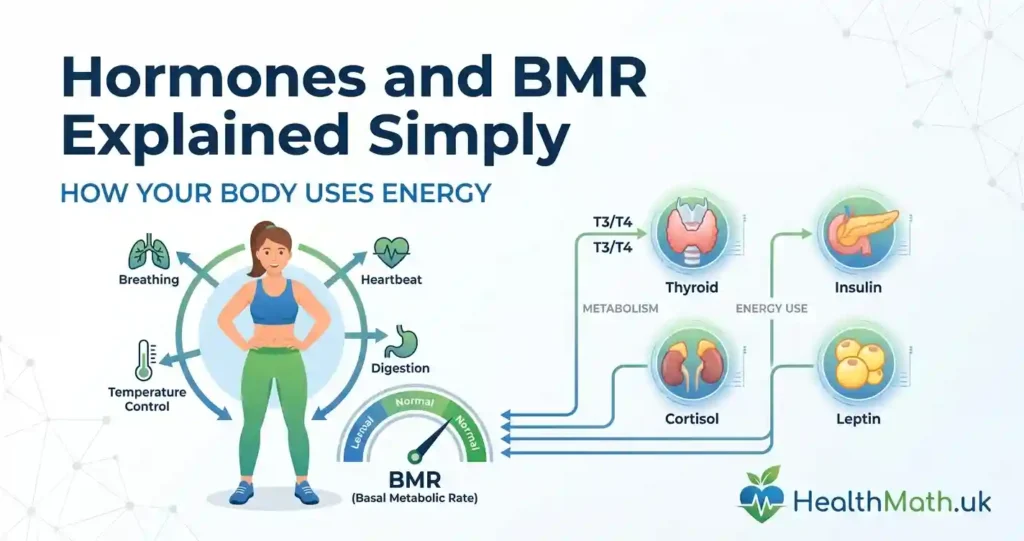
Understanding weight management often feels like piecing together a complex puzzle. While calories in versus calories out forms the foundation of energy balance, many people find that two bodies of the same weight can burn energy quite differently. A primary reason for this variation is the complex interaction between your basal metabolic rate (BMR) and your body’s chemical messengers: hormones.
Your BMR represents the foundational baseline of your energy expenditure—the baseline calories your body requires just to stay alive in a resting state. Hormones act as the control network, signaling to your cells how quickly or slowly to utilize that energy.
It is important to keep in mind that BMR is only one component of your Total Daily Energy Expenditure (TDEE), and hormones are just one set of factors among many—including age, genetics, and muscle mass—that shape your overall metabolism.
By understanding how hormones, BMR, calorie needs, and weight management connect, you can make informed lifestyle choices, set realistic targets, and work alongside your body rather than against it.
What Is BMR?
Basal Metabolic Rate (BMR) is the minimum amount of energy (measured in calories) your body needs to maintain basic, life-sustaining physiological functions while completely at rest in a neutral environment.
Even when sleeping or resting quietly in bed, your body is continuously performing essential biological work, including:
- Breathing and Gas Exchange: Maintaining respiratory muscle contractions and lung function.
- Circulation: Allowing the heart to pump blood through miles of blood vessels.
- Organ Function: Supporting ongoing cellular processes in the brain, liver, kidneys, and gastrointestinal tract.
- Cellular Repair and Production: Synthesizing proteins, repairing tissues, and generating new cells.
- Temperature Regulation: Maintaining a stable internal core body temperature.
       ┌─────────────────────────────────────────────────────────┐
       │             TOTAL DAILY ENERGY EXPENDITURE             │
       └────────────────────────────┬────────────────────────────┘
                                    │
    ┌───────────────────────────────┼───────────────────────────────┐
    │                               │                               │
┌───┴─────────────────┐   ┌─────────┴───────────┐   ┌───────────────┴─────────────┐
│  Basal Metabolic    │   │  Physical Activity  │   │  Thermic Effect of Food     │
│    Rate (BMR)       │   │  & Daily Movement   │   │         (TEF)               │
│   (~60–75% TDEE)    │   │   (~15–30% TDEE)    │   │     (~10% TDEE)             │
└─────────────────────┘   └─────────────────────┘   └─────────────────────────────┘
When discussing baseline energy use, you may encounter related terms:
- Resting Metabolic Rate (RMR): Similar to BMR, but measured under slightly less strict resting conditions (such as without requiring an overnight stay in a clinical setting). RMR values are typically 5% to 10% higher than strict BMR values, though the terms are often used interchangeably in everyday fitness contexts.
- Metabolism: The sum total of all chemical reactions occurring within the body to convert food into energy and maintain cellular life.
- Daily Calorie Requirements: The total number of calories you need to consume per day to maintain your current weight, incorporating your resting rate plus physical activity and the energy required to digest food.
What Is a Normal BMR?
There is no single “normal” or ideal BMR value. A person’s baseline energy requirement varies based on physical characteristics and individual biology:
- Age: Metabolic rates naturally slow over time, largely due to age-related loss of muscle tissue.
- Sex: Males generally exhibit higher BMRs than females of similar weight, primarily due to a higher proportion of lean muscle mass.
- Height and Weight: Larger bodies contain more cells and tissues, requiring more energy to maintain.
- Body Composition: Muscle tissue is far more metabolically active at rest than adipose (fat) tissue.
BMR is expressed in calories per day (kcal/day). For instance, an average adult male might have a BMR around 1,600–1,800 kcal/day, while an average adult female might have a BMR around 1,300–1,500 kcal/day.
Key Takeaway: Online BMR calculators use statistical equations to provide an estimate based on population averages. They offer a helpful reference point, but they cannot measure your unique physiological rate with laboratory precision.
BMR vs Metabolism: What’s the Difference?
While “BMR” and “metabolism” are frequently used interchangeably in informal conversations, they refer to distinct concepts:
- BMR isolates the baseline resting energy consumed purely by internal biological processes.
- Metabolism encompasses all energy-converting biological processes within the body, including digestion, movement, exercise, and repair.
Total Daily Energy Expenditure (TDEE)
│
├── 1. Basal Metabolic Rate (BMR) ~60–75%
│   └── Involuntary basic internal functions
│
├── 2. Thermic Effect of Food (TEF) ~10%
│   └── Energy required to digest, absorb, and metabolise food
│
└── 3. Physical Activity Expenditure ~15–30%
    ├── Non-Exercise Activity Thermogenesis (NEAT): Walking, fidgeting, posture
    └── Exercise Activity Thermogenesis (EAT): Planned workouts, sports
To understand your full daily energy output, you must look at Total Daily Energy Expenditure (TDEE), which combines:
- BMR: The baseline energy spent at rest (~60–75% of total expenditure).
- Thermic Effect of Food (TEF): The calories burned breaking down, absorbing, and processing food (~10% of total expenditure).
- Physical Activity: Energy spent through structured exercise (EAT) plus non-exercise physical movements like walking, standing, and fidgeting (NEAT) (~15–30% of total expenditure).
How Do Hormones Affect BMR?
Hormones serve as the body’s long-distance chemical messengers. Produced by endocrine glands (such as the thyroid, pancreas, and adrenal glands), they travel through the bloodstream to receptors on target cells, directing them to speed up, slow down, or alter specific biological activities.
Hormones influence metabolism by:
- Directing cells on how fast to convert oxygen and nutrients into energy (ATP).
- Signaling whether to burn stored body fat or preserve energy.
- Regulating appetite, hunger cues, and feelings of fullness.
- Controlling internal temperature adjustments in response to cold or heat.
Hormonal impacts vary significantly from person to person based on genetics, stress levels, medical conditions, and lifestyle. Rather than acting as simple switches for weight change, hormones operate within an interconnected feedback system where lifestyle choices directly influence hormone behavior, and hormones in turn affect energy processing.
Which Hormones Affect Metabolism?
Several primary hormones work together to direct your energy balance:
| Hormone | Primary Source | Main Role in Metabolism |
| Thyroid Hormones (T3/T4) | Thyroid Gland | Directly regulates cellular respiration rate and baseline BMR. |
| Insulin | Pancreas | Controls blood glucose uptake and nutrient storage (fat and glycogen). |
| Leptin | Fat Cells (Adipocytes) | Signals long-term energy sufficiency to the brain, suppressing appetite. |
| Ghrelin | Stomach | Triggers hunger signals and encourages food intake. |
| Cortisol | Adrenal Glands | Manages stress responses, mobilises fuel, and regulates glucose levels. |
| Growth Hormone (GH) | Pituitary Gland | Supports muscle growth, tissue repair, and fat metabolism. |
No single hormone acts entirely on its own. They operate as a dynamic system: an alteration in thyroid output can affect insulin sensitivity, while elevated cortisol levels can alter appetite signals like leptin and ghrelin.
Thyroid Hormones and BMR
The thyroid—a butterfly-shaped gland located at the base of your neck—acts as the master control center for your body’s baseline energy consumption.
                   ┌──────────────────────────┐
                   │    HYPOTHALAMUS (TRH)    │
                   └────────────┬─────────────┘
                                │
                                ▼
                   ┌──────────────────────────┐
                   │     PITUITARY (TSH)      │
                   └────────────┬─────────────┘
                                │
                                ▼
                   ┌──────────────────────────┐
                   │   THYROID GLAND (T3/T4)  │
                   └────────────┬─────────────┘
                                │
      ┌─────────────────────────┴─────────────────────────┐
      ▼                                                   ▼
Hyperthyroidism (Elevated T3/T4)            Hypothyroidism (Low T3/T4)
• Increased oxygen consumption              • Decreased cellular energy production
• Higher baseline BMR                       • Lower baseline BMR
• Unexplained weight loss                   • Potential weight gain & fatigue
It releases two primary metabolic hormones:
- Thyroxine (T4): The main circulating form of thyroid hormone, which is relatively inactive.
- Triiodothyronine (T3): The active form of thyroid hormone, converted from T4 in peripheral tissues like the liver and kidneys.
T3 binds to nuclear receptors inside cells, influencing how quickly your mitochondria convert nutrients into usable cellular energy (ATP). When thyroid hormone levels are in a healthy range, your metabolic processes run efficiently, keeping your baseline energy use stable.
Can an Underactive Thyroid Lower BMR?
When the thyroid gland produces insufficient T3 and T4, the clinical condition is known as hypothyroidism (underactive thyroid). According to NHS guidelines, hypothyroidism affects approximately 15 in every 1,000 women and 1 in every 1,000 men in the UK.
With lower circulating levels of thyroid hormones:
- Cellular energy expenditure decreases, causing BMR to drop below normal baseline estimates.
- Common symptoms can include persistent fatigue, feeling unusually cold, dry skin, constipation, and fluid retention.
- Unexplained weight gain or difficulty losing weight often occurs.
However, weight changes associated with hypothyroidism are frequently caused by fluid and salt retention rather than massive fat gain alone.
Clinical Reality: Simply dropping calorie intake very low is not an effective solution for thyroid-driven weight gain. In fact, severe calorie restriction can cause the liver to reduce the conversion of T4 into active T3, which may further lower resting energy expenditure. If you suspect an underactive thyroid, consult a GP for a blood test to check your Thyroid Stimulating Hormone (TSH) and free T4 levels.
Can an Overactive Thyroid Increase BMR?
Conversely, when the thyroid produces excessive amounts of T3 and T4, the condition is known as hyperthyroidism (overactive thyroid).
An excess of active thyroid hormones causes cellular metabolism to run at an accelerated pace:
- Baseline BMR increases significantly above normal predicted values.
- Common symptoms include unexplained weight loss despite an increased appetite, a rapid or irregular heart rate (palpitations), anxiety, tremors, sweating, and heat intolerance.
- Because the body burns fuel rapidly, it may begin breaking down muscle tissue alongside fat if total energy intake does not meet the elevated demand.
Any suspicion of hyperthyroidism requires medical evaluation by a physician or endocrinologist to protect cardiovascular health and normalize metabolic activity.
Insulin and BMR Explained
Insulin is a hormone produced by the beta cells of the pancreas in response to rising blood glucose levels—typically after you digest carbohydrates and proteins.
Insulin’s main functions include:
- Glucose Regulation: Facilitating the movement of glucose out of the bloodstream and into muscle, liver, and fat cells for energy or storage.
- Glycogen Synthesis: Directing excess glucose to be stored as glycogen in the liver and skeletal muscles.
- Nutrient Partitioning: Promoting the absorption of amino acids into muscle tissue for repair.
Popular diet books sometimes frame insulin as a simple “fat-storage switch” that completely stops weight loss whenever it is present. In reality, insulin is an essential hormone that regulates energy storage and utilization. While high insulin levels temporarily favor storing incoming nutrients, your overall body composition and weight depend on your total long-term energy balance rather than momentary shifts in insulin levels.
┌─────────────────────────────────────────────────────────────────────────┐
│                      CARBOHYDRATE MEAL CONSUMPTION                      │
└────────────────────────────────────┬────────────────────────────────────┘
                                     │
                                     ▼
┌─────────────────────────────────────────────────────────────────────────┐
│                 Pancreas Releases Insulin Into Bloodstream               │
└────────────────────────────────────┬────────────────────────────────────┘
                                     │
         ┌───────────────────────────┴───────────────────────────┐
         ▼                                                       ▼
┌──────────────────────────────────┐            ┌──────────────────────────────────┐
│   Muscle & Liver Cells           │            │   Adipose (Fat) Tissue           │
│   • Glucose taken up for fuel    │            │   • Excess fuel stored as fat    │
│   • Replenishes glycogen stores  │            │   • Lipolysis temporarily slowed │
└──────────────────────────────────┘            └──────────────────────────────────┘
Does Insulin Directly Change Your BMR?
Insulin does not directly dictate or alter your basal metabolic rate in the way thyroid hormones do. Standard mathematical BMR formulas (such as the Mifflin-St Jeor or Harris-Benedict equations) do not use insulin levels as a variable. Instead, they estimate energy expenditure based on age, sex, weight, and height.
However, insulin influences overall metabolism over time through its effects on insulin sensitivity:
- Insulin Sensitivity: When cells respond well to insulin, blood glucose is efficiently directed into muscle and organ tissues.
- Insulin Resistance: When cells become resistant to insulin signals, the pancreas produces higher amounts of the hormone to clear glucose from the blood. Chronically elevated insulin can promote fat storage, increase hunger cues, and lead to conditions like Type 2 diabetes.
While insulin resistance does not automatically lower your baseline BMR, it can affect overall energy balance by contributing to fatigue, encouraging overeating, and making physical activity feel more challenging.
Leptin, Ghrelin and Appetite Regulation
While BMR measures how many calories your body burns at rest, your weight is equally influenced by appetite hormones that regulate how many calories you take in.
            ┌──────────────────────────────────────────────┐
            │            THE APPETITE FEEDBACK             │
            └──────────────────────┬───────────────────────┘
                                   │
         ┌─────────────────────────┴─────────────────────────┐
         ▼                                                   ▼
┌───────────────────────────────┐           ┌───────────────────────────────┐
│           LEPTIN              │           │           GHRELIN             │
│   (The "Satiety" Hormone)     │           │    (The "Hunger" Hormone)     │
├───────────────────────────────┤           ├───────────────────────────────┤
│ • Produced by adipose (fat)   │           │ • Secreted primarily by the   │
│   cells.                      │           │   stomach when empty.         │
│ • Signals satiety to the      │           │ • Signals hunger to the       │
│   hypothalamus.               │           │   brain.                      │
│ • Higher levels indicate      │           │ • Levels spike before meals   │
│   adequate stored energy.     │           │   and drop after eating.      │
└───────────────────────────────┘           └───────────────────────────────┘
Does Weight Loss Affect Leptin?
When you lose body fat, your fat cells shrink and produce less leptin. The brain interprets this decline in circulating leptin as a sign that energy stores are running low.
This drop triggers a coordinated biological adaptation:
- Increased Ghrelin Production: The stomach releases more ghrelin, making hunger cues stronger and more frequent.
- Adaptive Thermogenesis: The brain sends signals to lower energy expenditure. You may subconsciously move less throughout the day (lowering NEAT), and your baseline BMR may experience a slight, temporary decrease.
This combined response—increased hunger alongside reduced energy output—is an evolutionary protection mechanism designed to defend body weight against starvation.
Important Note: Supplying exogenous leptin through supplements is not an effective weight-loss strategy. Individuals carrying excess body fat typically already have high circulating leptin levels, but their brain receptors may become resistant to the signal (leptin resistance). Sustainable lifestyle changes—such as eating adequate protein and prioritizing consistent sleep—are far more effective for managing appetite signals than trying to isolate individual hormones.
Cortisol, Stress and Metabolism
Cortisol, often called the body’s primary “stress hormone,” is a steroid hormone produced by the adrenal glands. It plays a vital role in survival by managing the body’s response to physical, psychological, or environmental stress.
In healthy, short-term situations, cortisol serves important metabolic functions:
- It mobilises stored glucose and fatty acids to provide immediate fuel for muscles during a perceived threat (the “fight or flight” response).
- It temporarily suppresses non-essential functions, such as digestion and reproductive processes, during acute emergencies.
- It helps control systemic inflammation and manage blood pressure.
Cortisol is not inherently harmful; normal daily surges (which peak early in the morning to help you wake up) are an essential part of healthy human physiology.
Can Stress Slow Your Metabolism?
Everyday psychological stress does not permanently shut down or break your baseline metabolic rate. However, chronically elevated cortisol levels caused by ongoing stress, sleep deprivation, and extreme dieting can indirectly disrupt your total energy balance in several ways:
- Increased Appetite and Cravings: Sustained cortisol levels, especially when combined with elevated insulin, can trigger cravings for energy-dense foods rich in refined carbohydrates and fats.
- Abdominal Fat Accumulation: High cortisol can promote visceral fat storage (fat deposited around deep abdominal organs), which is linked to increased metabolic health risks.
- Muscle Tissue Breakdown: If protein intake is insufficient or stress remains severe over long periods, cortisol can promote gluconeogenesis—breaking down amino acids from muscle tissue into glucose—which over time can lower baseline BMR.
- Reduced Non-Exercise Activity: Chronic stress often leads to fatigue, causing people to subconsciously reduce daily movement like walking or fidgeting, thereby lowering overall TDEE.
CHRONIC STRESS & SLEEP DEPRIVATION
 └── Elevates Sustained Cortisol Output
      ├── 1. Increases Cravings for High-Calorie Foods
      ├── 2. Promotes Visceral Fat Storage (Abdominal Area)
      ├── 3. Accelerates Muscle Breakdown (Lowering BMR over time)
      └── 4. Induces Lethargy & Reduced NEAT Movement
To keep cortisol levels balanced, focus on simple lifestyle practices: maintain consistent sleep hygiene, engage in moderate-intensity exercise, build dedicated recovery time into your routine, and avoid overly restrictive diets.
Other Factors That Affect BMR
While hormones play an important regulatory role, they are only one part of what determines your baseline energy needs. Several foundational physical characteristics account for the majority of variations in BMR:
                  FOUNDATIONAL BMR DETERMINANTS
 ┌───────────────────────────────┬───────────────────────────────┐
 │                               │                               │
 ▼                               ▼                               ▼
Body Composition              Biological Sex                  Age Factors
• Higher Lean Muscle Mass     • Males typically exhibit higher  • BMR tends to drop 1–2%
  increases resting energy      resting expenditure per kg      per decade after age 30,
  expenditure significantly     due to greater average lean      primarily due to muscle
  compared to fat mass.         muscle percentage.               loss (sarcopenia).
- Lean Muscle Mass: Muscle tissue burns roughly 10–15 kcal/kg daily at rest, whereas fat tissue burns approximately 4.5 kcal/kg. The higher your proportion of lean muscle, the higher your baseline BMR will be.
- Total Body Mass and Height: A larger body frame requires more total energy for simple biological maintenance than a smaller frame.
- Biological Sex: Differences in hormone profiles, bone density, and average muscle-to-fat ratios mean that males typically burn more baseline calories per kilogram of body weight than females.
- Genetics: Inherited genetic traits can cause baseline energy consumption to vary by roughly 5–10% between individuals of identical age, sex, and weight.
- Environmental Temperature: Cold environments force the body to spend extra energy on shivering and brown fat thermogenesis to maintain a stable core temperature.
- Illness and Recovery: Major physical trauma, infections, surgeries, or fever increase baseline energy needs as the body repairs damaged tissue and supports immune activity.
Does Muscle Mass Increase BMR?
Yes, maintaining or building skeletal muscle directly increases your baseline energy expenditure at rest.
Muscle is active tissue that constantly consumes energy to maintain cellular fluid balance, process proteins, and support movement. Adipose (fat) tissue, by comparison, serves primarily as an energy storage site and requires far less energy to maintain.
       ESTIMATED RESTING ENERGY EXPENDITURE BY TISSUE TYPE
┌─────────────────────────────────────────────────────────────────┐
│ Muscle Tissue: ~10 to 15 kcal / kg per day                       │
├─────────────────────────────────────────────────────────────────┤
│ Fat Tissue:    ~4.5 to 5 kcal / kg per day                      │
└─────────────────────────────────────────────────────────────────┘
A Realistic View: Some fitness claims suggest that adding a single kilogram of muscle will burn hundreds of extra calories per day at rest. In reality, one kilogram of skeletal muscle burns about 13 calories per day at rest. While this resting increase is modest, the real metabolic value of muscle shows up when you move: larger, stronger muscles burn significantly more calories during workouts and daily physical activity. Resistance training also helps prevent the natural loss of muscle mass that usually occurs during weight loss.
Does Age Lower BMR?
Baseline BMR often decreases gradually with age—typically by about 1% to 2% per decade after age 30. However, this decline is not an inevitable consequence of aging alone. Instead, it is largely driven by three primary lifestyle factors:
- Sarcopenia: The progressive loss of skeletal muscle mass and strength that occurs as people become less physically active with age.
- Decreased Physical Activity: Reductions in daily movement, structured exercise, and manual work lower overall energy needs.
- Hormonal Shifts: Gradual declines in growth hormone, DHEA, and testosterone (or estrogen during menopause) can make it easier to lose muscle and gain fat tissue.
By continuing regular resistance training and consuming adequate protein as you age, you can preserve lean muscle mass and maintain a strong, healthy baseline metabolic rate throughout your life.
Hormones, BMR and Weight Loss: What’s the Connection?
At its most fundamental physical level, body weight management comes down to long-term energy balance:
$$\text{Energy Balance} = \text{Caloric Intake} – \text{Total Daily Energy Expenditure (TDEE)}$$
- If you consistently consume fewer calories than your total daily expenditure, your body draws on stored fat and tissue for energy, resulting in weight loss.
- If you consistently consume more calories than your total daily expenditure, your body stores the surplus energy, resulting in weight gain.
                         THE ENERGY BALANCE EQUATION
  ┌───────────────────────────────────────────────────────────────────────┐
  │                         CALORIC INTAKE (Food)                         │
  └───────────────────────────────────┬───────────────────────────────────┘
                                      │
                                      ▼
                        ┌───────────────────────────┐
                        │   ENERGY BALANCE STATE    │
                        └─────────────┬─────────────┘
                                      │
         ┌────────────────────────────┼────────────────────────────┐
         ▼                            ▼                            ▼
  Caloric Deficit              Caloric Balance             Caloric Surplus
  (Intake < TDEE)              (Intake = TDEE)             (Intake > TDEE)
  • Weight Loss Occurs         • Weight Maintained         • Weight Gain Occurs
Where hormones come into play is in managing how this energy balance works in practice. Hormones act as internal regulators that affect both sides of the equation:
- Intake Side: Leptin, ghrelin, and insulin signal hunger and fullness, directly influencing how easy or difficult it is to stick to a target calorie intake.
- Expenditure Side: Thyroid hormones and cortisol influence baseline BMR, while energy levels shape your motivation to move and burn calories through NEAT and exercise.
Does a Slow Metabolism Make Weight Loss Impossible?
Having a lower BMR makes weight loss more challenging, but it does not make it impossible.
When people experience weight-loss plateaus, the cause is rarely a completely “broken” metabolism. Instead, plateaus are usually driven by predictable physiological shifts:
- Adaptive Thermogenesis: As you lose weight, your smaller body frame naturally requires fewer calories at rest. At the same time, your body makes subtle, subconscious adjustments to conserve energy—such as fidgeting less or slowing down non-conscious movements.
- Tracking Drift: Over time, it is easy to undercount calorie intake or underestimate portion sizes, which can unintentionally close a target calorie deficit.
                        WHY WEIGHT LOSS PLATEAUS OCCUR
  ┌────────────────────────────────────────────────────────────────────────┐
  │                           TOTAL WEIGHT LOSS                            │
  └───────────────────────────────────┬────────────────────────────────────┘
                                      │
         ┌────────────────────────────┴────────────────────────────┐
         ▼                                                         ▼
  Smaller Physical Frame                                Adaptive Adjustments
  • A smaller body naturally burns                       • Subconscious drops in daily
    fewer calories at rest (Lower BMR).                    movement (Lower NEAT).
                                                         • Spikes in ghrelin drive strong
                                                           hunger cues.
Avoid cutting calories to extreme lows to try to “force” weight loss. Severe calorie restriction lowers thyroid hormone conversion, accelerates muscle loss, elevates cortisol, and triggers intense hunger spikes—making long-term weight management far harder to sustain.
How to Calculate Your BMR
To estimate your baseline resting energy needs, researchers have developed validated mathematical formulas. One of the most accurate and widely used in clinical and fitness settings is the Mifflin-St Jeor Equation:
$$\text{For Men:} \quad \text{BMR} = (10 \times \text{weight in kg}) + (6.25 \times \text{height in cm}) – (5 \times \text{age in years}) + 5$$
$$\text{For Women:} \quad \text{BMR} = (10 \times \text{weight in kg}) + (6.25 \times \text{height in cm}) – (5 \times \text{age in years}) – 161$$
Example BMR Calculation
For a 40-year-old female who is 165 cm tall and weighs 70 kg:
- Weight step: $10 \times 70 = 700$
- Height step: $6.25 \times 165 = 1031.25$
- Age step: $5 \times 40 = 200$
- Combining these: $700 + 1031.25 – 200 – 161 = 1,370.25$
Her estimated BMR is roughly 1,370 calories per day. This represents the baseline calories her body would burn at complete rest over a 24-hour period.
How to Use Your BMR to Estimate Daily Calorie Needs
Because you do not spend your days resting in bed, you need to multiply your estimated BMR by an Activity Factor (the Physical Activity Level, or PAL) to find your overall Total Daily Energy Expenditure (TDEE).
$$\text{TDEE} = \text{BMR} \times \text{Activity Multiplier}$$
| Physical Activity Level | Description | Multiplier |
| Sedentary | Little or no structured exercise, desk job | BMR × 1.2 |
| Lightly Active | Light exercise or sports 1–3 days per week | BMR × 1.375 |
| Moderately Active | Moderate exercise or sports 3–5 days per week | BMR × 1.55 |
| Very Active | Hard exercise or sports 6–7 days per week | BMR × 1.725 |
| Extra Active | Very hard daily exercise or physical job | BMR × 1.9 |
Using our previous example (BMR = 1,370 kcal) for a person who is Lightly Active ($1,370 \times 1.375$):
$$\text{Estimated TDEE} \approx 1,884 \text{ kcal/day}$$
- To Maintain Weight: Aim for approximately 1,885 calories per day.
- For Sustainable Weight Loss: Subtract 300–500 calories per day (target ~1,385–1,585 kcal/day) to support a steady loss of roughly 0.5 kg (1 lb) per week.
Practical Advice: Treat calculated BMR and TDEE numbers as useful starting estimates rather than absolute rules. Track your food intake and body weight changes over three to four weeks, then adjust your daily calorie targets based on your actual real-world progress.
Can You Naturally Support a Healthy Metabolism?
While you cannot directly control your hormone levels without medical intervention, you can adopt evidence-based lifestyle habits that naturally support a healthy metabolism and clear hormonal signaling:
                  PRACTICAL METABOLIC SUPPORT HABITS
 ┌──────────────────────────────┬──────────────────────────────┐
 │                              │                              │
 ▼                              ▼                              ▼
Strength & Muscle              Protein & Nutrition            Sleep & Recovery
• Engage in resistance         • Eat adequate daily protein   • Aim for 7–9 hours of quality
  training 2–4 times per week    (1.2–2.0g/kg) to maintain      sleep to regulate leptin,
  to protect and build           muscle and maximize the        ghrelin, cortisol, and
  metabolically active muscle.   Thermic Effect of Food.        insulin sensitivity.
- Prioritise Resistance Training: Incorporate weight lifting, bodyweight exercises, or resistance bands 2–4 times per week. Building and preserving muscle tissue protects your baseline BMR, especially when you are in a calorie deficit.
- Consume Adequate Protein: High-protein foods (lean meats, fish, eggs, tofu, legumes, dairy) have a high Thermic Effect of Food (TEF)—burning 20–30% of their energy during digestion. Protein also provides the amino acids needed to retain muscle and helps keep you feeling full.
- Stay Active Throughout the Day: Maximize Non-Exercise Activity Thermogenesis (NEAT) by taking regular walking breaks, choosing stairs over elevators, and avoiding long periods of unbroken sitting.
- Prioritise 7–9 Hours of Quality Sleep: Chronic sleep deprivation raises ghrelin, lowers leptin, reduces insulin sensitivity, and elevates evening cortisol levels. Good sleep hygiene is essential for hormonal balance and metabolic health.
- Avoid Extreme Calorie Deficits: Very aggressive diets can trigger adaptive thermogenesis, accelerate muscle loss, and cause thyroid hormone conversion to drop. Aim for a moderate, sustainable calorie deficit instead.
Avoid Miracle Shortcuts: Be skeptical of commercial supplements, teas, or diets that promise to “boost” or “fix” your metabolism overnight. Sustainable metabolic health relies on consistent lifestyle habits—regular movement, balanced nutrition, adequate sleep, and effective stress management.
When Should You Speak to a GP About Hormones and Metabolism?
While lifestyle factors explain most variations in metabolic health, underlying endocrine disorders can sometimes play a major role.
You should schedule an appointment with your GP if you experience persistent symptoms, including:
- Unexplained Weight Changes: Gaining or losing significant weight without any deliberate changes to your diet or exercise habits.
- Chronic, Unrelenting Fatigue: Feeling exhausted even after getting consistent, high-quality sleep.
- Sensitivity to Temperature: Feeling uncomfortably cold when others are fine (a common sign of hypothyroidism) or struggling to tolerate heat (a potential sign of hyperthyroidism).
- Irregular Heart Rate: Experiencing a noticeably slow resting pulse or frequent heart palpitations.
- Changes in Hair, Skin, or Nails: Noticing thinning hair, unusually dry skin, or brittle nails alongside unexplained changes in energy levels.
Your GP can arrange standard NHS blood tests—such as a Thyroid Function Test (TSH, free T4), HbA1c (for insulin and glucose control), or morning cortisol checks—to evaluate your endocrine health.
Frequently Asked Questions About Hormones and BMR
Do hormones affect BMR?
Yes. Hormones serve as chemical messengers that instruct cells how rapidly to convert nutrients into energy. Thyroid hormones (T3/T4) directly regulate baseline cellular energy use and BMR, while other hormones like cortisol, insulin, leptin, and ghrelin influence energy storage, body composition, and appetite.
Which hormone affects BMR the most?
Thyroid hormones (specifically active T3) have the most direct impact on baseline BMR. T3 directly controls oxygen consumption and cellular energy production across most tissues in the body.
Does low thyroid function lower BMR?
Yes. Hypothyroidism (an underactive thyroid) causes a drop in circulating T3 and T4 levels, which reduces baseline cellular energy expenditure and lowers BMR below normal estimated averages.
Can hormones cause weight gain?
Hormonal conditions can contribute to weight gain by lowering baseline energy expenditure (such as in hypothyroidism), encouraging fluid retention, increasing appetite, or altering how the body stores fat. However, weight changes usually result from a combination of hormonal signals, diet, activity levels, and overall lifestyle factors.
Can losing weight change your BMR?
Yes. As you lose weight, your total body mass decreases, meaning your body requires fewer calories to maintain basic physiological functions at rest. This natural adjustment in BMR, combined with subtle reductions in daily movement, is known as adaptive thermogenesis.
Does fasting slow your metabolism?
Short-term intermittent fasting (such as an 8- to 16-hour window) generally does not lower your baseline BMR. However, prolonged severe calorie restriction over several weeks or months can cause your body to conserve energy by reducing thyroid hormone conversion and lowering BMR.
Can exercise increase BMR?
Regular resistance training increases BMR over time by building and maintaining lean muscle mass, which is more metabolically active at rest than fat tissue. Cardiorespiratory exercise burns calories during the activity itself, but it has a smaller long-term effect on resting BMR than building muscle.
Does muscle increase BMR?
Yes. Skeletal muscle is metabolically active tissue that burns roughly 10–15 calories per kilogram daily at rest, compared to fat tissue which burns about 4.5 calories per kilogram. Building muscle raises your resting expenditure while significantly increasing the total calories you burn during movement.
How accurate are BMR calculators?
Online BMR calculators provide statistical estimates using formulas based on population averages. While they offer a solid starting point for planning daily nutrition, individual metabolic rates can vary by roughly 5–10% due to factors like body composition, genetics, and hormone levels.
Should I use BMR or TDEE for weight loss?
Use TDEE (Total Daily Energy Expenditure) to set your daily calorie targets. BMR only measures the calories your body burns at complete rest, whereas TDEE includes physical movement, exercise, and digestion—giving you a complete view of your actual daily energy needs.
Understanding Hormones and BMR
Your Basal Metabolic Rate (BMR) forms the physiological baseline of your daily energy needs. While hormones like T3, T4, insulin, leptin, ghrelin, and cortisol regulate how your body processes fuel and manages appetite, they operate within a broader network of lifestyle and biological influences.
Rather than viewing hormones as simple switches for weight gain or loss, focus on the factors you can influence directly:
- Build and maintain lean muscle through regular resistance training.
- Eat a balanced diet rich in whole foods, fiber, and adequate protein.
- Support hormonal balance by prioritizing 7–9 hours of sleep each night.
- Manage stress levels to avoid chronically elevated cortisol.
- Use calculated BMR and TDEE targets as practical references, adjusting your intake based on real-world results.

Ehatasamul Alom is a dedicated health-tech enthusiast and the co-founder of BMRCalculator. With a passion for metabolic science, he focuses on providing accurate health data for the UK community. Ehatasamul ensures that every tool and guide aligns with NHS standards and public health research. His mission is to simplify complex biological data, helping British residents make informed decisions about their fitness, calorie needs, and long-term wellness. When not analyzing health trends, he explores the latest innovations in wearable fitness technology.