
Right, so you have got your age, height and weight written down, a cup of tea beside you, and no interest in typing your details into yet another website. Good. A manual BMR calculation step by step is genuinely simple once you see it laid out properly, using nothing more than a formula, a pen, and a bit of patience. BMR is an estimate of the energy your body uses at rest, and the method you use to work it out matters more than people expect. I have worked through this exact maths with readers across the country, from Manchester kitchen tables to university halls, and it always clicks once you see it broken into small steps. By the end of this guide, you will be able to calculate your own BMR by hand, check any online tool against it, and understand exactly what that final number means.
What Is BMR and Why Calculate It Manually?
Before any maths happens, let’s get clear on what this number actually represents. BMR is an estimate of the energy your body needs to support basic functions while at rest, things like breathing and keeping your heart working.
BMR explained in simple terms
Imagine lying quietly in bed all day. Your body would still need energy. Your heart would keep beating, your lungs would keep working, and your cells would still need fuel. BMR, short for Basal Metabolic Rate, is an estimate of that basic energy demand, measured in kilocalories, or kcal, per day.
What BMR includes
BMR covers the energy needed for essential body processes. Breathing, heart function, brain activity, keeping your body temperature steady, cellular processes, and basic organ function all sit inside this number. It does not include the calories you burn walking to the shops, cycling to work, or digesting your Sunday roast, a distinction covered further in BMR vs active calories.
What BMR does not include
This is where readers often get caught out. Walking, exercise, work, household tasks, fidgeting, and the energy used to digest food all sit outside your BMR figure entirely, something our guide on why BMR matters for daily calories explains in more depth.
Why manually calculating BMR can be useful
Online calculators are quick, but working through the maths yourself lets you see what is happening behind the screen. You can spot errors, understand the formula properly, and compare different equations with real confidence, rather than just trusting how your BMR calculator works blindly.
What Information Do You Need for a Manual BMR Calculation?
The good news is that most common BMR formulas need only a handful of basic details. Get these inputs right first, and the maths stops feeling intimidating.
Age
Age is part of most standard BMR equations. Use your current age in complete years, rather than guessing or rounding to the nearest five, since how age affects BMR shows just how much this single input shifts your result.
Biological sex or formula sex category
Many traditional BMR equations use a sex-specific constant near the end of the calculation. Different calculators may phrase this differently, but the underlying maths stays consistent, and how age and gender affect BMR explains the reasoning behind it.
Body weight
Weight is a key input. UK readers often think in stones and pounds, while most equations need kilograms, so getting your conversion right matters enormously here.
Height
Height is usually entered in centimetres for modern BMR equations. Measure without shoes where possible, and convert feet and inches carefully before you start.
A calculator or spreadsheet for arithmetic
Manual BMR means applying the formula by hand, not necessarily doing every multiplication in your head. A basic calculator, or a simple handheld calculator like this one, stops a silly arithmetic slip from ruining perfectly good maths.
The Mifflin-St Jeor Formula Explained
For a general adult BMR estimate, the Mifflin-St Jeor equation is a strong starting point, and it is the formula behind our own BMR calorie calculator.
Mifflin-St Jeor formula for men
Here is the full formula, written out clearly:
BMR = (10 x weight in kg) + (6.25 x height in cm) minus (5 x age in years) + 5
Mifflin-St Jeor formula for women
The female version uses the same basic structure but a different final constant:
BMR = (10 x weight in kg) + (6.25 x height in cm) minus (5 x age in years) minus 161
What each part of the formula means
A formula can look like a wall of numbers at first glance, so let’s break it into four simple chunks. Ten times weight, 6.25 times height, five times age, then a final constant that shifts by sex category.
Why weight is multiplied by 10
Body weight is a strong driver of resting energy needs, so it carries the heaviest coefficient in the equation.
Why height is multiplied by 6.25
Taller bodies generally carry more tissue to maintain, so height adds a meaningful positive contribution.
Why age is multiplied by 5
Resting energy needs tend to decline gradually with age, which is why this term gets subtracted rather than added, a pattern explored fully in how BMR slows with age.
Why the final constant changes by sex category
This constant accounts for average differences in body composition between the two categories used in the original research.
Manual BMR Calculation Step by Step for a Man
Now let’s move from theory to real maths, using a fictional UK example so you can follow every stage without wondering where a number suddenly appeared.
Example person’s details
Meet James, aged 35, who lives in Leeds and wants to understand how his online BMR calculator arrived at its result. His details are simple enough to copy alongside your own numbers.
Age 35 years, weight 80 kg, height 180 cm, using the Mifflin-St Jeor formula for men.
Step 1: Multiply body weight by 10
10 x 80 = 800
Step 2: Multiply height by 6.25
6.25 x 180 = 1,125
Step 3: Multiply age by 5
5 x 35 = 175
Step 4: Put the numbers into the formula
BMR = 800 + 1,125 minus 175 + 5
Step 5: Calculate the final BMR
BMR = 1,755 kcal per day
What James’s result actually means
This is an estimated basal energy requirement, not a recommendation to eat exactly 1,755 calories every day. James’s actual daily energy needs will sit higher once movement and other energy costs get added in, exactly the confusion we unpack in BMR vs TDEE. Treat this figure as a starting point for further calculations, never as an exact laboratory measurement.
Manual BMR Calculation Step by Step for a Woman
Let’s repeat the process with a second example so you can see how the female Mifflin-St Jeor equation works. The structure stays the same, only the final constant changes.
Example person’s details
Meet Sarah, aged 30, living in Bristol. She weighs 65 kg and stands 165 cm tall. We will work through this slowly, like following a recipe with numbers instead of flour.
Age 30 years, weight 65 kg, height 165 cm, using the Mifflin-St Jeor formula for women.
Step 1: Multiply weight by 10
10 x 65 = 650
Step 2: Multiply height by 6.25
6.25 x 165 = 1,031.25
Step 3: Multiply age by 5
5 x 30 = 150
Step 4: Insert the numbers
BMR = 650 + 1,031.25 minus 150 minus 161
Step 5: Calculate the result
BMR = 1,370.25 kcal per day
How to round the answer
There is no need to carry a quarter of a calorie around in your pocket all day. Round 1,370.25 to approximately 1,370 kcal per day for practical use, since small rounding differences genuinely do not matter in real life.
Manual BMR Calculation Worked Example Table
A table makes this process much easier to scan. Here are both examples side by side, drawn from years of walking readers through this exact maths, so you can see how the same formula produces a different estimate depending on personal inputs.
| Step | Male Example | Female Example |
|---|---|---|
| Age | 35 years | 30 years |
| Weight | 80 kg | 65 kg |
| Height | 180 cm | 165 cm |
| Weight calculation | 10 x 80 = 800 | 10 x 65 = 650 |
| Height calculation | 6.25 x 180 = 1,125 | 6.25 x 165 = 1,031.25 |
| Age calculation | 5 x 35 = 175 | 5 x 30 = 150 |
| Final constant | +5 | minus 161 |
| Estimated BMR | 1,755 kcal per day | 1,370.25 kcal per day |
How to Calculate BMR in Stones, Pounds and Feet
UK readers may have their weight written in stones and their height in feet, rather than kilograms and centimetres. Convert your measurements properly before using the Mifflin-St Jeor equation.
Convert stones and pounds to kilograms
If your bathroom scales say 11 stone 4 pounds, do not put “11.4 kg” into the equation. That would describe a rather different person entirely. One stone equals 14 pounds, and one pound equals approximately 0.453592 kg.
Worked example: 11 stone 4 pounds
Convert 11 stone into pounds, add the remaining 4 pounds, convert the total pounds into kilograms, then round sensibly. Weighing yourself on a reliable set of digital scales like these that display kilograms directly removes this conversion step altogether.
Convert feet and inches to centimetres
Height conversion is another common stumbling block. A height of 5 feet 6 inches must be converted into centimetres before it goes anywhere near the Mifflin-St Jeor equation. One inch equals 2.54 cm, and one foot equals 12 inches.
Worked example: 5 feet 6 inches
Convert 5 feet into inches, add the extra 6 inches, multiply the total by 2.54, and arrive at approximately 167.64 cm.
Why unit conversion errors can create huge BMR mistakes
Mixing kg and lb, mixing cm and inches, treating stone as kilograms, entering decimal feet incorrectly, and rounding too early are the five most common culprits behind a wildly wrong result, all covered further in common BMR calculation mistakes.
BMR Formula Comparison: Which Formula Should You Calculate?
Mifflin-St Jeor is not the only option out there. Different formulas use different inputs and were built from different populations, which is one reason two BMR calculators can disagree, a topic covered fully in why online BMR calculators differ.
Mifflin-St Jeor
The main general-use formula in this guide, using age, body weight, height, and sex category. It is easy to calculate, commonly used, and does not require a body-fat percentage.
Harris-Benedict
Another well-known predictive method, one you may still encounter in older calculators and nutrition resources. Original and revised versions both exist, which explains some result differences on its own.
Katch-McArdle
This formula takes lean body mass into account. It can be useful for people with reliable body-composition data, though the quality of the final answer depends entirely on the accuracy of that data.
Cunningham equation
Another lean-body-mass-based method, often discussed in sports and exercise contexts, and relevant to BMR for athletes vs sedentary people.
BMR Formula Comparison Table
Use this table to choose a formula based on your own situation. The goal is not to crown one equation the winner for every human being on earth, but to show why different approaches genuinely exist.
| Formula | Main Inputs | Best Used For | Main Advantage | Main Limitation |
|---|---|---|---|---|
| Mifflin-St Jeor | Age, sex, height, weight | General adult estimates | Simple and widely used | Still an estimate |
| Harris-Benedict | Age, sex, height, weight | General estimates | Long established method | Older equation versions exist |
| Revised Harris-Benedict | Age, sex, height, weight | General adult use | Updated coefficients | May differ from Mifflin-St Jeor |
| Katch-McArdle | Lean body mass | People with body composition data | Accounts for lean mass | Needs reliable body-fat data |
| Cunningham | Lean body mass | Active and athletic populations | Lean mass based | Requires body composition |
How to Calculate BMR With the Harris-Benedict Formula
You may want to check your result against another established equation. Here is the formula, with a clear note that different versions of Harris-Benedict genuinely exist.
Original Harris-Benedict formula for men
BMR = 66.47 + (13.75 x weight in kg) + (5.003 x height in cm) minus (6.755 x age)
Original Harris-Benedict formula for women
BMR = 655.1 + (9.563 x weight in kg) + (1.850 x height in cm) minus (4.676 x age)
Worked example using the same person
Using James from our earlier example, with identical age, weight, and height, only the formula changes here. That lets you see clearly that any difference in result comes from the equation itself, not from any change in James.
Why the Harris-Benedict result may differ
Different coefficients, a different original study population, and a different formula development period all explain why this equation can land on a slightly different number than Mifflin-St Jeor for the exact same person.
How to Calculate BMR Using Katch-McArdle
This section adds real depth for readers who already know their body-fat percentage, and explains why body composition can matter when comparing formula results.
What lean body mass means
Lean body mass is everything in your body other than stored fat. It includes muscle, organs, bones, water, and other lean tissues, a concept explored further in the role of muscle mass in BMR.
Calculate lean body mass
Lean Body Mass = Body Weight x (1 minus Body Fat Percentage)
Worked example
Take a body weight of 80 kg with a body fat percentage of 20%. Convert 20% to 0.20, then calculate the resulting lean body mass figure.
Apply the Katch-McArdle equation
BMR = 370 + (21.6 x lean body mass in kg)
Why this result may differ from Mifflin-St Jeor
Different inputs, the inclusion of lean body mass, and the accuracy of your body-fat estimate all shift this number. More information does not automatically mean a more accurate answer, especially if that body-fat figure was only roughly estimated.
Manual BMR Calculation Table: Three Methods Compared
A side-by-side comparison helps you see that formulas are estimates, not competing calculators fighting over the last biscuit in the tin.
| Method | Data Needed | Calculation Style | Example Use |
|---|---|---|---|
| Mifflin-St Jeor | Age, sex, height, weight | General predictive equation | Most adults |
| Harris-Benedict | Age, sex, height, weight | Traditional predictive equation | Formula comparison |
| Katch-McArdle | Lean body mass | Body composition based | People with reliable body fat data |
| Cunningham | Lean body mass | Lean mass based | Active populations |
How to Turn Your BMR Into Daily Calorie Needs
This is where readers often slip up. BMR is not the same as the number of calories you burn on a normal day. To estimate daily needs, you need to factor in activity and total energy expenditure.
Understand TDEE
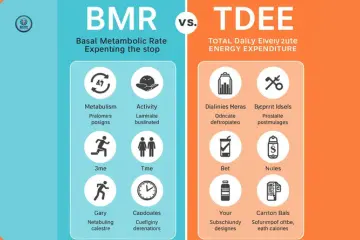
Total Daily Energy Expenditure, or TDEE, is a broader estimate of the energy you use across a full day. It includes your BMR plus movement, exercise, NEAT, and the thermic effect of food, all explained through our TDEE calculator.
Use an activity multiplier
A common simplified method multiplies your BMR by an activity factor. These categories are estimates and should never be treated as laboratory measurements.
Sedentary activity
Little planned exercise, mostly sitting, and low daily movement overall.
Lightly active
Some regular walking, light exercise, and a generally active daily routine.
Moderately active
Regular exercise, frequent movement, and a genuinely active lifestyle.
Very active
Hard training, physically demanding work, and high daily activity levels throughout.
Worked TDEE example
With a BMR of 1,755 kcal per day and an activity multiplier of 1.375, the estimated TDEE comes to approximately 2,413 kcal per day.
Why TDEE is still an estimate
Activity categories are broad, exercise varies week to week, NEAT varies from person to person, and metabolism itself differs, so treat any TDEE figure as a helpful guide rather than a fixed truth.
BMR, TDEE and RMR: Do Not Mix Them Up
These terms often appear together on calculator websites, yet they do not mean exactly the same thing. Understanding the difference stops you using the wrong number for the wrong job, a confusion tackled directly in BMR vs metabolism.
BMR
Basal energy expenditure, measured under strict resting conditions, using predictive estimates from a formula.
RMR
Resting Metabolic Rate, measured under less strict testing conditions, and often slightly different from BMR in practice, a distinction explored in BMR vs AMR.
TDEE
Total daily energy expenditure, including activity and every other daily energy cost on top of resting needs.
Quick comparison table
Keep this one simple. You should be able to glance at it and immediately understand which number represents what.
| Term | What It Means | Includes Activity? | Common Use |
|---|---|---|---|
| BMR | Basic energy needed at rest | No | Metabolic estimate |
| RMR | Resting energy expenditure | No planned activity | Resting energy assessment |
| TDEE | Total daily energy expenditure | Yes | Daily calorie planning |
Common Mistakes When Calculating BMR Manually
Most mistakes here are surprisingly ordinary. A wrong unit, a missed minus sign, or a formula mix-up can send your final answer wandering off in entirely the wrong direction.
Using pounds instead of kilograms, using inches instead of centimetres, mixing formula versions, forgetting the negative age term, using the wrong sex-specific constant, rounding too early, confusing BMR with TDEE, treating the result as an exact measurement, and using unreliable body-fat estimates all sit on this list, and our guide on why your BMR calculator seems wrong covers several of these from the online-tool side too.
Manual BMR Calculation Mistakes Table
This quick troubleshooting table gives you something practical to check whenever your answer looks wildly different from an online calculator.
| Mistake | What Happens | How to Fix It |
|---|---|---|
| lb entered as kg | BMR becomes inaccurate | Convert lb to kg |
| Inches entered as cm | Height is distorted | Convert to cm |
| Wrong formula | Different result | Check equation name |
| Wrong age sign | Calculation error | Follow formula exactly |
| Wrong constant | Result shifts | Check male or female equation |
| Early rounding | Small error | Round at the end |
| BMR used as TDEE | Daily needs underestimated | Calculate TDEE separately |
How Accurate Is a Manual BMR Calculation?
Manual calculation can be mathematically accurate while still being an estimate of your actual metabolism. That distinction matters. You can apply a formula perfectly and still not know your exact personal energy expenditure, something our BMR calculator accuracy explained guide explores in far more depth.
Formula accuracy vs individual accuracy
A formula may perform well across a whole population but still overestimate or underestimate any one individual. Predictive equations are useful tools, but they were never direct measurements.
Why your actual metabolism may differ
Body composition, age, genetics, hormonal factors, health conditions, medication, previous weight loss, and energy restriction can all nudge your true metabolism away from the predicted number, points echoed in limitations of BMR calculators.
How indirect calorimetry differs
Indirect calorimetry offers a more direct way to assess resting energy expenditure by measuring gas exchange. It is not needed for most people, but it helps explain why any single formula cannot hand you a perfect personal number.
When professional assessment may be useful
Clinical nutrition needs, complex medical conditions, significant unexplained weight changes, specialist sports performance, and dietetic support are all good reasons to seek a professional opinion rather than relying on a formula alone.
Worldwide Expert Advice on Using BMR Formulas
Let’s bring in genuine expert context here, without turning this into a medical textbook. The key message from metabolic research stays simple. Equations are useful prediction tools, but real human energy expenditure is far more complex than one formula alone.
Expert perspective from Kevin D. Hall, PhD
Kevin D. Hall, PhD, a researcher at the US National Institute of Diabetes and Digestive and Kidney Diseases, has published mathematical models of metabolism showing that body weight and energy expenditure change dynamically over time. His work highlights that weight loss is not a perfectly linear process, that the body adapts as weight changes, and that simple calorie rules can overstate expected weight loss.
What this means for manual BMR calculations
Use BMR as a starting estimate, never expect exact predictions, reassess after meaningful changes, and pay attention to real-world trends over time, a habit covered further in when to recalculate your BMR.
Expert-informed practical advice
Choose one recognised formula, enter accurate measurements, calculate carefully, keep BMR and TDEE separate, monitor your progress, and adjust gradually rather than dramatically.
How to Use Your Manual BMR Result for Weight Management
The calculation only becomes useful once you know what to do with it. BMR can act as a genuine starting point for estimating your calorie needs, without turning one formula into a rigid daily rule.
Use BMR to estimate TDEE, then understand maintenance calories
Your BMR feeds directly into your TDEE, which in turn helps you understand your rough maintenance calorie figure through a proper calorie needs calculator.
Create a sensible calorie deficit for weight loss
For UK readers, the NHS advises a sustainable approach to weight loss and commonly suggests reducing intake by around 600 kcal per day for many adults who need to lose weight, while recognising that individual needs vary. Avoid extreme restriction, focus on sustainable habits, consider food quality and portion sizes, and stay active throughout, ideas expanded on in using BMR for weight loss.
Use your real-world weight trend as feedback
Track weekly averages rather than single-day fluctuations, monitor waist measurements, note your energy and hunger levels, and adjust gradually over time using a calorie deficit calculator as your guide.
Do not assume eating below BMR is automatically the answer
BMR was never meant as a prescribed calorie target. Individual needs vary, very low calorie intake may be unsuitable for many people, and professional advice is always worth seeking when in doubt, a myth tackled directly in common BMR myths.
A Simple Manual BMR Calculation Checklist
Here is a quick process worth saving or printing, turning this guide from something you read once into a genuine reference you return to.
Before you calculate, record your age, weight, and height, confirm the correct formula, and convert your measurements into the required units.
While you calculate, write the formula down, calculate each part separately, keep the correct plus and minus signs, avoid rounding too early, and check your arithmetic carefully.
After you calculate, record your BMR, do not confuse it with TDEE, estimate your activity level if needed, use the result as a starting point, and compare it against real-world trends over the following weeks.
Frequently Asked Questions About Manual BMR Calculation
Can I calculate my BMR without an online calculator? Yes. Use a recognised formula and apply the correct inputs and units.
What is the easiest BMR formula to calculate manually? Mifflin-St Jeor, thanks to its simple inputs and straightforward arithmetic.
Should I use kilograms or pounds for BMR? Most common formulas use kilograms, so convert pounds to kilograms first.
Should height be in centimetres or inches? Mifflin-St Jeor uses centimetres, so convert feet and inches before you begin.
Why is my manually calculated BMR different from an online calculator? Different formulas, different input values, different rounding, and different BMR or RMR definitions can all explain the gap.
Is Mifflin-St Jeor the most accurate BMR formula? It is often a strong general choice, though not perfect for everyone, since individual accuracy genuinely varies.
Can I use BMR to calculate calories for weight loss? BMR is your starting point. Estimate your TDEE, then apply a sensible calorie deficit while considering your individual needs.
Should I recalculate BMR after losing weight? Yes, if you are using the equation for ongoing calorie estimates, since weight changes alter the formula result.
Is manual BMR calculation better than an online calculator? The maths is identical if you use the same formula. Manual calculation gives you greater transparency, while a reputable calculator such as our most reliable BMR calculator is faster and less prone to arithmetic slips.
Final Manual BMR Calculation Workflow
Let’s finish with a practical workflow rather than a generic conclusion, one you can follow immediately after closing this article.
The 8-step manual BMR process
Choose your formula, record your age, measure your weight, measure your height, convert units, insert the values into the formula, calculate each section separately, then round the final answer sensibly.
The best starting formula for most general readers
Use Mifflin-St Jeor as your primary general example, understand why formula choice matters, and compare another equation if your results ever seem unusual, particularly through our BMR calculator alternatives explained guide.
The number is a starting point, not a verdict
Your BMR is not a score, a diagnosis, or a metabolic report card. It is a useful estimate that helps you understand energy needs when used alongside activity, nutrition, and real-world results. Calculate carefully, understand what the number means, keep BMR separate from TDEE, avoid false precision, use consistent methods, and adjust based on longer-term trends. Seek advice from a GP, registered dietitian, or other qualified professional whenever medical or complex nutritional issues are involved.
Sources and Further Reading
This guide draws on the original Mifflin-St Jeor and Harris-Benedict research papers, published work on lean-mass-based equations, NHS guidance on sustainable weight loss, and the metabolic modelling research of Kevin D. Hall, PhD, in line with the standards set out in our editorial policy.
For further reading, our BMR for beginners guide and what is BMR explained article build strong foundations, while why BMR changes suddenly, signs of low or high BMR, and when not to rely on BMR alone round out the wider picture nicely. You may also find our women’s BMR calculator, men’s BMR calculator, body fat percentage calculator, protein calculator, our full range of health tools, and our FAQs page useful for anything left unanswered here.
Final Recommendation
Having walked hundreds of readers through their own manual BMR calculation step by step, my honest advice is this. Learning the maths by hand genuinely deepens your understanding, even if you end up using an online tool day to day. Pick one recognised formula, convert your units properly, and treat the final figure as a sensible starting point rather than a fixed rule.
A decent set of digital scales like these keeps your weight input accurate, which matters far more than people assume. Recalculate after any real change in weight or activity, and always lean on a GP or registered dietitian if your health needs are complex. That steady, honest approach has worked well for my readers for years, and I trust it will work well for you too.

Ehatasamul Alom is a dedicated health-tech enthusiast and the co-founder of BMRCalculator. With a passion for metabolic science, he focuses on providing accurate health data for the UK community. Ehatasamul ensures that every tool and guide aligns with NHS standards and public health research. His mission is to simplify complex biological data, helping British residents make informed decisions about their fitness, calorie needs, and long-term wellness. When not analyzing health trends, he explores the latest innovations in wearable fitness technology.